
Recently, Mohou.com learned that 3DM Digital Manufacturing, a developer of 3D printers and laser light sources, announced the launch of a new technology that can be used with specific materials or applications by adjusting its work of 3D printing by selective laser sintering (SLS). 3DM’s customizable lasers would produce higher resolution parts with shorter lead times and improved mechanical properties compared to CO2 or fiber optic beams. The company has fully optimized its technology in an R&D environment and is now preparing to commercialize it with the launch of its own proprietary device. Once launched, these products are expected to facilitate various application cases of 3D printing, where customization is essential.
3DM Digital Manufacturing’s core technology is the solid-state laser developed by the company specifically for 3D printing. This allows the company to efficiently combine up to six lasers into a single beam to increase beam power and printing speed.
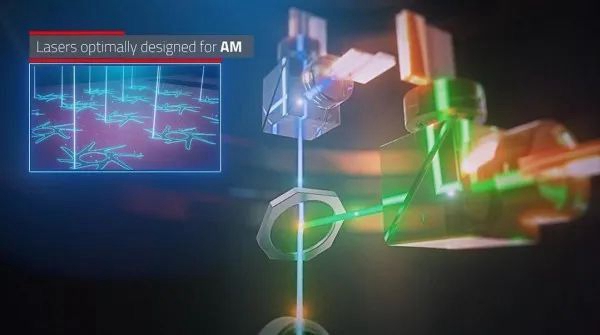
(Image source: 3DM Digital Fabrication)
“What’s unique about us is that we make our own lasers,” says Ido Eylon, CEO of 3DM Digital Manufacturing. “We don’t use CO2 lasers, fiber lasers or anything like that, we actually make our own lasers, which allows users to use them. specific wavelengths that best match plastic materials. » Although 3DM was nominally founded in Israel in 2016, the roots of its technology go back to the history of its main shareholder, Dr. Daniel Majer. A graduate of Israel’s Weizmann Institute of Science, the 3DM founder spent 30 years in the research and development of optoelectronic components, as well as laser development and almost 10 years in 3D printing research.
Building on Majer’s research, 3DM has developed a soon-to-be-commercialized laser capable of melting polymer powder 10 times faster than existing printing technologies. Additionally, the technology is capable of increasing the resolution of thermoplastic additive manufacturing of parts well beyond that of current leading printers, opening new markets for industrial 3D printing.
3DM believes that 3D printing can take a larger share of the global polymer materials manufacturing market. Currently, although a lack of technological innovation means industrial 3D printing “occupies only a few percent of this market,” the company said the low cost and high scalability of its technology have the potential to change this situation. 3DM began as an incubator company for Terralab Ventures, which still holds a 23% stake in 3DM. 3DM has since been spun off and listed on the Israel Stock Exchange. The company completed its IPO in June 2021 and used US$13 million in funding to launch its first commercial products.
What is the difference between 3DM’s patented laser and other lasers on the market?
The light source itself is essentially an array of tiny quantum cascade lasers (QCLs) smaller than a grain of rice. Each light source emits several watts of energy and its wavelength can be customized to suit a given material and arrangement of part layers. Unlike traditional fixed-wavelength CO2 lasers, 3DM claims its technology absorbs laser light more efficiently (and perhaps faster). The company also noted that its laser produces parts with a very high surface finish; its intended wavelength flexibility also makes it compatible with a wider range of materials.
Essentially, 3DM attaches its laser to an assembly consisting of a cooling mechanism, a driver and a lens to form a laser module, thereby turning it into a marketable product. Some of these can be combined into a beam unit capable of creating the first multi-wavelength spots on a given powder during 3D printing, as well as writing partial geometries. The four beam units are combined in sequence to create a 3DM print head.
In the first iteration of the product, the company combined four laser print heads, using a stitching algorithm to ensure there were no gaps between areas. That said, the company says its approach is scalable and that introducing more beams could increase 3D printing speeds. In third-party testing, the technology even produced parts with superior mechanical properties than other leading SLS printers.
Additionally, 3DM technology also allows for longer wavelengths than cheaper fiber lasers, without the need for additive manufacturing to ensure laser interaction. It is reported that the company’s laser can emit at any wavelength in the mid-infrared spectrum, allowing it to match the absorption properties of any thermoplastic and allowing users to select the most economical raw material for a given use case.
Source: 3D Printing Network
Daguang focuses on providing solutions such as precision CNC machining services (3-axis, 4-axis, 5-axis machining), CNC milling, 3D printing and rapid prototyping services.



















