
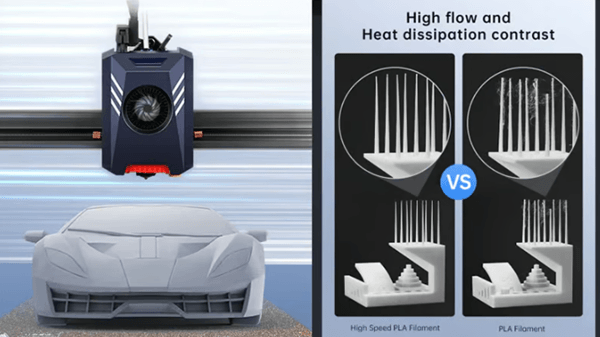
3D printingPLA material, most people know this, because PLA is the most basic printing materialbut today many yarn manufacturers label their materialsThe “high speed” label makes people wonder: is it a gimmick or is there a mystery behind it? Is there any scientific basis behind this?
Let’s take a look at the highwayBehind the hype and hyperbole around 3D printing and how your material choices impact printing speed.
You may be wondering, what print speed is considered high speed? Answers vary, but generally speaking,Speeds of 300 mm/s and above are considered high speeds. Today, more and more FDM 3D printers can operate at these speeds. For example, the Bambu Lab printer can print up to 500 mm/s, the fastest Anycubic is around 300 mm/s, Creality’s K1 Max says it has a maximum speed of 600 mm/s. s and some Original Prusa and Elegoo machines can reach 500 mm. /second. On the professional desktop side, Raise3D Pro3 (using proprietary materials) can reach 350 mm/s.
These new speeds require new materials.This itemmagic monkey networkWe’ll unveil the highway with everyoneThe secret of the PLA。
what is high speedPLA?
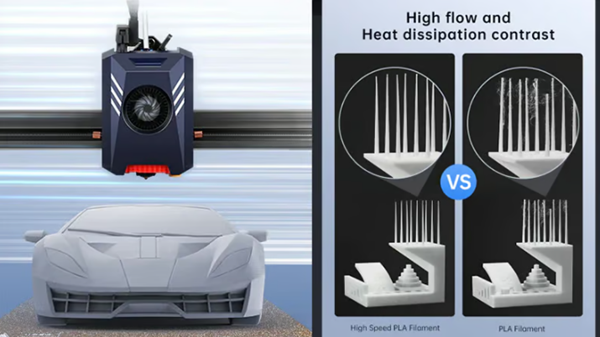
with standardsCompared with PLA filaments, Anycubic said its high-speed PLA filaments have better fluidity and heat dissipation, which can avoid high-speed printing defects.
(Source: Anycubic)
The moving speed of the nozzle during the extrusion process will affectVarious properties of 3D printed parts. High print speeds place new demands on controlling other print parameters (heat, layer height, flow rate, fan speed, etc.) and can lead to over-extrusion at the edges and under-extrusion. -extrusion elsewhere, to cords, to bleeding, to layer displacement, to filling. Gaps, Warps, and Surface Defects – A common troubleshooting tip is to reduce the print speed. Additionally, studies have shown that adding new layers before previous layers have completely solidified can result in deformation, loss of dimensional accuracy, and reduction in mechanical properties.
So while you canPrint almost any media at speeds of 300 mm/s, but final quality is an issue. The goal of high-speed PLA is to allow you to print quality parts faster. Material manufacturers say that a part’s layer adhesion, surface quality, and overall mechanical properties are variables that will change between regular PLA and high-speed PLA.
high speedPLA is a reformulation of PLA (polylactic acid) so that it behaves differently. One of the main goals of these high-speed versions is more consistent extrusion at higher speeds, providing consistent surface finish and mechanical properties. As you probably know, the higher the maximum print speed, the greater the range of different speeds the printer can produce when manufacturing parts.
high speedAnother property of PLA is that it melts and cools more quickly.
Faster print speeds can reduceThe time the PLA filament stays on the hot end, so it needs to be formulated to melt faster. This leads to a method of measuring polymers called “melt flow index”.
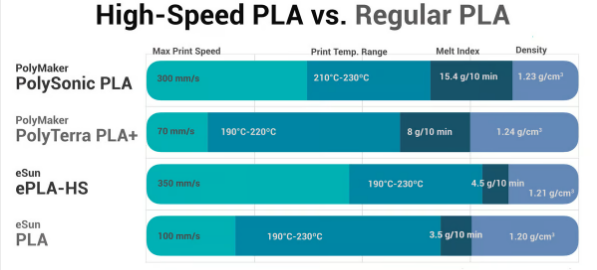
high speedThe printing parameters and quality of PLA materials are slightly different from ordinary PLA from the same company (Source: All3DP)
hot flow index(MFI) – also known as melt mass flow rate (MFR) or melt index – is a measure of the fluidity of a polymer when subjected to a specific set of temperature and pressure conditions during the extrusion process. MFI tests have fixed conditions, usually defined by international standards (such as ASTM or ISO).
only a fewPLA manufacturers disclose this measurement in their filament data sheets. Maybe no one actually buys filament based on MFI data, but eSun and PolyMaker say they disclose the data to help customers develop consistent processing conditions to achieve a certain degree of quality control and predict the performance of the polymer in various applications, as this can affect the final part. properties such as mechanical strength, surface finish and dimensional stability.
How is PLA transformed into high speed PLA?

Today’s high speedHigh-speed 3D printing on 3D printers requires materials optimized to achieve different properties (Source: PolyMaker)
Brian, materials scientist at Solvay Specialty PolymersAlexander (member of the All3DP Editorial Advisory Board) said that there are ways to control melt strength, crystallization rate and viscosity in polymer processing, but these often remain secrets. ‘business. “We are now starting to see specialized or optimized grades of PLA for additive manufacturing rather than just standard grades for injection molding,” he said.
Alexander said changes to PLA to increase processing speed could be the result of adding additives to standard PLA, or the result of adjustments made early in production of the polymer, known as The reactor stage, where chemical reactions occur to form polymer chains.
However, what happens to performance when a polymer is optimized for speed? Should I sacrifice anything for fast printing?
Material manufacturerPolyMaker launched PolySonic PLA in September 2023. Along with commercializing the material, the company also shared research on the mechanical properties of the material. As shown below, the tensile strength of a test print made with PolySonic PLA Pro at 300 mm/s was 12% lower than the same part made with PolyLite PLA at 46.5 mm/s.
Certainly,PLA is not a material sought after for its mechanical strength, but is mainly used for parts with high surface quality and detail. PolyMaker’s testing of its own materials shows that there is no change in the dimensional accuracy of high-speed PLA tolerances compared to standard PLA. According to the company, this is partly due to the material’s ability to transition from fluid to solid with almost zero shrinkage.
in comparisonWhen you look at the datasheets for PLA versus high-speed PLA, you can see signs of polymer reformulation in the measurements, such as the high-speed material having a lower molecular density. However, data sheets and research claims can be misleading, especially when you use them to compare materials. We noticed that the mechanical properties listed for test parts printed with high-speed materials often indicated a print speed of only 40 mm/s.
“To really check the integrity of the polymer, you need to print the part at different speeds and processing parameters and run rapid impact tests (Charpy or Izod) to see how the part breaks,” Alexander points out. “Impact testing will highlight defects in the printed part, such as interlayer adhesion or porosity, which will first be affected by tensile modulus or strength.”
Despite all these measures, your broadbandThe PLA experience can be unique. High-speed 3D printing is a combination of materials, hardware, software and part geometry.
To test your printing speed, download the Print Speed Test Template. These templates usually come with instructions on how to configure the correct settings. This model linked here will print essentially the same shape at gradually increasing speeds, allowing you to visually identify the best settings.
High speed or high volume extrusionPLA filament can cost up to twice as much as regular PLA from the same brand, so experimenting with your system using typical parts is the best way to know if the high-speed PLA you choose is a gimmick or not.
Daguang focuses on providing solutions such as precision CNC machining services (3-axis, 4-axis, 5-axis machining), CNC milling, 3D printing and rapid prototyping services.



















