
Machining Perfection: Conquering Tool Runout for Unmatched Precision and Efficiency
Understanding the Runout Challenge
At the heart of precision machining lies a pervasive yet elusive adversary: tool runout. This phenomenon, the deviation in a cutting tool’s rotational path from its ideal axis, manifests as radial displacement at increasing distances from the spindle. Unlike glaring defects, runout operates insidiously. Parts may meet nominal specifications while the machining process suffers invisible degradation. When a drill bit or end mill’s cutting edges don’t rotate concentrically, cutting forces concentrate asymmetrically. High-performance probes can detect the resulting diameter variations post-machining, but by then, quality loss is often irreversible. The quest then becomes proactive prevention.
The Hidden Toll of Uncontrolled Runout
The consequences of excessive runout impact every facet of machining operations:
- Accelerated Tool Death: When runout occurs, cutting load concentrates on fewer teeth. A six-flute tool effectively becomes a three-flute tool with just 0.001" runout. This uneven force distribution causes specific flutes to wear prematurely, drastically shortening tool life.
- Compromised Part Quality: Dimensional inconsistencies, surface finish variations (like chatter or poor roughness), and geometric inaccuracies arise unbeknownst to machinists.
- Costly Cascading Effects: Beyond tooling expenses, unbalanced forces wreak havoc on machine health. Spindle bearings, guideways, and drive mechanisms face excessive stress, leading to accelerated wear and potential costly repairs.
- Stability & Productivity Loss: Unpredictable vibration hinders achievable feed rates and depths of cut, limiting throughput and forcing conservative machining parameters.
Uneven tool wear is a hallmark sign of excessive runout.
Deconstructing Runout Contributors & Solutions
Runout is rarely singular in origin; it’s a synergy of mechanical influences. Addressing it requires a systematic, multi-faceted approach.
- The Critical Role of Tool Holders (The Foundation)
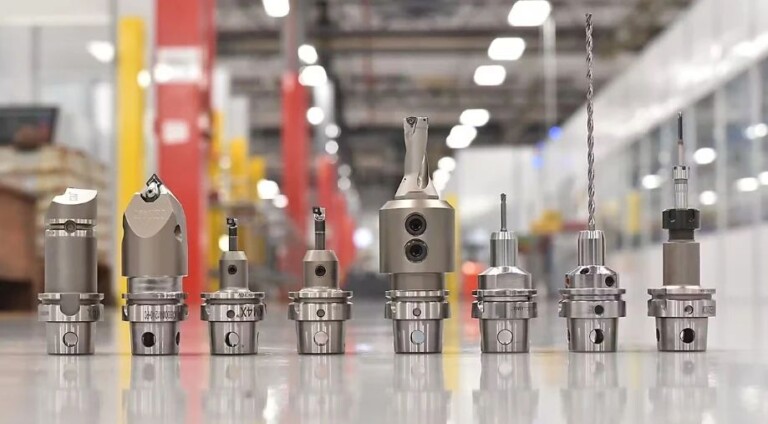
Tool holders are the vital interface between machine and cutter – mastering this link controls runout generation.- Four Key Attributes: Assess holders on:
- Tightening Force: Consistent, high clamping force ensures positive tool shank engagement. Insufficient force allows micro-movement.
- Concentricity: The internal geometry must center the tool shank with minimal radial variation (< 3 microns is ideal for precision work).
- Rigidity: Preventing flex under cutting loads minimizes induced runout. Stiffer holders (hydraulic, shrink fit, high-end mechanical) excel.
- High-Speed Balance: Imbalance amplifies vibration, effectively increasing functional runout during operation. Precision holders are balanced (e.g., G2.5 @ 25,000 RPM).
- Metal-on-Metal Contact is King: Maximize contact area at critical points:
- Taper Contact: The holder-spindle connection (e.g., CAT, BT, HSK). Look for holders achieving ≥ 90% contact area.
- Flange Contact: The holder-nut connection surface provides axial stability. Ensure it’s flat and mating properly.
- Tool-Shank Contact: Premium collets or shrink/chuck bores grip the tool consistently around its entire circumference, eliminating eccentricity. Worn or low-quality collets are major offenders.
- Nut & Stud Advancements:
- Upgrade to bearing lock nuts. These deliver higher, more uniform clamping force with reduced frictional drag compared to standard nuts, ensuring concentric seating.
- Never underestimate pull studs. Cheap or deformed studs misalign the holder during drawbar retraction, skewing the taper fit. Invest in certified studs crafted from fully hardened premium tool steel (like H13) with precision-ground features.
- Four Key Attributes: Assess holders on:

Precision at the taper, shank, and flange interfaces is paramount for minimal runout.
Tool Assembly Geometry: Lever & Ratio Effect
Physical tool length and overhang dramatically impact how runout manifests:- The Lever Rule: Runout at the tool tip magnifies with tool length relative to its diameter. A tiny 0.0002" runout at the holder can become 0.002" inches at the tip of a long-reach end mill.
- Keep it Stubby: Minimizing gage length (Length/Diameter ratio) is the most effective way to enhance rigidity and dampen amplified runout. Prioritize short holders and minimal tool protrusion.
- Modular Systems Demand Caution: If extended lengths are unavoidable (complex cavities), select high-precision modular systems specifically designed for maximum rigidity and minimal incremental runout per connection. Resist using extensions unless absolutely necessary.
- Size Sensitivity: Thresholds matter. A 0.0005" runout might be acceptable on a 1" face mill, causing minimal impact. That same runout on a 1/8" micro-end mill can lead to immediate tool breakage or unusable parts. Be increasingly vigilant with smaller diameters.
- Tool Material Matters (Beyond Hardness)
The composition of the cutting tool itself influences its sensitivity to runout:- Carbide vs. HSS: While offering superior hardness and heat resistance, solid carbide tools are inherently more brittle than High-Speed Steel (HSS). This makes them significantly less forgiving of radial impact loads caused by runout. HSS tools typically exhibit marginally better tolerance to slight runout conditions despite their lower overall cutting performance limits.
- Cutting Edge Geometry: Sharper, more positive rake geometries are generally more susceptible to impact fracture from runout than robust, negative-rake designs.

Carbide’s brittleness increases vulnerability to runout-induced shock loads.
Proactive Runout Management: A Precision Culture
Combating runout isn’t a one-time fix; it’s an ongoing commitment to precision:
- Tool Holder Audits: Regularly inspect and clean spindles, holders, collets, nuts, and pull studs. Measure baseline runout using a precision dial indicator (or probe) on a calibration arbor every time a holder is set up and periodically thereafter. Log results to track performance.
- Strategic Investment: View tool holders not as cheap commodity tools, but as critical precision components. Premium hydraulic or heat shrink holders offer superior concentricity and rigidity over standard collet chucks.
- Calibrated Tightening: Use torque wrenches with holder-specific settings to achieve optimal and consistent clamping force without damaging holder components.
- Machine Health Check: Spindle condition is foundational. Worn spindle bearings are a direct source of runout. Schedule preventative maintenance and spindle probing verification.
The Precision Advantage
Taming runout delivers significant, measurable returns: tools last longer, machine downtime decreases, part quality soars, and achievable machining parameters expand for faster cycle times. By understanding the physics of runout and implementing rigorous control measures focused on high-precision toolholding, optimized assembly geometry, and meticulous maintenance, manufacturers transform a hidden enemy into a benchmark of process excellence. Minute investments in precision yield substantial returns in productivity and quality dominance.



















