
Artificial intelligence in 3D printing and manufacturing is already here and growing. How it develops is crucial. Arvind Rangarajan, global director of software and data for personalization and 3D printing at HP, said: “We are currently studying the impact that artificial intelligence will have on 3D printing. There’s a lot of innovation to look forward to, but there’s also some. » reasons to proceed with caution.
Rangarajan said he has developed a “comprehensive artificial intelligence strategy” for HP over the past few years to smoothly implement artificial intelligence 3D printing tools. He sat down with All3DP to discuss artificial intelligence at HP and the 3D printing industry: where it came from, where it is now, and where it’s going in the future.
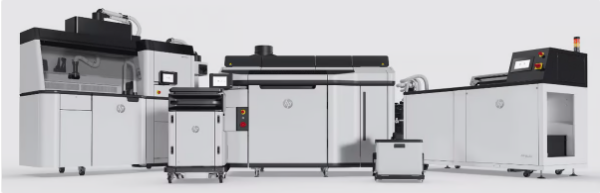
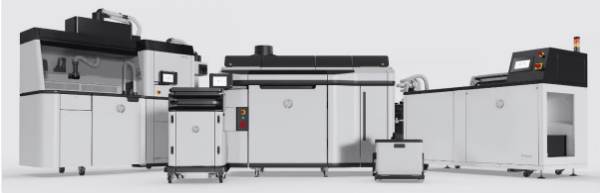
HP Multi Jet 5200 Series 3D Printing Solution (Source: HP)
Maintenance and availability
With the recent explosion of interest in applications of artificial intelligence, andThe opportunities are ripe for collaboration and investment from companies like Nvidia. HP is following the trend and implementing artificial intelligence technology at both software and hardware levels.
HP already leverages traditional machine learning methods to collect various telemetry data for its predictive maintenance software.
Rangarajan said predictive maintenance is one of the first applications of artificial intelligence at HP. The company’s polymer 3D printers, known as Jet Fusion machines, have more than 30 built-in alerts that can alert users “weeks to a month” in advance of a hardware failure, allowing companies to prepare and repair on their own terms.
But modern artificial intelligence solutions have allowed HP to go beyond traditional machine learning techniques, allowing it to pursue coveted advances such as improving part repeatability in demanding materials like metal . HP achieves this through digital twin technology: software that uses real-time data to simulate the effects of forces on objects. The results are clear: HP’s digital twin technology helps better prepare parts for printing with algorithms that predict and account for warping.
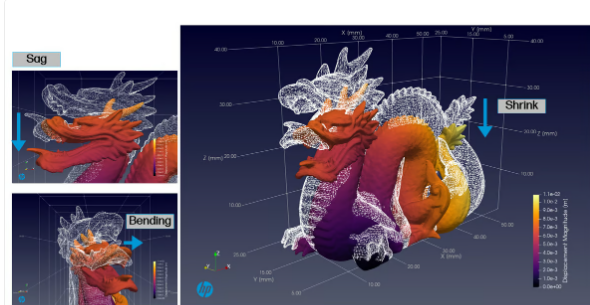
The Stanford test model demonstrates the need to predict deformations (source:Nvidia)
Although manufacturers have been able to collect part repeatability data within their production frameworks, until recent improvements in artificial intelligence models, relatively small data sets have not been able to provide insight. meaningful information.Rangarajan translation.
Now withThe collaboration of large AI companies like Nvidia is unlocking the potential of these smaller data sets. HP leveraged and participated in Nvidia’s open source Modulus framework to develop the Virtual Foundry Graphnet model: a graph-based deep learning algorithm that allows users to predict part deformations such as shrinkage, bending, and sag in metal binder jetting applications.
existIn a research paper published in July in the journal Sensors and Materials, the HP team said its graph-based deep learning approach “achieves significant speed improvements over traditional physics simulation software while maintaining the accepted level of precision. The level of accuracy achieved is “an average deviation of 0.7 microns for a 63 mm test part in a single sintering step… an average deviation of 0.3 mm over the entire sintering cycle.”
“People want more reliability and consistency, whether it’s within a build, within a build or between printers,” Rangarajan said. “Therefore, from[AI]Judging by the evolution of technology and the needs of 3D, it’s a good match. This is when people really started applying AI to 3D printing, as it began to move into production. And[用户]Thinking, “Oh, I can now take the software and the data that we’ve collected and actually provide a meaningful model that can help achieve reliable, consistent production from machine to machine and machine to machine.” ‘other. » ‘”
Artificial intelligence-assisted design
While HP’s AI-powered predictive maintenance already works on shop floors, deformation models will soon improve metalThe reproducibility of 3D printing, but Rangarajan still sees skill barriers such as 3D design as a major barrier to adopting technologies that artificial intelligence will soon solve.
The first design area is3D scanning.
HP and other companies in the additive manufacturing industry use “body-conforming” tools that leverage 3D scanning technology to create personalized products such as orthotics and other medical devices. But when it comes to precisely fitted products, 3D scanning is not a seemingly plug-and-play solution.
The 3D scanning process produces large point clouds that must be deburred by experienced 3D modelers before the design can be implemented and a usable model can be produced. Although this process requires some 3D modeling skills, it is essentially a routine operation. Therefore, HP is working to better automate the custom design process using AI algorithms that perform 3D scans and simplify the data by identifying key landmarks in the model, then use those points to benchmark to parametrically create custom designs.
“We created an important score, the difference between people, and translated it into a design that could be quickly delivered to the client,” says Rangarajan. “So instead of waiting hours to send it to a remote third-party designer to look at that point cloud and manually design the content, we can now provide design options to the client immediately while they are still in the clinic. »
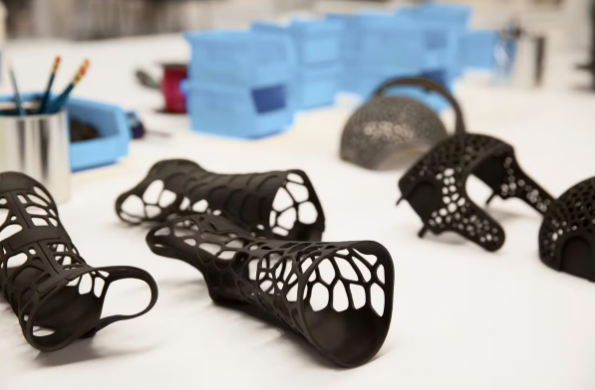
Example of HP body adaptation application (Source: HP)
Although3D scanning seems to be HP’s most direct way to solve design hurdles, but it’s not the only one. Generative AI for 3D models (or 3D text) is also showing promise, with HP and its partners already demonstrating the technology to a wide audience.
Held in San Jose, CaliforniaAt the Nvidia GTC conference, HP collaborated with Nvidia and Shutterstock to demonstrate a complete end-to-end text-3D modeling process, allowing attendees to generate 3D models from text in real time in less than a minute .
Nvidia’s blog said of the demo: “Shutterstock’s 3D AI Generator allows designers to quickly iterate on concepts and create digital assets that HP can convert into 3D printable models via workflows. automated work. »
The pipeline automatically handles color mapping, tracks parts to ensure stability and allows users to add brackets if necessary, Rangarajan said, before adding that HP is taking the next step internally to create its own color matching application. 3D text conversion. “By combining different generative AI technologies, we can create more detailed models than NVIDIA’s text-to-3D pipeline.”
Material Formula and Precautions
Although HP converts the textThere is a lot of excitement about the most intuitive and widely applicable results in 3D applications, but Rangarajan says the process is still ongoing and, while there is enthusiasm within the company for the prospects, it makes it clear that it is important to keep realistic expectations. in the industry. Successful application of AI tools is essential.
“If someone over-promises about what AI can bring to a process and ends up failing, it will impact every OEM in the market,” he said. “This has already happened in the field of additive manufacturing. People over-promised, destroying the potential of those who were more cautious in their development.”
To some extent, this is already happening in the field of artificial intelligence.Rangarajan lamented that allegations of data misuse by other AI application developers have undermined the debate on data privacy and AI, making it more difficult to address customer privacy concerns while working to collect the data sets needed for the applications. These apps could be of great use. to the 3D printing industry. Material formulation and development is part of this and, according to Rangarajan, is the driving force behind the popularity of 3D printing.
“We need to find the right operating mechanisms in terms of data ownership, data security and privacy to be able to collect this data from customers anonymously to really accelerate our improvement and optimization.[3D打印]The speed of the process,” he said. “Today, the cycle time to develop and refine a process, even for polymers, can be months, compared to years for metals. Optimization takes two or three years. But if you manage to collect this data, it may take several weeks. For polymers, this may only take a few days. “
AI materials formulation is a pillar of Rangarajan’s AI strategy, which he hopes to implement in the next three to five years, but that won’t happen without trust between manufacturers like HP and their users.
Fortunately, the great HPAI solutions are already on the way and Rangarajan has set the bar for success very high ahead of its launch. He talks about the importance of apps “beating the experts.” “I hope AI solutions will provide extraordinary insights,” he said. “So if an experienced user of HP Multi Jet Fusion technology would never make a decision like this and AI helps them make that decision, then it will improve their process.”
Expectations are high for the company’s new and upcoming AI applications.
Daguang focuses on providing solutions such as precision CNC machining services (3-axis, 4-axis, 5-axis machining), CNC milling, 3D printing and rapid prototyping services.



















