
3D printing has significant benefits in the automotive industry, such as reducing manufacturing costs while increasing production speed. Computer-aided design (CAD) software forms the basis of the 3D printing process because the parts produced are based on CAD files. A company’s 3D printed products can be protected by both a design patent and a utility patent, but during the patent application process, claims to protect the manufacturing process, including CAD files, can be tricky and often rejected. Large original equipment manufacturers (“OEMs”), such as Ford and Toyota, as well as auto parts suppliers and emerging start-ups, should ask themselves one question: what aspects of their 3D printing operations can be protected by patents ? of the product or the 3D manufacturing process?
Case
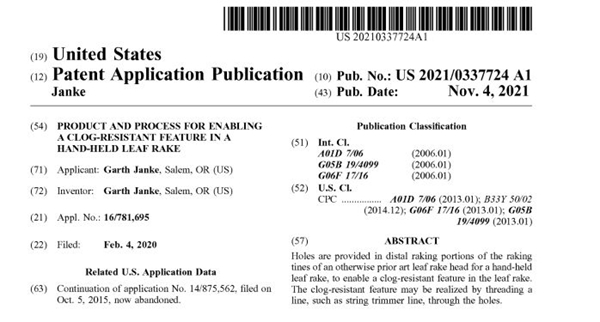
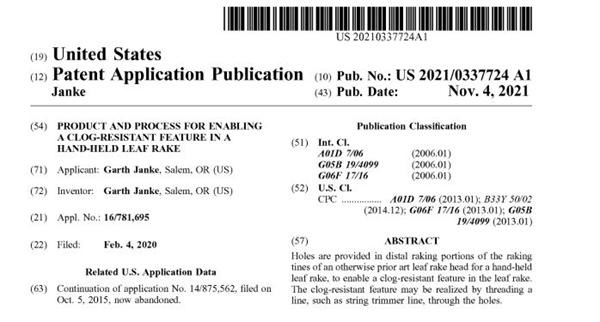
The following takes as an example the invention of the applicant Garth Janke. The title of the invention applied by Garth Janke is “Products and processes for enabling anti-clogging functions in portable leaf rakes” (published under number US2021/0337724A1). There are three rights requirements that are helpful in better understanding the “3D printing” process. “. Questions arising from patent protection:
●Claim 1: A leaf rake head product used to achieve an anti-clog function in a hand-held leaf rake.
● Claim 21: A method for activating an anti-clogging function in a portable leaf rake, comprising installing on a computer a first mathematical model, the first mathematical model describing. . [权利要求1的产品]。
● Claim 26: The method of claim 21, further comprising applying the first mathematical model to a commercially available 3D printer to result in converting the first mathematical model into a defined actual leaf rake head product. . [权利要求1的产品]。
The examiner approved the content of product claim 1, while process claims 21 and 26 were rejected under 101 USC. Claims 21 and 26 signify the use of a mathematical model (e.g. a CAD file) on a computer and the use of a mathematical model (for example a CAD file) on a 3D printer. The rejection of claims 21 and 26 shows how difficult it is to obtain patent protection for “3D printing” claims.
Janke agreed with the examiner’s decision in responding to the notice of examination, but Janke also asked the court a question: How do claims 21 and 26 (manufacture of leaf rake heads by applying a mathematical model of leaf rake heads on a 3D printer) under section 101? is not eligible for patentability, then why is the actual and known patentable product of claim 1 (i.e. the leaf rake head) eligible for patentability under Section 101 ? What is the qualification determination and basis for power claims?
Janke’s patent issues are closely related to 3D printing in the automotive industry. Patent requirements for products (equipment) will be successfully met during the patent application process, while process requirements, such as applying CAD files to a computer or 3D printer, even if the product itself Even if it turns out to be eligible for patent, it can still be rejected under section 101 of the law.
How to patent the “3D printing” process?
So how should automakers protect their 3D printing operations? As the rejection of Janke’s process claims 21 and 26 shows, process patent claims targeting the installation of CAD files on a computer or 3D printer are likely to encounter the same problems as Janke’s under the Article 101.
For companies using 3D printing processes to manufacture automotive parts, the initial intellectual property strategy is to file utility patents and design patents simultaneously. A utility patent will cover the functionality of a product, while a design patent protects the decorative features of the design. In other words, the functional aspects of the design are not covered.
On the other hand, special caution is needed when using method or process claims to protect a company’s 3D printing operations, particularly when the company’s process involves installing of a mathematical model (such as a CAD file) on a computer and the application of this mathematical model on a computer. 3D printer (such as CAD files). Since process claims for mounting a CAD file on a 3D printer may encounter similar rejection issues as the Janke patent, additional design patent filings for decorative features of parts in the CAD file are a means of generating a powerful portfolio of knowledge on the protection of property rights. Keep in mind that as online access to CAD files increases, more patent infringers are created, so it becomes increasingly important to have a strong intellectual property portfolio.
Additionally, collaboration with other 3D printing manufacturers in the automotive sector can provide additional protection against potential infringers and litigants. For example, effective negotiations with other OEMs, suppliers or emerging start-ups can provide some security by forming partnerships and defensive patent pools. It should be noted that when co-inventing a new concept through cooperation and bringing it to the level of commercial development, the terms of the agreement should be carefully considered to avoid compromising the duration protection of the company’s patent.
summary
In the booming automotive industry, the market is encouraging original equipment manufacturers, auto parts suppliers and emerging start-ups to determine their respective intellectual property strategies as early as possible. They must determine whether the company’s 3D printing products and 3D manufacturing processes comply with requirements. patent applications.Please ask and how to be protected from violations and lawsuits.
source:3D printing network
Daguang focuses on providing solutions such as precision CNC machining services (3-axis, 4-axis, 5-axis machining), CNC milling, 3D printing and rapid prototyping services.



















