
Global Bulk CNC Milling Turning Exporters: How Repeatability Survives Volume
A prototype proves a design. A 10,000-part order proves a process. This page breaks down the mechanics behind global bulk CNC milling turning exporters: where dimensional drift comes from, how fixtures and probes stop it, and when a bulk route is the wrong pick for your part.
Key takeaways
What separates bulk runs from job-shop work
A job shop optimizes each order as an independent event. Tooling is set, a few parts come off, the job ships, and the next setup erases the memory of the last one. Bulk milling and turning works differently. The process must hold the same nominal dimension on part 1 and part 8,500 without a human re-deciding what good looks like.
That shift changes what matters. On a five-part order, the dominant risk is a programming error or a bad first-article setup. On a 10,000-part order, those risks are already retired. What remains is slow variation: spindle growth, coolant temperature swings, insert flank wear, bar stock diameter tolerance stacking through a collet.
So when buyers screen global bulk CNC milling turning exporters, the useful question is not how many spindles sit on the floor. It is whether the supplier has instrumented the drift. In-process probing, SPC control limits, and scheduled insert changes are the tells.
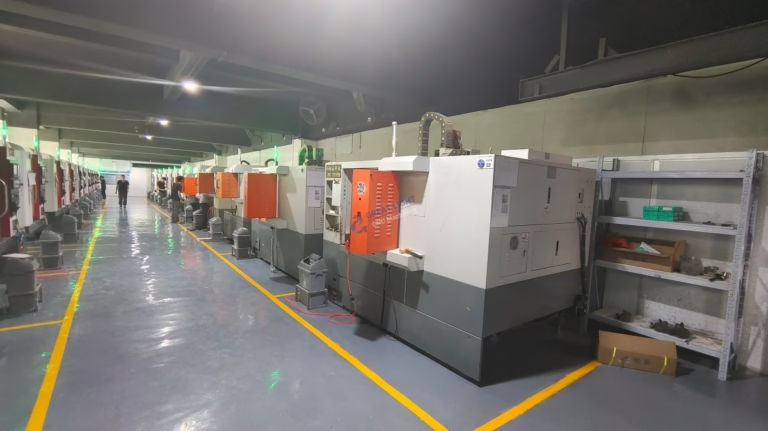
GreatLight runs 127 high-precision CNC machines across three wholly-owned plants, with a 7,600 m² main facility in Dongguan and a second site in Singapore. Capacity matters, but the reason volume customers stay is the process discipline that keeps a batch inside ±0.005 mm from start to finish.
Where dimensional drift actually comes from
Thermal expansion is the largest single contributor on long runs. A spindle that has been cutting for six hours is not the same machine that cut the first article at 8 a.m. Aluminum expands roughly 23 μm per meter per degree Celsius. On a 300 mm bore, a 5 °C rise in the part and fixture moves the diameter by about 3 μm. That is most of a ±0.005 mm band.
Tool wear is the second source, and it is directional. A carbide insert does not lose size evenly; flank wear pushes the effective cutting edge, which changes the finished diameter in a predictable direction. Turning tools wear the nose radius, milling tools wear the corner. Both produce a slow trend that a single first-article check will never catch.
The third source is fixturing repeatability. Hydraulic vises, collets, and soft jaws all clamp with some positional scatter. When a batch is split across shifts or across two machines, that scatter compounds. Bulk suppliers solve it with quick-change pallet systems and dedicated soft jaws, so the part locates against the same surfaces every cycle.
Coolant quality belongs on the same list. Concentration drift changes both heat removal and chip evacuation. A sump that runs lean for a week will show up as surface finish variation long before it shows up as a size failure.
- 1Thermal growthCompensate with warm-up cycles and in-process probing, not with hope.
- 2Insert wearChange on a counted cycle, not on a visual guess.
- 3Clamping scatterDedicated pallets beat re-set vises across shifts.
Fixtures, probes, and the SPC loop
The mechanical answer to drift is a fixture that removes operator judgment. On a bulk turning job, that usually means a dedicated collet or a machined soft jaw set, cut in place so the gripping surface matches the bar stock diameter. On milling, it means a tombstone or pallet with hardened locating pins, so the second op picks up the datum from the first op without re-indicating.
The measurement answer is automated in-process probing. A spindle probe can check a critical bore or a datum face every N parts, and the machine offset updates from that reading. This turns a batch into a closed loop: cut, measure, correct, continue. The probe does not need to check every feature, only the ones that drift first.
The statistical layer sits on top. Control limits are set from the first-article run, and the operator plots the probe results. A trend that is still inside tolerance but moving toward a limit is the early warning. That is the point where a bulk supplier changes an insert or lets the machine cool, rather than waiting for a scrap event.
GreatLight inspects 100% of parts before shipment, with raw material checks, in-process monitoring, and final inspection, and reports are available on request. For volume programs, that inspection data doubles as the SPC record.
When a bulk route is the wrong choice
Bulk machining is not automatically cheaper or better. It wins when geometry is stable and the design is frozen. If the part is still moving, a bulk run locks in a mistake 10,000 times. Prototype and low-volume routes exist precisely to iterate before that commitment.
It also loses on very large single parts. A 4,000 mm frame with a handful of units per year is a low-volume problem, not a bulk problem, even though the machine hours are significant. The setup cost never amortizes, so dedicated fixtures do not pay for themselves.
Tight tolerances on soft or gummy materials are another poor fit. Plastics such as POM and PP move after machining as they release internal stress. A ±0.005 mm callout on a thin POM wall is a design problem, not a machining problem, and no exporter can hold it reliably across a large batch.
Finally, bulk runs punish loose GD&T. If a drawing leaves a datum ambiguous, the supplier must guess, and a guess repeated 10,000 times is a recall. Fix the drawing before the purchase order.
Traceability and material control across borders
For medical, aerospace, and automotive buyers, a finished part without a paper trail is scrap. Every bar of raw material needs to link back to its mill certification, and that link has to survive the trip through turning, milling, finishing, and packing. Digital lot tracking is what makes that possible.
The practical version is simple. Material arrives with a heat number. That heat number is recorded against the work order. The work order follows the parts through each operation. At the end, the finished part serial or lot ties back to the original cert. If a question comes up two years later, the answer is a query, not an archaeology project.
Certifications matter here too. GreatLight holds ISO 9001:2015, IATF 16949:2016, ISO 13485:2016, and ISO 27001:2022. The first three cover quality and industry-specific process control. The fourth covers the data side, which matters when a customer's CAD files and drawings cross borders.
Confidentiality is part of the same story. Uploads are handled as confidential, and an NDA is available on request. For buyers sending proprietary geometry to an overseas supplier, that is a baseline requirement, not a nice-to-have.
Which production route fits your part
Match the route to the geometry and the volume, not to the unit price alone.
| Route | Typical volume | Best fit | Main risk |
|---|---|---|---|
| Rapid prototyping | 1–50 parts | Design still moving, fit checks | Geometry changes after tooling |
| Low-volume machining | 50–500 parts | Stable design, mixed variants | Setup cost per variant |
| Bulk milling and turning | 1,000–10,000+ parts | Frozen design, tight tolerance | Drift on long runs |
| Die casting plus machining | 10,000+ parts | Thick sections, non-critical faces | Porosity and tooling lead time |
| 5-axis machining | Any volume | Complex angles, few setups | Cycle time on simple parts |
The short answer
If your design is frozen and the volume is above 1,000 parts, a bulk exporter with in-process probing and dedicated fixtures will beat a job shop on cost and consistency. If the design is still moving, or the part is a one-off large frame, stay on a prototype or low-volume route and do not pay for tooling you will throw away.
Questions buyers ask before committing
How do you hold ±0.005 mm across a 10,000-part run?
Tolerance is held by controlling drift, not by cutting more carefully. We run warm-up cycles before the first article, use in-process probing on the features that move first, and plot the results against SPC control limits.
Inserts are changed on a counted cycle rather than on a visual check. If a probe reading trends toward a limit while still inside tolerance, the process is corrected before any part goes out of spec.
What is the minimum order quantity for bulk work?
There is no minimum order quantity. We run from one prototype to 10,000+ part runs, so the same supplier can carry a program from first article through production.
Which materials are available for large batches?
Aluminum grades include 6061, 6061-T6, 2024, 5052, 5083, 6063, 6082, 7075, and ADC12. Stainless covers 303, 304, 316, 316L, 420, 430, 431, 440C, and 17-4PH.
Steel, copper and brass, titanium, Inconel, magnesium, and engineering plastics such as POM, PEEK, and PC are also stocked. Material choice is usually driven by the tolerance callout, not by the drawing default.
How large a part can you machine in bulk?
Maximum processing size is 4,000 mm, with travels of 4,000 × 400 × 150 mm on the largest machines. Medium and compact travels cover 750 × 1,150 × 550 mm down to 500 × 310 × 200 mm.
The floor includes 16 simultaneous 5-axis machining centers, 12 four-axis mills, 27 three-axis machines, and 16 mill-turn centers, plus a Ø400 mm rotary table for round work.
How fast can a bulk order start and ship?
Quotation and free DFM analysis come back within 12 hours. Production can start within 24 hours of approval, and parts ship in 3–5 days.
Historical late-delivery probability is below 2%. Exact schedules depend on material availability and finishing, so confirm on the quote.
Can you sign an NDA before we send drawings?
Yes. Uploads are secure and confidential, and an NDA is available on request. That covers the data side, which sits alongside our ISO 27001:2022 certification.
Send drawings, get a bulk machining plan
We return a quotation and free DFM analysis within 12 hours, with a fixturing and inspection plan for the batch size you specify.
12-hour quote100% inspectionNDA on request
More from the shop floor
We publish setup notes, tooling trials and inspection data from the factory floor.











