
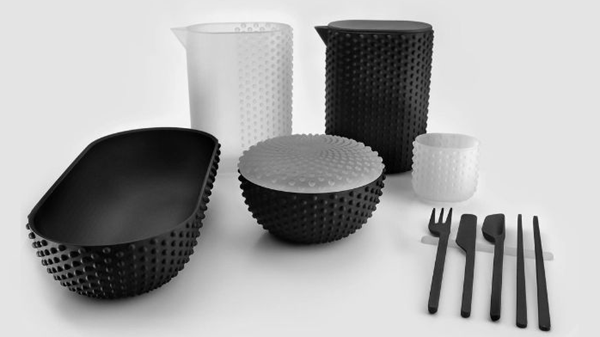
In recent years,3D printing has taken the food industry by storm. From the highly anticipated launch of Cocoa Press’ Chocolate 3D Printer to the continued industrialization of 3D food printing by companies like Revo Foods and Steakholder Foods, preparing meat, fish, and desserts has never seemed so simple. However, applications of 3D printing are not limited to direct food manufacturing. It is also possible to use this technology to create food contact parts, including plates, cutlery and even packaging. However, these parts, even if they are produced by 3D printing, must guarantee indisputable food safety during their use.
butWhat exactly does “food security” mean? What are the most important aspects of 3D printing? We answer these questions and take a closer look at how users can ensure 3D printed parts are food safe. Although ceramics and metals can be considered safe for food use, we focus specifically on plastics because they are generally more readily available, particularly for non-industrial additive manufacturing.
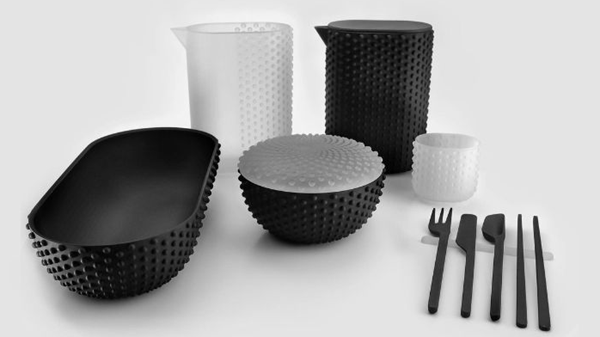
Joe Doucet’s 3D printed tableware (Photo credit: Joe Doucet)
What is food safety?
DiscussBefore tackling the subject of 3D food printing, it is necessary to define the notion of food safety. Generally speaking, the term “food” refers to materials that can come into direct contact with food. Any material thus defined must meet specific standards depending on its intended use in order to pose no risk to food safety. However, these requirements vary by country.
For example, in the United States, food material and process safety regulations are regulated by the Food and Drug Administration (FDA) promulgated. The FDA’s Code of Federal Regulations, Chapter 21 (CFR 21), contains specific regulations that govern substances permitted in the manufacture of single-use or reusable parts. As far as the EU is concerned, the food safety of polymer materials and components is regulated by Directive 10/2011.
Generally speaking, to ensure food safety, a premises must meet several criteria: not allow the migration of harmful substances, not diffuse color, odor or taste, remain safe under normal conditions of use, be durable and resist corrosion. Durable enough to withstand frequent cleaning. It should also have a smooth, easy-to-clean surface, without breaks or sharp interior corners and, finally, be resistant to pitting, chipping, scratching, warping and rotting. Anyone wishing to useAnyone who 3D prints parts that come into contact with food should follow these recommendations.

Food grade materials or parts are often represented by this universal symbol.
Is PLA food safe?
Before tackling the process itself, it is important to consider one main aspect: the choice of materials, particularly plastics. Recently, concerns have been raised that these materials could leach chemicals into food. However, there are many available. domesticThe most commonly used polymer in 3D printing is undoubtedly PLA. This material is very appreciated for its ease of printing as well as its biodegradability (under good conditions). But can it come into contact with food?
The answer is not simple. Technically speaking,The FDA considers pure PLA, which contains no colorants or other additives, to be safe for food use. However, if the PLA is colored, the additives can release chemicals that make it unsuitable for food. There are other factors that make it less suitable, including its low thermal stability, meaning its properties can change when exposed to a certain level of heat. This makes it unusable for use with parts that may be exposed to heat (such as appliances designed for microwave ovens). Additionally, it is not dishwasher safe and cannot be fully cleaned, meaning the product must be disposable to avoid bacterial contamination. Although the FDA has approved it as a safe material, these limitations make PLA a suboptimal choice for food applications.
PLA is not the only material that can be considered food safe. The FDA’s list of food polymers also includes other materials such as polypropylene, PETG (PET is a commonly used material for plastic bottles, although PETG, like PLA, is considered safe for foods as long as the filament does not contain additives such as dyes), PA11, PA12 and silicone.
food safety3D printing
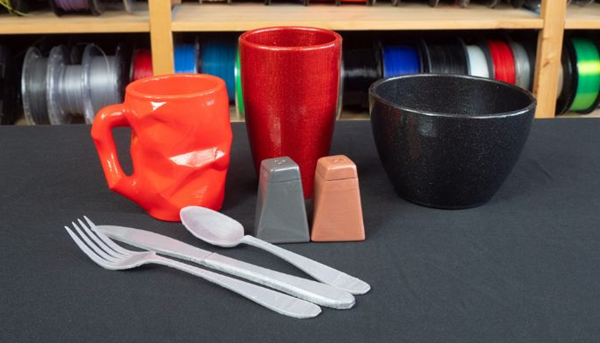
Parts manufactured by Prusa to test food safety (Photo credit: Prusa Original 3D Printers)
In addition, notably BASF andSeveral material manufacturers, including igus, offer their own ranges of food materials that meet all required standards. But the food safety of a material does not necessarily guarantee the food safety of the final part, because it also depends on the manufacturing process used.
How does 3D printing ensure food safety?
As we mentioned, the materials simply ensure food safetyThe first step in 3D printing. Even if you use FDA-approved materials, the 3D printing process itself can contaminate the part, making it potentially dangerous. Let’s see how FDM, SLS or resin 3D printing affects the final part.
FDM 3D printing remains the most widely used process and is often favored by manufacturers when manufacturing parts that come into contact with food. However, the process itself does not necessarily guarantee food safety. Therefore, some specific considerations must be taken into account.
Firstly, regarding the nozzle, most3D printers come with brass nozzles, but some may contain traces of lead. The safest solution is to choose an FDA-approved stainless steel nozzle. It is also recommended to choose a direct extruder instead of a Bowden extruder. Additionally, before 3D printing parts for food applications, the 3D printer must be thoroughly cleaned to remove any potentially toxic material residue.
However, despite all these security considerations,FDM 3D printing is not considered an extremely safe food 3D printing process. Indeed, by its nature, there remains space in the work, especially between the layers. These spaces can become areas for bacterial growth, making the room unfit for consumption. It is therefore recommended that parts manufactured using the FFF food process be single-use or reprocessed.
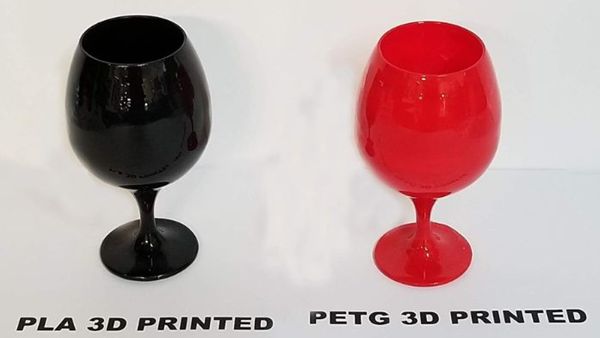
Food Coatings Can Help3D printed parts are more suitable for use with food (Image source: The Epoxy Experts)
Smooth and apply a food-safe material, such as an epoxy or silicone coating, to help seal cracks and pores. This creates a sealed surface that prevents food particles from building up and makes cleaning easier. However, it should be noted that these coatings wear out over time. Therefore, even if a part is not for single use, it is not recommended to remain in prolonged contact with food or to use it intensively.
This coating can also be combined with otherUsed with 3D printing processes to improve food safety. Take SLA 3D printing as an example. Generally speaking, the resin 3D printing process is not considered food safe due to its toxicity, although the surface of the final part is smoother than that of parts made with FDM technology. However, the addition of a food coating can make these parts suitable for food contact.
A similar situation will occur with SLS 3D printing. Although this process is considered more food safe than many others (because it avoids nozzle or resin issues), especially when printing nylon, the parts remain porous. This is why, once again, it is highly recommended to use a food-safe coating to seal the parts.
In any case, it should be emphasized that although food security3D printing is possible, but it is not without risks. Safety must be the top priority in everything related to food in order to guarantee the health of those who consume it. That’s why everything that comes into contact with consumer goods is subject to extensive testing. However, taking these factors into account and ensuring the use of food-safe materials, one could consider using a 3D printer to create original cookie molds or even pieces like cutlery.
source:3dnatives
Daguang focuses on providing solutions such as precision CNC machining services (3-axis, 4-axis, 5-axis machining), CNC milling, 3D printing and rapid prototyping services.



















