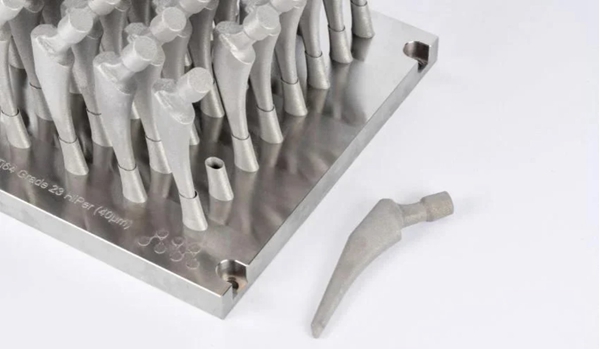
DMLS technology was proposed by EOS and patented in 1994. The process is now used in all fields, including aerospace, medicine and automotive. It can combine the advantages of metal 3D printing with excellent performance and repeatable parts.
DMLS technology, like other additive manufacturing technologies, also requires supports. To take the technology further and thus realize its full potential for users, EOS has developed a range of solutions enabling metal 3D printing of complex geometries while significantly reducing support structures. This is because removing supports from metal 3D printing adds additional time, material costs, and post-processing efforts.
△Metal printing process on the EOSQuad laser system (Image source: EOS GmbH)
Challenges related to support structures in metal 3D printing
For most users of DMLS technology today, they must add media based on the required components. Indeed, only in this way can we 3D print geometries with more complex and detailed designs. This includes, for example, cantilever designs of less than 30 degrees, integrated bridge structures and even grooves in components. Without support structures, all these geometries would distort.
To address this challenge, the researchers added supports during the design process, which then had to be removed manually or automatically after 3D printing. As we’ve seen, adding supports is a necessity for many parts, but also presents some cost issues. Therefore, the innovative ability to print using a smaller number of support structures in the DMLS process opens up entirely new possibilities for metal 3D printing and takes the technology to the next level.
How EOS supports its customers in implementing supportless 3D printing
To benefit from the possibilities of supportless 3D printing, three factors must be considered: processes, tools and appropriate expertise. With these aspects in mind, EOS presents an excellent example of supportless DMLS 3D printing using turbines, which often rely on support structures due to their complex geometry. In particular, each impeller has large differences due to characteristics such as diameter, number of blades or cover plates, which makes supportless printing more complex. However, according to EOS, it is important that the necessary knowledge is widely available at all levels.
To be able to exploit the full possibilities of metal 3D printing with little support, operators need additive thinking, which can be achieved through everything from targeted training to appropriate consultation. The importance of this knowledge is reflected in aspects such as design, arrangement of components on the build platform and even the materials used in the process. The Smart Fusion tool, which should be available to users soon, is also an important piece of the puzzle in solving the problem of unsupported metal 3D printing. The tool adjusts the laser energy input to the geometry of interest and can reduce thermal stress. Therefore, reducing support structures in metal-based additive manufacturing not only reduces construction time, but also reduces post-processing efforts and saves materials.
Davy Orye, team leader at Additive Minds Consultants, added: “Even though we are pushing the boundaries of what is possible with supportless 3D printing, you still have to deal with real-world physics, so everything It’s not possible. But our solution. This will be a game changer. Our pilot customers and those who have tested the technology with us are excited about the possibilities – and I would say we are ready to innovate together in metal 3D printing.
△The wheel is produced on the EOS M 290 using an optimized 316L printing process, without internal supports, and the cost is reduced by 35% (Photo source: EOS GmbH)
This means that supportless 3D printing technology based on metal materials can make great progress and prove very attractive. A separate cost analysis shows that taking the wheel as an example, a cost saving of 35% can be achieved. Specifically, these savings were mainly reflected in post-processing, materials and construction time, while the cost and effort of the design process with almost no support structure increased by 8% to 14%. Aside from the cost benefits, supportless 3D printing can also help users print more sustainably, as they therefore require fewer materials and generate less waste. Ultimately, this allows for a safer workflow since the user is no longer required to post-process via cutting and sanding.
Source: Internet
Daguang focuses on providing solutions such as precision CNC machining services (3-axis, 4-axis, 5-axis machining), CNC milling, 3D printing and rapid prototyping services.