
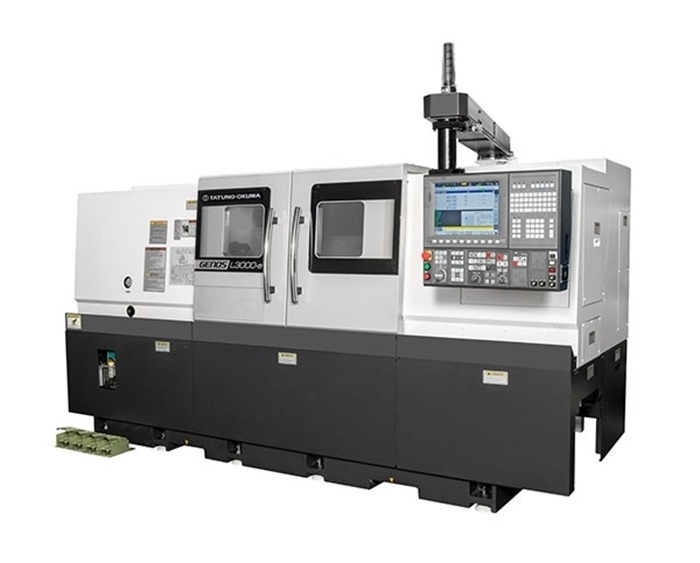
As the manufacturing industry continues to strive for high precision and efficiency,Datong Okuma Turning and Milling CompositeMachining has become a key technology for solving complex part processing problems. However, to take full advantage of its benefits, an effective solution is necessary.
1. Optimization of tool selection is an important part of combined turning and milling processing.
Since the processing of Datong Okuma turn-mill composites involves various processing methods, the cutting tools need to adapt to different working conditions. For the turning process, coated carbide tools can be used, which have good wear resistance and heat resistance, can withstand high cutting forces, and extend the tool life. When milling, select the appropriate cutter geometry and blade material according to the processing material and milling process. For example, when processing aluminum alloy, a high-speed steel cutter with a sharp cutting edge can be used to achieve smooth surface quality; When processing high-strength alloy steel, carbide cutter and reasonable chip breaker design are necessary. to cope with the impact of cutting high hardness materials.
2. Reasonable planning of treatment paths can significantly improve treatment efficiency and quality.
Use advanced computer-aided manufacturing (CAM) software, combined with a 3D model of the part, to generate precise toolpaths. During the programming process, the multi-axis linkage characteristics of the compound turning-milling machine tool should be fully considered to avoid tool interference and reduce no-load moving time. For example, for rotating parts with complex curved surfaces, rough turning can be performed first to remove most of the excess stock, and then the milling function can be used to complete the surface finish. By optimizing the cutting sequence and cutting parameters, the tool maintains a stable cutting state during the entire processing process and reduces processing errors.
3. Precise clamping and positioning of the workpiece forms the basis for ensuring processing accuracy.
Design special fixtures to ensure the stability of the workpiece during the processing process of Datong Okuma turning and milling composites. For odd-shaped parts, use combination pliers or flex pliers to quickly adjust and tighten according to the contours of the parts. At the same time, the high-precision positioning system of the machine tool is used together with the online measuring device to monitor the position accuracy of the workpiece in real time. Once deviations are detected, compensation and correction are carried out in time to ensure the accuracy of the processing dimensions.
4. Cooling and lubrication during processing cannot be ignored.
Proper coolant can not only reduce the cutting temperature and extend tool life, but also improve the quality of the machined surface. Select the appropriate coolant type and concentration based on the machining material and tool material. In the combined processing of turning and milling, a high-pressure cooling system is used to precisely spray coolant into the cutting area, effectively discharging the cutting heat and suppressing the generation of accumulated edges.
5. In addition, the skill level and experience of the operator have a significant impact on the results of composite processing in turning and milling.
Strengthen operator training to familiarize them with the operation panel, programming instructions and processing technology of compound turning and milling machine tools. Regularly organize technical exchanges and experience sharing activities to enable operators to understand new technologies and processing methods and improve their ability to solve practical problems.
In summary, through a series of effective solutions such as optimizing tool selection, planning processing paths, precise tightening and positioning, reasonable cooling and lubrication, and improving staff skills, The advantages of combined processing of turning and milling can be fully utilized to achieve efficient processing and precise processing of parts, to meet the high-quality requirements of modern manufacturing for processing complex parts.
Daguang focuses on providing solutions such as precision CNC machining services (3-axis, 4-axis, 5-axis machining), CNC milling, 3D printing and rapid prototyping services.



















