GreatLight CNC Machining Factory logo
CNC Machining
Rapid Prototyping
Materials
Industries
News
About GL

Get Instant Quote

PEEK CNC Machining

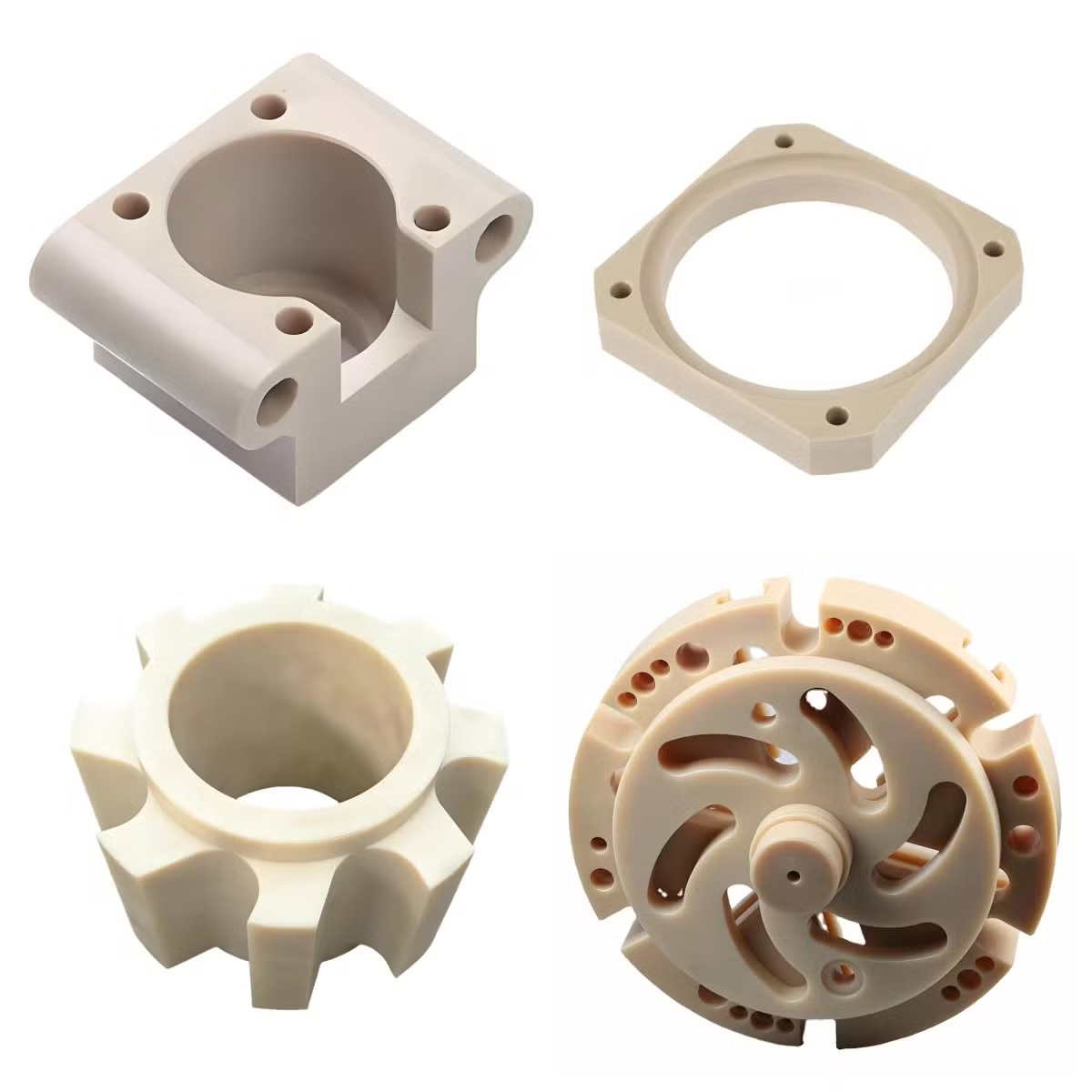
CNC Machined PEEK Plastic Precision Parts

GreatLight machines unfilled and filled PEEK to ±0.005 mm on 5-axis centers. Send a STEP file and we return a quote with DFM notes within 12 hours. One prototype or ten thousand parts, same process control.

±0.005 mm toleranceRa 0.2–0.8 μm finishFrom one part upward16 five-axis centersISO 9001 · IATF 16949NDA on request
peek cnc machining
±0.005 mmAchievable tolerance on PEEK features
16Simultaneous 5-axis machining centers
12 hQuote and DFM analysis turnaround
3–5 daysTypical shipping window after machining
Failure modes

Where PEEK parts go wrong on the shop floor

Most rejected PEEK parts are not cut badly. They are held, clamped or cooled badly.

01

Do you get chatter on thin walls?

PEEK is roughly 20 times softer than steel. Too much radial engagement pushes a 1.5 mm wall away from the cutter, and the finished part bows. By the time it is measured on a CMM, the wall is out of tolerance and the batch is scrap.

02

Melting instead of cutting

Poor heat removal leaves smeared flanks and a burnt smell. A cutter run too fast turns the chip into a sticky ribbon that welds back onto the part. Surface finish drifts past Ra 3.2 μm and the seal face will not hold pressure.

03

Does the part move after machining?

PEEK absorbs moisture and relaxes after the cut. A ring machined from a dry blank can grow a few hundredths of a millimeter overnight. If the drawing calls for a press fit, that growth either locks the assembly or leaves it loose.

04

Cracking at the corners

Sharp internal corners and deep pockets concentrate stress in a notch-sensitive material. Parts pass incoming inspection, then crack in the field under thermal cycling. The failure shows up at the customer, not at the machine.

How we machine it

Cutting PEEK on its own terms

Tooling, fixturing and annealing are set for plastic, not adapted from a steel job.

cnc-machining-hdpe
Process control

Tooling and cooling built around PEEK

We cut PEEK with sharp, polished carbide at high surface speed and low feed per tooth. Chips clear fast, and the heat leaves with them instead of soaking into the part. For unfilled grades that is usually enough. For 30% glass-filled or carbon-filled PEEK we move to diamond-coated tooling, because the fiber abrades carbide in a few hours.

Cooling matters as much as the cutter. We use high-pressure air blast or a mist of clean coolant, never a flood that lets the chip recirculate. On a 4,000 mm machine bed we can hold a long insulator or a thin valve plate without stacking soft jaws.

  • 1
    Sharp polished carbide or diamond-coated toolsDepends on filler content, not on the part size.
  • 2
    Air blast or clean mistKeeps chips out of the cut and stops smearing.
  • 3
    Low radial engagementThin walls stay where the drawing puts them.

Get Instant Quote

low volume manufacturing
Fixturing

Clamping that does not crush the blank

PEEK gives way under point loads. A vise tightened the way you would tighten on aluminum will leave jaw marks and a bowed bore. We hold parts on soft jaws machined to the blank profile, or on a vacuum plate when the wall is under 2 mm. Clamping pressure is set to the material, not to the operator's habit.

For parts that need tight flatness we rough machine, stress-relieve, then finish. The intermediate anneal lets the blank relax before the final pass, so the dimensions stay put after the part leaves the machine. Every PEEK job gets a first-article check and a final CMM report on request.

  • 1
    Soft jaws profiled to the blankLoad spreads over the whole face, not two points.
  • 2
    Rough, relieve, then finishRemoves residual stress before the tolerance pass.
  • 3
    First article plus final CMMInspection reports on request for every lot.

Grade selection

Which PEEK grade fits the part

Tell us the service temperature and the chemical exposure, and we will confirm the grade before cutting.

GradeTypical partWhen to avoid it
Unfilled PEEKSeals, bearings, insulatorsWear surfaces under high load
30% glass-filledStructural brackets, pump housingsSliding contact against metal
30% carbon-filledWear pads, gears, bushingsParts needing electrical isolation
PEEK with PTFELow-friction seals and linersHigh-load bearing surfaces
Medical-grade PEEKSurgical instruments, dental partsNon-medical industrial use
What we run

Machining services around PEEK parts

PEEK is one material in a shop that covers metals, plastics and finishing under one roof.

01

5-axis machining

Complex PEEK geometry in one setup. Undercuts, angled ports and contoured seal grooves without re-fixturing the part.

02

CNC milling and turning

Mill-turn centers handle a PEEK blank to finished part, including cross-holes and threads, with fewer setups.

03

Rapid prototyping

One PEEK prototype for fit and function testing before you commit to a tool or a production run.

04

Surface finishing

Bead blasting, tumbling and polishing on plastic parts, with masking where sealing faces must stay flat.

05

3D printing

Where a PEEK part is too complex to cut, we print the geometry and machine only the critical faces.

06

Assembly and inspection

Press fits, inserts and final dimensional reports handled before the parts leave the plant.

Scope

PEEK machining scope at a glance

ItemCapability
Tolerance±0.005 mm (±0.0002 in)
Surface finishRa 0.2–0.8 μm for sealing faces
Maximum part size4,000 mm on the large travel machine
Machines available127 CNC machines, 16 five-axis
Order quantityOne prototype to 10,000+ parts
Quote turnaround12 hours with free DFM analysis
Inspection100% before shipment, reports on request
Why GreatLight

Reasons engineers send PEEK work here

±0.005

Tolerance held on plastic

Micron-level accuracy on PEEK features, verified on a CMM before the lot ships.

16

Five-axis capacity

Sixteen simultaneous 5-axis centers take on contoured and undercut PEEK geometry.

4,000

Long parts in one setup

The large travel machine reaches 4,000 × 400 × 150 mm for long insulators and rails.

ISO 13485

Medical process control

Medical-grade PEEK runs under a quality system built for device components.

100%

Inspection before shipment

Raw material check, in-process monitoring and final inspection on every lot.

24 h

Production start

Once the drawing is released, machining can begin within 24 hours.

15 yearsMachining since 2011
7,600 m²Manufacturing space
150Technicians on staff
99.99%Qualification rate
Where PEEK parts go

Industries that specify PEEK and what we deliver

Automotive-front-bumper-plastic-rapid-prototyping-jpg

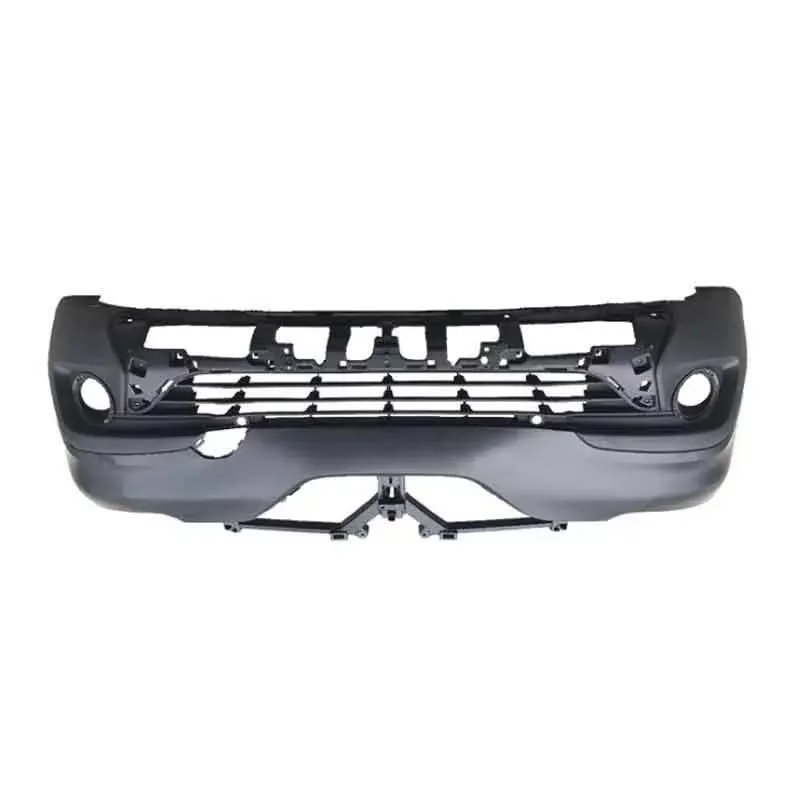
Automotive and EV

Insulating bushings and sensor housings that survive underhood heat.

  • ±0.005 mm
  • Ra 0.8–1.6 μm
  • 100% inspected
option-1-concise-seo-focused

Medical devices

Surgical instrument bodies and dental components machined from medical-grade PEEK.

  • ISO 13485
  • Autoclavable
  • Deburred by hand
cnc machining

Semiconductor and electronics

Insulators and wafer-contact parts where outgassing and conductivity both matter.

  • Unfilled PEEK
  • Clean handling
  • Lot traceability
cnc machining

Aerospace and energy

Seal rings and valve seats for high-temperature fluid service.

  • 4,000 mm travel
  • Seal faces
  • CMM report
FAQs

Questions engineers ask before sending PEEK files

Which PEEK grade should I specify?

Start from the service conditions, not the datasheet headline. Unfilled PEEK covers most seal, insulator and bearing work. Add glass fiber when you need stiffness and dimensional stability at temperature.

Carbon-filled grades raise wear resistance but conduct slightly and will chew through uncoated carbide. Tell us the temperature, the chemical and whether the part slides against metal, and we will confirm the grade before cutting.

Can you hold ±0.005 mm on PEEK?

Yes, on features that are rigid enough to measure. A 20 mm bore in a thick wall is straightforward. A 0.5 mm fin is not, because the material deflects under the probe.

We flag marginal features in the DFM review and tell you which dimensions we can hold and which ones need a geometry change.

How does PEEK compare with POM or PTFE for machining?

POM machines faster and costs less, but it softens well below PEEK's range and will not take steam or aggressive solvents. PTFE is more chemically inert but creeps under load.

Choose PEEK when the part sees heat above 150 °C, repeated sterilization or high mechanical load. If none of those apply, POM is the cheaper answer.

Will the parts change size after machining?

They can. PEEK takes on moisture from the air and releases internal stress after the cut. A ring machined dry may move a few hundredths of a millimeter over the following days.

For tight fits we rough machine, stress-relieve, then finish, and we measure at a controlled temperature. If your assembly needs a press fit, tell us and we will plan the sequence around it.

What file format do you need?

STEP or IGES for the geometry, plus a 2D drawing for tolerances, surface finish and critical dimensions that the 3D model cannot carry.

Send both and we return a DFM analysis with the quote, usually within 12 hours.

What is the smallest order you accept?

There is no minimum order quantity. We run a single PEEK prototype and we run 10,000-part production lots on the same machines with the same inspection routine.

Prototype parts ship in 3–5 days once machining starts. Batch work is scheduled after the first article is approved.

Can you machine filled PEEK without contaminating it?

Yes. Glass and carbon fillers are abrasive, so those jobs get dedicated tooling and a clean-down before the run. Medical-grade PEEK is kept separate from industrial grades.

Uploads stay confidential and we sign an NDA on request before any file is opened.

Do you supply inspection reports?

Every lot is inspected before shipment: raw material check, in-process monitoring and a final dimensional check. Reports are issued on request.

For medical and aerospace parts we can include a first-article report and material certificates with the shipment.

Send your PEEK drawing for a 12-hour quote

Upload a STEP file and get pricing with DFM notes. One part or ten thousand, inspected before it ships.

12-hour quote100% inspectionNo minimum orderNDA on request

Trusted by engineers and manufacturers worldwide

Tesla Ford Motor Company BYD Auto Denso Magna International Boeing Airbus Medtronic KUKA FANUC