GreatLight CNC Machining Factory logo
CNC Machining
Rapid Prototyping
Materials
Industries
News
About GL

Get Instant Quote

Impeller machining

CNC Machined Aluminum Alloy Impeller

Five-axis milling of closed and semi-open impellers in 6061, 7075 and 2024. Blade profiles held to ±0.005 mm, with balancing and 100% inspection before shipment.

Ø400 mm rotary table16 five-axis centersRa 0.2–0.8 μmOne part to 10,000+
aluminum-alloy-cnc-processing-2
±0.005 mmAchievable tolerance
16Simultaneous 5-axis centers
99.99%Qualification rate
12 hQuote and DFM analysis
Where impellers fail

Four Problems That Show Up After Machining

Most impeller scrap is decided before the first cut. These are the four we see most often.

01

Blade thickness drifts along the span

A blade modeled at 1.2 mm that measures 0.9 mm at the tip loses pressure ratio and shifts the operating point. Thin-wall deflection is the usual cause, and it is invisible in a CMM report that only checks a few points.
02

Balance grade missed on the first run

An impeller that passes dimensional inspection but vibrates at 12,000 rpm is scrap. Unbalanced mass comes from uneven stock removal on the hub and from blade-to-blade variation that a drawing tolerance never captures.

03

Rebuild cost after a single bad setup

One wrong work offset and a closed impeller with integral shroud becomes a paperweight. You lose the blank, the roughing hours, and the slot in the schedule. Rework is rarely possible once the flow path is cut.

04

Surface finish that eats efficiency

As-machined flanks at Ra 3.2 μm add friction loss inside the passage. The part still fits and still spins. It just moves less air per watt, and nobody notices until the unit is on a test bench.

How we machine it

One Setup, One Datum, Full Blade Access

Five-axis simultaneous milling removes the need to re-fixture the flow path.

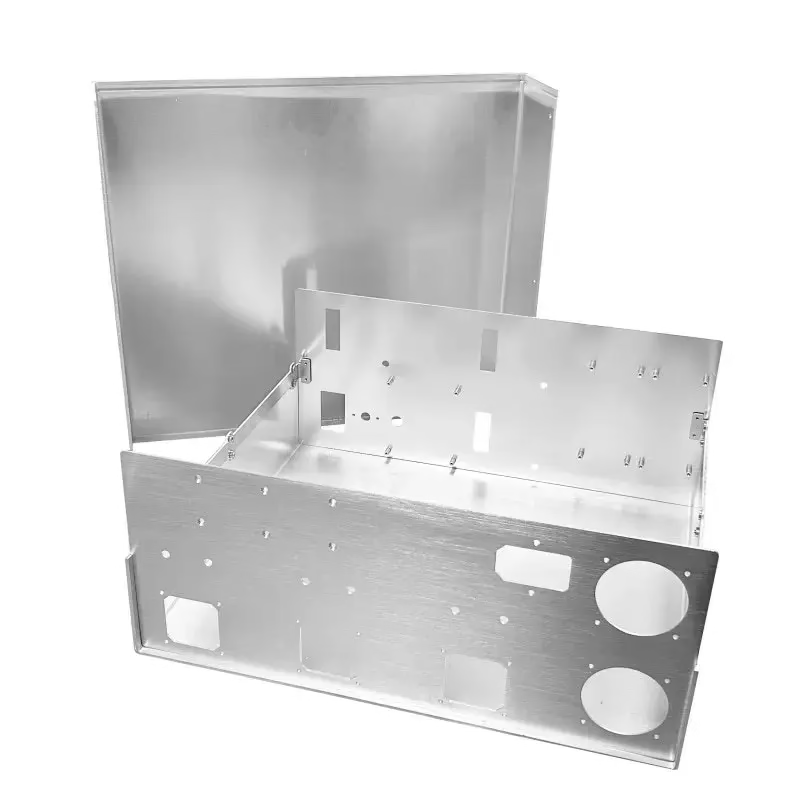
aluminum-alloy-industrial-control-chassis-sheet-metal-processing
Five-axis strategy

Blades cut in a single continuous setup

Impeller geometry punishes repositioning. Every new fixture adds a datum shift, and a datum shift on a twisted blade shows up as wall thickness variation. We rough and finish the flow path on simultaneous five-axis centers so the hub, blades and shroud stay in one coordinate system.

Tool access is the other half. A 4,000 × 400 × 150 mm envelope and a Ø400 mm rotary table let us tilt the part instead of reaching around it. That means shorter tools, less chatter, and blade tips that finish at the programmed thickness.

  • 1
    One datumHub, blades and shroud machined without re-clamping.
  • 2
    Short toolsTilted access reduces overhang and chatter on thin blades.
  • 3
    Ø400 mm tableHandles splitter blades and integral shrouds.

Get Instant Quote

aluminum-vs-stainless-steel-cnc-lathing-machining-service
Material and balance

Alloy Choice and Mass Control

7075-T6 gives the highest strength for high-tip-speed rotors. 6061-T6 machines cleaner and welds if you need a repair path. 2024 is the middle option when fatigue life matters more than peak strength. We stock all three, plus 5052, 5083, 6082 and ADC12 for cast-then-machined work.

Cutting aluminum fast is easy. Holding balance is not. We control stock removal around the hub so the finished part starts close to balanced, then check residual unbalance before the impeller leaves the shop. Material certificates travel with the part.

  • 1
    7075-T6High tip speed, high stress, tight blade sections.
  • 2
    6061-T6Easier to machine, good corrosion behavior.
  • 3
    2024Fatigue-driven duty cycles and cycling loads.
Selection guide

Which Process Fits Your Impeller

Pick by geometry and volume, not by habit.

CaseBest processWhy
Open or semi-open rotor, low volumeFive-axis milling from solidNo tooling cost, geometry changes stay cheap
Closed impeller with integral shroudFive-axis from solid or split-and-bondOne setup keeps the flow path aligned
Casting-like shape, 500+ piecesDie casting plus finish machiningLower piece cost, aluminum still machines clean
Prototype for flow testingRapid prototypingIterate blade angles before committing to production
What we run

Services Around Impeller Production

Machining is one step. These are the ones that usually sit next to it.

01

5 Axis CNC Machining

Simultaneous five-axis milling for blades, hubs and integral shrouds. 16 centers available.

02

4 Axis CNC Machining

Rotary work for hubs and shafts where one face needs indexed access. 12 mills.

03

CNC Milling & Turning

Mill-turn centers for impellers on an integral shaft, so runout stays controlled.

04

Rapid Prototyping

Flow-path iterations in days, before you cut aluminum.

05

Part Surface Finishing

Anodizing, bead blasting and polishing to bring passage walls down to Ra 0.8–1.6 μm.

06

Metal Die Casting

ADC12 bodies cast close to shape, then finish machined on the same datums.

Capability range

Machining Envelope and Inspection

ItemRangeNotes
Tolerance±0.005 mm (±0.0002 in)Held on blade thickness and hub bores
Surface finishRa 0.2–0.8 μm fine, Ra 0.8–1.6 μm standardPassage walls usually specified at 0.8–1.6 μm
Max part size4,000 mm maximum processing sizeLarge envelopes on selected machines
Rotary capacityØ400 mm rotary tableSplitter blades and closed rotors
Inspection100% before shipmentReports available on request
Lead timeQuote in 12 h, parts ship in 3–5 daysProduction can start within 24 h
Why GreatLight

Numbers Behind the Impeller Work

Fifteen years of aluminum cutting, measured rather than described.

15Y

Machining since 2011

Three wholly-owned plants and 7,600 m² of floor space in Dongguan, plus a Singapore factory.

127

High-precision CNC machines

16 simultaneous five-axis centers, 12 four-axis mills, 27 three-axis machines and 16 mill-turn centers.

±0.005

Millimeters of tolerance

Blade thickness, hub bores and shroud gaps inspected against the drawing, not against a sample.

99.99%

Qualification rate

Raw material check, in-process monitoring and final inspection on every lot.

ISO 9001

Plus three more systems

IATF 16949, ISO 13485 and ISO 27001 cover automotive, medical and information security work.

0 MOQ

No minimum order quantity

From one prototype to 10,000+ part runs on the same process.

7,600 m²Manufacturing space
150Skilled technicians
3Wholly-owned plants
<2%Historical late-delivery rate
Industry requirements

What Each Sector Demands, And How We Meet It

Aluminum-machining-for-automotive-engine-parts

Automotive and EV

Turbocharger and cooling rotors that survive thermal cycling without losing balance.

  • IATF 16949
  • ±0.005 mm
cnc-magnesium-alloys

Aerospace

Lightweight rotors where wall thickness and balance are both flight-critical.

  • Material certs
  • 100% inspection
low volume manufacturing

Industrial pumps

Open and closed impellers in small lots, with repeat runs that match the first article.

  • No MOQ
  • 3–5 day shipping
cnc-machining-hdpe

HVAC and blowers

Passage walls finished to Ra 0.8–1.6 μm to keep friction loss low.

  • Ra 0.8–1.6 μm
  • 5-axis milling
FAQs

Impeller Machining Questions

Which aluminum alloy should an impeller be made from?

7075-T6 when tip speed and stress are high and blade sections are thin. 6061-T6 when you want easier machining, better corrosion behavior and a repair path. 2024 sits between them for fatigue-driven duty cycles.

We keep 6061, 6061-T6, 2024, 5052, 5083, 6063, 6082, 7075 and ADC12 in stock, so the choice is driven by the application rather than availability.

Can you hold wall thickness on thin blades?

Yes, down to ±0.005 mm on blade thickness when the geometry allows. The limit is usually blade height to thickness ratio, not the machine.

If a blade is very tall and very thin, we will tell you during the DFM review and suggest a change to the rib or fillet instead of quoting a tolerance we cannot repeat.

Do you machine closed impellers with an integral shroud?

Yes. The Ø400 mm rotary table and five-axis tilting let us reach the passage without splitting the part.

For very narrow passages we may recommend a split-and-bond design, which is a mechanical decision rather than a machining limitation.

How is balance handled?

We control stock removal around the hub during roughing so the part starts close to balanced, then check residual unbalance before shipment.

If your drawing specifies a balance grade, send it with the model and we will machine to that requirement.

What surface finish do the passage walls get?

Standard as-machined finish is Ra 1.6–3.2 μm. Impeller flow paths are normally specified at Ra 0.8–1.6 μm, and fine finishing can reach Ra 0.2–0.8 μm.

Bead blasting, tumbling and polishing are available if you want a specific wall condition rather than a number.

How fast can I get a quote and parts?

Quotation and a free DFM analysis come back within 12 hours. Production can start within 24 hours of approval, and parts ship in 3–5 days.

No minimum order quantity applies. One prototype and a 10,000-part run go through the same process.

Can you sign an NDA before I send drawings?

Yes. Uploads are secure and confidential, and an NDA is available on request before you share any geometry.

We work under ISO 27001:2022 for information security, which covers how customer data is stored and handled.

Do you provide inspection reports?

Every part is inspected before shipment, covering raw material check, in-process monitoring and final inspection. Reports are available on request.

For impellers, the report typically covers blade thickness at defined stations, hub bore, shroud gap and residual unbalance.

Send Us Your Impeller Model

Upload a STEP file and get a quote with DFM feedback within 12 hours. No minimum order quantity, 100% inspection before shipment.

12-hour quote100% inspectionNo MOQNDA on request

Trusted by engineers and manufacturers worldwide

Tesla Ford Motor Company BYD Auto Denso Magna International Boeing Airbus Medtronic KUKA FANUC