
Chemical CNC Alloy Machining Services
This page explains how chemical etching and CNC machining are combined on alloy parts, what geometries each step handles, and where the pairing stops making sense. It is written for design engineers and sourcing engineers who need to pick a process, not a slogan. After reading it you can judge whether your part belongs in this workflow or in plain milling.
Two Removal Methods, One Part
The workflow pairs a chemical etch that opens fine features across a sheet of alloy with CNC cutting that brings the same part to its final thickness, flatness, and hole accuracy.
What This Process Actually Is
The etch step uses a photoresist mask and a chemical bath to dissolve metal where the mask is open. There is no cutter force, no burr on the etched edge, and no work hardening. Features down to a few tenths of a millimeter across a 0.2 mm sheet are routine, which is where milling struggles.
The CNC step then takes over. It sets the outline, drills and reams holes to ±0.005 mm, faces the part to a flat datum, and cuts pockets or counterbores the etch cannot hold. Because the etch already removed most of the area, the cutter spends its time on accuracy, not on roughing.
The order matters. Etching first lets you keep a carrier frame that holds dozens of small parts flat through milling. Mill first and you risk distorting thin webs before the etch ever starts.
One limit is worth stating early: this is not a replacement for five-axis work. If your part is a solid block with deep 3D contours, plain CNC machining is faster and cheaper.
- 1Etch handlesFine slots, grids, perforations, and thin webs in sheet alloy.
- 2CNC handlesOutlines, tight holes, flat datums, pockets, and threads.
- 3Not a fitDeep 3D cavities, thick billets, and high-volume simple plates.
Which Alloys Etch and Machine Well
Alloys that etch cleanly tend to be the ones with predictable grain and no heavy alloying segregation. Aluminum 6061, 5052, and 6063 etch evenly and mill without drama. Stainless 304 and 316 hold fine features but need a slower etch bath to avoid undercut at the mask edge.
Copper alloys behave differently. C110 and C101 etch fast and give crisp edges, which is why they show up in busbars and RF shielding. Beryllium copper etches well but needs controlled handling and a documented process, since the dust and bath chemistry are regulated.
Titanium and Inconel sit at the other end. Both resist chemical attack, so an etch step is slow and rarely economic below 0.5 mm. For these, CNC milling with the right cutter and coolant is usually the better path, and we will say so in the DFM review rather than quote a process that will not pay off.
Magnesium AZ31B and AZ91D machine fast and light, but the chips are flammable. That changes housekeeping and coolant choice more than it changes the etch.
Alloy Families at a Glance
Typical behavior when the two steps are combined. Actual results depend on sheet thickness and feature size.
| Alloy | Etch behavior | CNC behavior | Typical use |
|---|---|---|---|
| Aluminum 6061 / 5052 | Even removal, clean edges | Free cutting, good finish | Chassis, brackets, heat sinks |
| Stainless 304 / 316L | Fine features, watch undercut | Work hardens, light passes | Medical, food equipment |
| Copper C110 / C101 | Fast etch, crisp detail | Gummy, needs sharp tooling | Busbars, RF shielding |
| Titanium TC4 | Slow etch, low economy | Difficult but predictable | Aerospace brackets |
| Inconel | Very slow, rarely used | Tool wear is the limit | Hot-section parts |
| Magnesium AZ31B | Etches, chips are reactive | Fast cutting, strict handling | Lightweight housings |
Chemical Etching vs. Straight CNC Milling
Pick etching when the feature is smaller than the cutter that would have to reach it, or when the sheet is too thin to clamp without bowing. A 0.3 mm perforated grid in a 0.2 mm stainless sheet is an etch job. Milling it would take a 0.3 mm cutter, several passes, and a fixture that costs more than the parts.
Pick milling when the part needs a true 3D form, a threaded hole, an interference fit bore, or a flatness callout tighter than the sheet can hold on its own. Etching is a through-thickness process; it cannot create a step, a chamfer, or a counterbore.
The combined route pays off in the middle. Think of a thin alloy plate with a dense pattern of slots plus four precision dowel holes and a milled perimeter. Etch the pattern, mill the datums. One setup, one carrier frame, one inspection report.
Volume shifts the answer too. Above roughly 10,000 identical thin parts, a dedicated etch tool and a simple trim die often beat both routes on cost per piece. Below that, the hybrid workflow is usually the practical choice.
How We Run These Parts in Dongguan
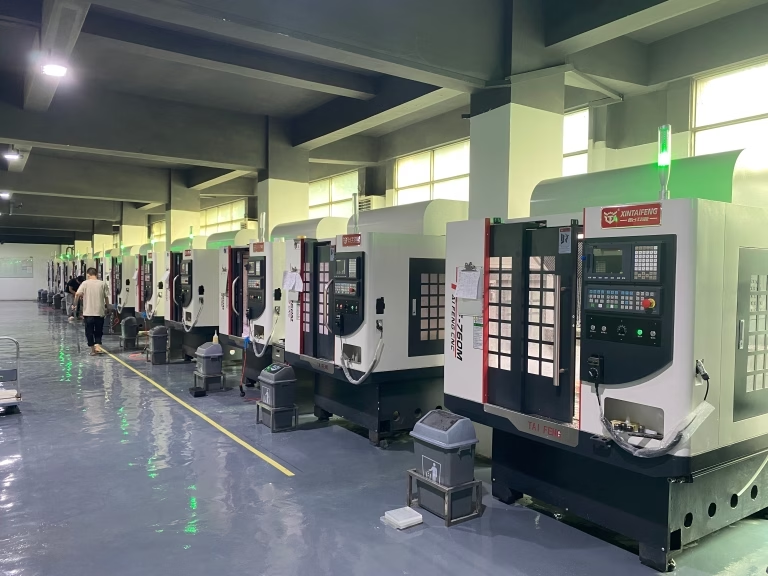
We hold ±0.005 mm on milled features and Ra 0.8–1.6 μm on finished faces. Etched edges come out matte and burr-free, which is usually left as-is unless the drawing calls for passivation or plating. Our 127 CNC machines include 16 simultaneous 5-axis centers and 16 mill-turn centers, so a hybrid part does not wait on a single spindle.
The maximum processing size is 4,000 mm, which covers most panel and frame work. Smaller travel envelopes at 750 × 1,150 × 550 mm and 600 × 600 × 600 mm handle the rest. A Ø400 mm rotary table is available when the part needs indexed features on more than one face.
Every order gets a raw material check, in-process monitoring, and a final inspection before shipment. Qualification rate runs at 99.99%. Reports are available on request, and we inspect 100% of parts rather than sampling.
If you send a drawing, you get a quotation and a free DFM analysis within 12 hours. Production can start within 24 hours, and parts typically ship in 3–5 days. There is no minimum order quantity, so a single prototype and a 10,000-part run go through the same front door.
- 1CertificationsISO 9001:2015, IATF 16949:2016, ISO 13485:2016, ISO 27001:2022.
- 2FinishingAnodizing, plating, powder coating, bead blasting, laser marking.
- 3ConfidentialitySecure uploads; NDA available on request.
Questions Engineers Ask Before Quoting
What is the thinnest alloy sheet you can etch and still mill?
We regularly run 0.2 mm stainless and aluminum sheet on a carrier frame. Below that, handling and flatness become the limit rather than the etch itself.
If your part is thinner than 0.2 mm, tell us the flatness callout. In some cases a temporary backing plate solves it; in others we will recommend a different route.
How tight a tolerance can the etched features hold?
Etch tolerance depends on sheet thickness. As a rule of thumb, expect about ±10% of the material thickness on feature width, and better on hole position if the pattern is stepped and repeated.
Critical dimensions should be placed on milled features instead. That is where ±0.005 mm applies.
Can you combine etching with anodizing or plating?
Yes. Clear, color, hardcoat, and conductive anodizing are all available, along with electroless nickel, zinc, silver, and gold plating.
Etched edges take anodizing differently than milled faces because of the surface texture. If the color match matters, say so on the drawing.
What file format do you need for a DFM review?
STEP or IGES for the 3D geometry, plus a 2D drawing with tolerances, material, finish, and any critical callouts. DXF is fine for flat-pattern-only parts.
The free DFM analysis comes back within 12 hours and flags features that will not survive the etch or the mill.
Is there a minimum order quantity?
No. We run from one prototype to 10,000+ part runs with the same process control.
For very high volumes of thin parts, we will tell you in the DFM review if a dedicated etch tool would be cheaper than the hybrid route.
How do you protect our design data?
Uploads are handled as confidential, and we can sign an NDA before you send files. Our information security management is certified to ISO 27001:2022.
Access to customer drawings is limited to the engineers and programmers who need it for the quote and the process plan.
Send the Drawing, Get a Process Answer
We will tell you which steps your part needs, what tolerance each feature can hold, and what it costs. No minimum order quantity.
12-hour quote and DFM±0.005 mm milling100% inspection









