
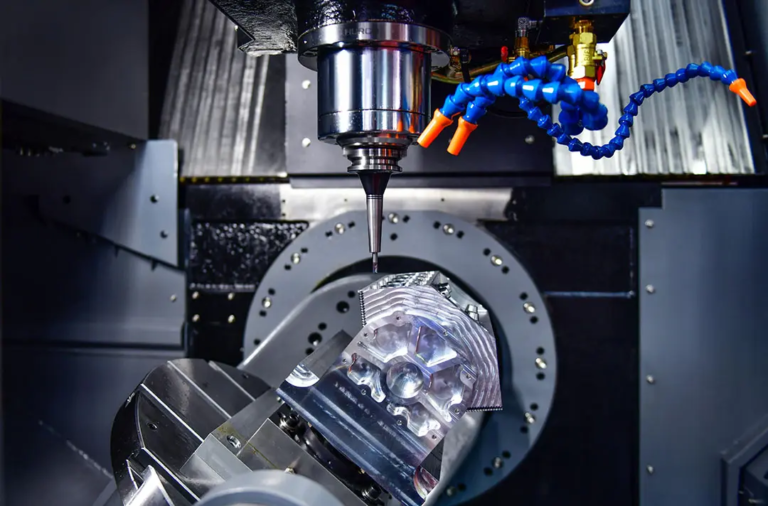
Of all the tools in a modern metal fabrication shop, few are as impressive—or as misunderstood—as the CNC press brake. This machine, a cornerstone of precision metal forming, represents the perfect marriage of mechanical engineering and digital control. For those in the know, it’s not just a "bender"; it’s the brain behind the brawn, enabling the creation of complex, high-tolerance parts that are essential in industries from aerospace to custom automotive.
But what exactly is it, and why should manufacturers, engineers, and designers care?
Let’s dive in.
What is a CNC Press Brake?
At its core, a press brake is a machine used to bend sheet metal into desired shapes. The "CNC" part stands for Computer Numerical Control. This means that a computer, programmed by an operator, controls all aspects of the bending process.
Traditional press brakes required immense skill from the operator to manually position the metal, calculate the force needed, and handle the machine. A CNC press brake automates this. The operator simply loads a digital design (often created in CAD software), and the machine does the rest—positioning the material, applying the exact amount of force with the hydraulic system, and controlling the angle of the bend with incredible precision.
The key components include:
- The Frame: The main structure that holds everything together.
- The Ram (or Beam): The upper part that moves down to apply force, holding the punch.
- The Die: The lower part that the punch presses the metal into. Different die shapes create different bends (e.g., V-die, U-die).
- The CNC Controller: The "brain" of the operation. This is where the operator inputs the design (e.g., material type, thickness, desired angle) and the system calculates the required force, depth, and positioning.
The Power of CNC: Beyond Simple Bending
So why opt for a CNC-controlled machine over a manual one? The benefits are substantial for any serious manufacturing operation.
1. Unmatched Precision and Repeatability:
Human error is virtually eliminated. Once a program is created for a specific part, every subsequent part will be identical. This is critical for mass production and complex assemblies where components must fit together perfectly. The CNC machine’s precision is measured in fractions of a degree.
2. Dramatically Increased Efficiency:
Changing from bending one part to another on a manual machine can take 15-30 minutes as the operator changes the tooling and recalculates settings. With a CNC press brake, this changeover happens in seconds. The operator just selects the next program, and the machine automatically adjusts. This drastically reduces downtime and increases productivity.
3. Ability to Handle Complexity:
Many modern products require complex parts with multiple bends at different angles. A CNC press brake can handle this with ease. Features like CNC axis crowning (which automatically adjusts the bed to compensate for deflection and ensure a perfectly flat bend across the entire length) and back gauge automation (which positions the material with extreme accuracy) make the impossible, possible.
4. Enhanced Safety:
While safety always depends on the operator, CNC press brakes are designed with safety in mind. Features like light curtains, two-hand operation buttons, and automated processes that keep the operator’s hands away from the pinch point significantly reduce the risk of accidents.
Why This Matters for Your Project
You might be reading this as an engineer, a product designer, or a procurement manager for a manufacturing firm. Understanding the capabilities of your manufacturing partners is key.
When you partner with a manufacturer like GreatLight, which utilizes advanced CNC machining and fabrication capabilities, you’re not just getting a part bent. You’re getting a part bent correctly.
- Accuracy: Your parts will fit together as designed, the first time.
- Cost-Effectiveness: Less manual labor and faster cycle times mean lower costs, especially for larger runs.
- Material Savings: The precision of CNC means less scrap from incorrectly bent parts.
- Future-Proofing: Designs can be saved and reused. If you need more parts in six months, the program is ready to go, saving time and money.
Conclusion: The Unseen Backbone of Modern Manufacturing
The CNC press brake is a perfect example of a technology that, while not always visible to the end consumer, is absolutely critical to the products we use every day. From the laptop you’re using to read this, to the car you drive, to the medical equipment in a hospital, the precision and strength of these products are often dependent on the precision of the components inside—components made possible by CNC machining.
It represents a shift from artisan-led craftsmanship to technology-enhanced precision. It’s not about replacing human skill but augmenting it, freeing up skilled operators to focus on design, problem-solving, and overseeing more complex tasks, while the machine handles the repetitive, precise execution.
Investing in, or partnering with a manufacturer that invests in, advanced CNC machinery like this is not just about keeping up with technology. It’s about ensuring quality, safety, and efficiency in a world where the demands for precision and complexity are only increasing.
FAQ: CNC Press Brakes
Q1: What’s the difference between a regular press brake and a CNC press brake?
A standard press brake relies entirely on the operator’s skill to position the material and set the machine. A CNC (Computer Numerical Control) press brake uses a computer to control the positioning, force, and depth of the bend, making it far more accurate, repeatable, and efficient for complex or high-volume jobs.
Q2: Can a CNC press brake handle any material?
While primarily used for metals (steel, aluminum, stainless steel, etc.), CNC press brakes can be tooled to work on other materials like certain plastics or composites, provided the correct tooling is used to avoid damaging the material. The key is the material’s hardness and thickness, which the machine’s software can calculate the required force for.
Q3: Are CNC press brakes only for large manufacturers?
Not at all! While they are a significant investment, the efficiency and cost savings they provide make them accessible to a wide range of businesses. Many job shops and fabricators use CNC press brakes because they allow a small team to take on a huge variety of work with guaranteed quality. The ROI is often quickly realized through reduced labor costs and material savings.
Q4: How do I know if my project needs CNC bending?
If your project involves:
- Metal parts that need to be bent.
- Requirements for high precision and consistency (e.g., aerospace, medical devices).
- Complex parts with multiple bends.
- Medium to high production runs.
…then you absolutely need a CNC press brake. For one-off, simple brackets, a manual machine with a skilled operator might suffice, but for anything beyond that, CNC is the way to go.
Q5: What does "five-axis" refer to in the context of CNC?
While "five-axis" is more common in CNC milling, the principle applies. It refers to the number of directions in which the cutting tool (or in this case, the bending tool) can move. A standard press brake might only move up and down (the Y-axis). A more advanced CNC press brake will have automation on the back gauge (the R-axis for in/out movement and Z-axis for left/right finger movement). This multi-axis control is what allows for the incredible precision and automation of the bending process.



















