On April 12, 2023, Mohou.com learned that using 3D printing to replace traditionally manufactured metal media can reduce energy consumption, according to the first commissioned research paper released by global trade group Additive Manufacturers Green Trade Association (AMGTA) and material costs. , and reduce the carbon footprint, giving manufacturers a more sustainable option.

The report, authored by the Golisano Sustainability Institute at the Rochester Institute of Technology, is titled “Comparison of Life Cycle Assessment of Low Pressure Turbine (LPT) Mounts by Two Manufacturing Methods.” The report uses life cycle analysis (LCA) to analyze commercial aerospace low-pressure turbine mounts, compares laser powder bed fusion (LPBF) 3D printing manufacturing with traditional manufacturing methods and estimates support weight reduction of more than 50% during aircraft service. the life. Although the final results of the comparison have not yet determined which manufacturing method consumes the most energy, AMGTA said the results confirmed the “significant impact” of light commercial aircraft engines and airframes on carbon emissions.
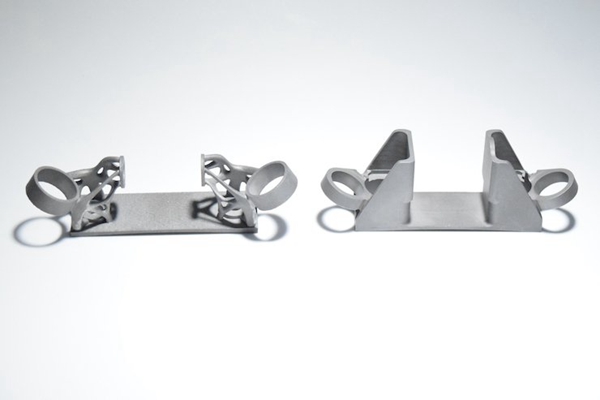
△Comparison of 3D printed bracket design (left) and traditional design (right)
The key takeaways from LCA are:
The jury is still out on which manufacturing method (traditional or additive manufacturing) would consume the most energy. But overall, this neutral result represents an improvement over previous studies, but the reasons for the greater energy used in manufacturing LPBFs need to be explored in more detail.
The importance of the energy mix: The study found that by far the most important factor in determining the sustainability of production is the energy mix where the manufacturing plant is located and whether that energy network is produced sustainably. Therefore, the source of energy and how it is produced must be considered to ensure the sustainability of the manufacturing process.
Huge Impact on Aircraft Lightweighting: The study shows very clearly that for every kilogram of weight saved through 3D printing manufacturing designs to lighten aircraft components, the total weight of the aircraft will be reduced by 13,376 kilograms. This means that a lightweight design can significantly reduce aircraft fuel consumption and carbon emissions, which is of great importance to the sustainability of the aviation industry.
Overall, 3D printing produces a more durable part: the impact of lightweighting is what determines that the technology produces more durable parts than those traditionally designed and manufactured. Therefore, using 3D printing technology in the manufacturing process can significantly improve the durability of parts and reduce carbon emissions and resource waste. “The release of this peer-reviewed LCA marks an important milestone for the AMGTA,” said Sherri Monroe, AMGTA Executive Director. “This study clearly demonstrates the real impact of this technology on aircraft and engine design and provides insight into other industries. and A good foundation has been laid for adopting similar strategies in the project.
△GE tests T901 rotor engine for US military and 3D printed metal parts reduce weight by 20%
The importance of using 3D printing technology to develop and optimize components
The two-year study used three LCA methods to analyze the two scaffolds, including the midpoint indicator-based assessment method ReCiPe 2016 version 1.1, the cumulative energy demand v1.11 method and the Intergovernmental Panel on Climate Change IPCC GWP100 2021. Of these, two methods show that, strictly from a manufacturing perspective, producing conventional stents requires less energy, while another suggests that the additively manufactured version produces less carbon dioxide. However, in all cases, the results show that the grid energy mix has a huge impact on the sustainability of the manufacturing process. Additionally, this LCA study complied with ISO 14040:2006(E) standards and was evaluated by EarthShift Global.
Although the choice of LPT supports simply demonstrates the impact of lightweighting on aircraft engines, AMGTA believes that the lessons learned from the current LCA can be applied more broadly by aircraft and engine manufacturers across multiple systems. mechanical. Additionally, transportation lightweighting methods using additive design technologies are not limited to laser powder bed fusion technology, as other 3D printing technologies such as binder jetting, laser deposition Directed energy and polymer printing can also eliminate weight redundancy in vehicles, aircraft and ships.
Source: Antarctic Bear
Daguang focuses on providing solutions such as precision CNC machining services (3-axis, 4-axis, 5-axis machining), CNC milling, 3D printing and rapid prototyping services.