

3D printing is gradually changing the construction industry. Various projects, such as houses and shopping centers, are already taking shape thanks to this technology. Today, one project is attracting particular attention: researchers at Nanyang Technological University in Singapore (NTU Singapore) have developed concrete 3D printing technology capable of capturing carbon. This innovation opens up new perspectives for reducing the ecological footprint of buildings.
The new technology, published in the journal Carbon Capture Science and Technology, could transform the construction industry. It addresses the environmental impact of cement, which represents around 1% of global CO2 emissions.8%. This approach is expected to reduce the need for traditional methods such as reinforced concrete by optimizing material usage, speeding up construction times and reducing labor requirements. Let’s see how it works.
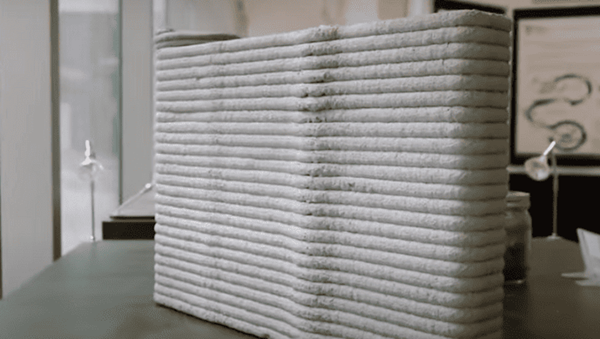
A more ecological and efficient concrete3D printing
This newThe 3D printing method incorporates carbon dioxide and steam collected as byproducts of industrial processes directly into the concrete mix. The process permanently immobilizes CO2 in the concrete structure, improving its mechanical properties compared to traditional 3D printing methods. Specifically, the team designed a system in which a 3D printer is connected to a carbon dioxide pump and a nozzle that sprays steam. During the printing process, carbon dioxide reacts with the concrete’s components to solidify, and the steam increases the concrete’s ability to absorb the gas, making the structure stronger.
School of Mechanical and Aerospace Engineering, Nanyang Technological University(MAE) and Tan Ming from the Singapore Center for 3D Printing (SC3DP) Professor Jen highlighted the importance of reducing greenhouse gas emissions from the construction sector, which is one of the most polluting sectors in the world. world: “Our new 3D concrete printing system improves the mechanical properties of concrete and helps reduce environmental impact. It demonstrates the possibility of using carbon dioxide produced by power plants or other industries for 3D printing of concrete. As traditional cement emits large amounts of carbon, our method offers an alternative to 3D printing. inject carbon dioxide by printing concrete.
Tests show the new technology can produce stronger, more durable concrete. with traditionalCompared to the 3D printing method, the resulting concrete can support 37% more weight and bend almost 45% more before breaking. In addition to these mechanical properties, the process is also more environmentally friendly, capturing 38% more carbon dioxide than conventional methods. The researchers now plan to refine their technique to increase its effectiveness. They also hope to explore the use of recycled industrial gases in the 3D printing process, rather than pure carbon dioxide.
Daguang focuses on providing solutions such as precision CNC machining services (3-axis, 4-axis, 5-axis machining), CNC milling, 3D printing and rapid prototyping services.



















