
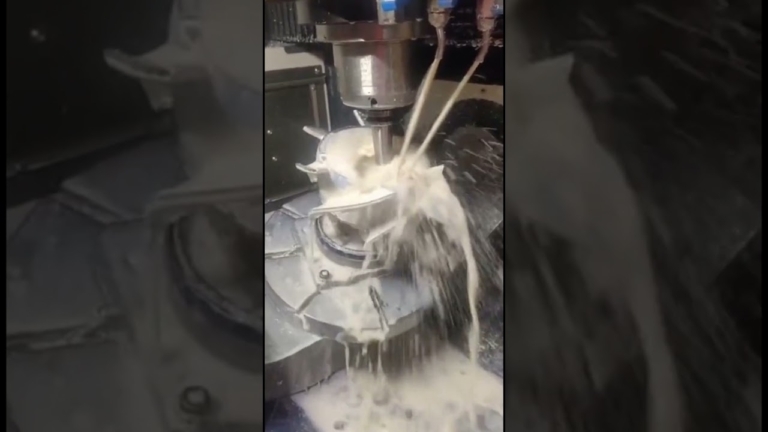
Here is the article about CNC machining of impeller parts:
Introduction
CNC machining is a process used to create complex parts with high precision, accuracy, and surface finish. One of the most common applications of CNC machining is in the production of impeller parts. Impellers are used in various industries, such as aerospace, automotive, and power generation, where they are responsible for conveying fluids, gases, or other materials.
Overview of Impellers and Their Applications
Impellers are a type of rotating component designed to increase the pressure or flow rate of a fluid, gas, or other materials. They are widely used in various industries, including:
- Aerospace: Impellers are used in aircraft and spacecraft to control air or gas flow.
- Automotive: Impellers are used in internal combustion engines to improve fuel flow and efficiency.
- Power generation: Impellers are used in power plants to increase the flow of steam or gas for turbine power generation.
- Pharmaceuticals: Impellers are used in the production of pharmaceuticals to mix and blend ingredients.
Principle of CNC Machining of Impeller Parts
The principle of CNC machining of impeller parts is based on the use of computer-controlled machines that can read and execute Computer-Aided Design (CAD) files. CNC machines use a three-axis system, consisting of a spindle, a guide, and a gantry, to move and operate cutting tools. The cutting tools, such as cutting inserts or cutting heads, are designed to remove material from the workpiece, which is typically a solid block of material, to create the desired shape and size of the impeller part.
Advantages of CNC Machining of Impeller Parts
There are several advantages of CNC machining of impeller parts, including:
- High precision and accuracy: CNC machines can achieve high precision and accuracy, ensuring that the impeller part is manufactured to exact specifications.
- Increased productivity: CNC machining allows for the production of parts at a faster rate, with minimal human intervention.
- Improved surface finish: CNC machines can produce a smooth surface finish, which is critical for impeller parts that are subject to high-speed operation.
- Reduced human errors: CNC machines are not prone to human error, reducing the risk of mistakes and defects.
- Cost-effectiveness: CNC machining can be more cost-effective than traditional machining methods, as it reduces labor costs and increases productivity.
Types of CNC Machining Operations Used in Impeller Part Production
There are several types of CNC machining operations used in the production of impeller parts, including:
- Turning: This operation is used to produce cylindrical or conical shapes, such as the hub and vanes of an impeller.
- Milling: This operation is used to produce flat surfaces, such as the plate or disk shape of an impeller.
- Drilling and tapping: This operation is used to create holes and threads, such as for mounting or connecting the impeller to other components.
- Grinding and lapping: This operation is used to improve the surface finish and accuracy of the impeller part.
Conclusion
In conclusion, CNC machining is an essential process in the production of impeller parts, offering several advantages, including high precision, increased productivity, improved surface finish, reduced human errors, and cost-effectiveness. Whether used in aerospace, automotive, or power generation, impellers play a critical role in conveying fluids, gases, or other materials. By leveraging CNC machining technology, manufacturers can produce high-quality impeller parts that meet the exacting requirements of these industries.
Daguang focuses on providing solutions such as precision CNC machining services (3-axis, 4-axis, 5-axis machining), CNC milling, 3D printing and rapid prototyping services.



















