
The Sculptors of Steel: How Advanced Grinding Technologies Master Complex Surfaces**
In the high-stakes arena of precision manufacturing – where the throaty roar of a jet engine, the seamless shift of an electric drivetrain, or the silent efficiency of a surgical robot hinges on perfection – traditional machining often meets its match. Components like turbine blades with intricate airfoils or gearbox teeth demanding micron-level accuracy present surfaces that defy conventional tools. Enter the modern marvels of CNC grinding technology: not mere machines, but master artisans, wielding abrasive wheels like sculptors’ chisels to carve near-impossible geometries into the most demanding materials. They are the quiet revolutionaries shaping the backbone of advanced industry.
Beyond Linear Limits: The Elegance of Controlled Helical Motion
What sets these grinding virtuosos apart? It starts with their fundamental choreography. Unlike simple cylindrical grinders confined to linear strokes, the pinnacle in this field leverages a sophisticated kinematic principle: the synthesis of precisely coordinated helical motion. Imagine the fluid interplay between a screw and a nut. Here, the rotating workpiece and the traversing grinding wheel head are rigidly linked through a complex transmission system, moving with a defined mathematical relationship, or speed ratio. This dance generates a continuous, controlled spatial trajectory.
This capability is crucial for complex flank geometries – the intricate curves defining gear teeth. Whether crafting the precisely involute profile of high-efficiency worm gears or tackling the labyrinthine surfaces of spherical worms found in advanced robotics, this helical principle provides an inherent, kinematically pure solution. The result in aerospace applications is profound: significantly reduced gear transmission noise and mitigated vibration amplitudes, directly translating to smoother, more reliable, and quieter engines.
Multi-Axis Mastery: Unlocking Geometric Freedom
The true leap into the realm of boundless complexity comes with multi-axis CNC integration. Modern precision grinders transcend the X/Y/Z linear axes, incorporating rotational axes (typically A and/or B) right on the workpiece spindle or the grinding head itself. This transforms a rigid toolpath into a dynamic, fluid dance in five-dimensional space.
Advanced CNC programming becomes the conductor. It allows engineers to:
- Generate precise toolpath vectors from any angle, navigating overhangs, undercuts, and compound curvatures impossible on simpler machines.
- Integrate instantaneous tool grinding point control, accounting for the wheel’s constantly changing contact profile.
- Employ closed-loop feedback systems utilizing online probes and gauges. Real-time measurements detect deviations, enabling immediate path compensation – turning passive machining into adaptive sculpting. Designers are freed: the only limit becomes physics, not machine capability.
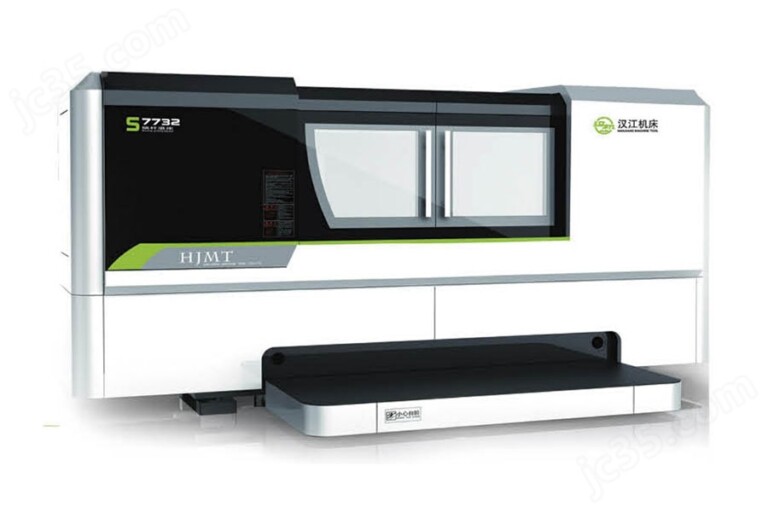
Precision incarnate: A multi-axis grinder sculpting a turbine blade, where microns determine performance. (Image: Representative CNC Grinding)
The Guardians of Microns: Intelligent Control for Unwavering Precision
Maintaining sub-micron tolerances over hours of grinding demands relentless intelligence built into the machine itself:
Diamond-Perfect Wheels:
- Automated In-Process Dressing: Diamond-tipped form rollers continuously true and profile the grinding wheel during operation. Guided by preset geometry data, this ensures the cutting profile remains razor-sharp and dimensionally perfect, countering inevitable abrasive wear.
- Dynamic Balancing: High-speed rotation exaggerates any imbalance. Integrated balancing systems continuously monitor and adjust the wheel’s mass distribution (often using counterweights or fluid injection), neutralizing vibration sources before they can affect surface finish or registration.
- Conquering the Invisible Enemy: Thermal Deformation:
- Embedded Thermal Guardians: A network of precision thermocouples strategically embedded in the machine structure, spindle, and hydraulic systems constantly monitors minute temperature gradients.
- Active Cooling & Compensation: Closed-loop thermal management isn’t just coolant on/off. Advanced systems intelligently direct coolant flow where heat is detected, maintain consistent fluid temperatures, and feed thermal drift data back to the CNC.
- FEA-Powered Predictions: Finite Element Analysis (FEA) software simulations integrate with the control system. They proactively model thermal expansion within the machine structure and workpiece under current grinding conditions, allowing the CNC to anticipate and compensate for distortion before it manifests as a size deviation. This proactive strategy drastically enhances first-pass yield rates.
Digital Wisdom: Turning Experience into Algorithmic Advantage
The modern grinder is a repository of collective intelligence:
- Process Knowledge Databases: Decades of documented experience on grinding diverse alloys (superalloys, carbides, ceramics) are stored – optimal wheel types, grit sizes, speeds, feeds, coolant formulas, and stepovers for specific geometries.
- AI-Driven Optimization: Algorithms analyze massive datasets from ongoing production – sensor readings, achieved tolerances, tool wear rates. They learn patterns and recommend optimized parameters for new jobs based on material, geometry, and required finish, accelerating setup and reducing scrap.
- Democratizing Expertise: This digital codification allows even new technicians to leverage decades of accumulated best practices, converting tacit knowledge into tangible, immediate productivity.
Integrated Power: The Turn-Mill-Grind Paradigm
Advancements push beyond pure grinding:
- Integrated Turning/Grinding Spindles: High-precision, motorized spindles rotate the workpiece. This enables complete "Done-in-One" machining: rough turning, finish turning, and precision grinding – all in one setup. Eliminating part transfer between machines eradicates handling damage and registration errors (like runout), delivering unprecedented concentricity and perpendicularity.
- In-Process Metrology & Adaptive Control: Touch-trigger probes are not merely for setup. Automatic in-cycle gauging verifies critical dimensions during the grinding sequence. Sophisticated control systems can then dynamically adjust feed rates or finishing passes to adapt to minor material variations or emerging thermal effects, ensuring parts consistently meet spec regardless of minor process fluctuations. This is a game-changer for high-mix, high-precision environments like job shops tooling for high-growth fields like EV drivetrains or medtech.
The Indispensable Bridge: From CAD Vision to Real-World Preeminence
From the whirring core of a space-bound turbine to the complex articulation of an industrial robotic arm or the ultra-smooth operation of an electric vehicle’s reduction gearbox, advanced grinding technology underpins functional perfection. It transcends its role as merely a shaping tool; it is the indispensable technological truss connecting digital design dreams with tactile, high-performance reality.
The Future: AI, Autonomy, and the Next Level of Precision
The trajectory is clear. The convergence with artificial intelligence is not looming; it’s underway. We’re moving towards systems capable of:
- Autonomous Toolpath Generation & Optimization: Learning from massive datasets, self-programming minimal-energy or minimal-time paths, dynamically avoiding chatter or thermal overload.
- Predictive Maintenance & Self-Correction: Using sensor fusion to predict wheel life, spindle bearing health, or cooling efficiency degradation and automatically scheduling maintenance or compensating in-process.
- Closed-Loop Digital Twins: High-fidelity real-time virtual replicas mirroring the physical machining process, allowing simulations and adjustments to be perfected instantly in the digital space before committing to the workpiece.
- Sustainable Precision: Optimizing energy use, coolant consumption, and wheel lifespan through data-driven control.
The revolution ignited by ultra-precision grinding technology has shattered once-insurmountable barriers in manufacturing complex surfaces. It continuously propels entire industries – aerospace, automotive, energy, medical – to new heights of performance, reliability, and miniaturization. In the sculptor’s hands, the metal yields; in the grinder’s intelligent embrace, the impossible becomes routine. This is the silent, relentless pulse shaping the future of engineered perfection.



















