
Unveiling the Heart of Precision Motion: A Deep Dive into CNC Lead Screw Grinding Technology
At the core of high-performance machinery—from aerospace actuators to CNC machining centers—lies an unsung hero: the precision lead screw. These helical powerhouses convert rotary motion into millimeter-perfect linear movement, enabling everything from microscopic adjustments in optical instruments to massive aerospace actuators. But how are these mission-critical components manufactured to withstand extreme precision requirements? Enter the technological marvel known as the CNC lead screw grinding machine.
Why Precision Lead Screws Demand Specialized Manufacturing
Lead screws operate under unforgiving conditions—handling heavy loads, maintaining positional accuracy under vibration, and enduring millions of movement cycles. Standard machining simply can’t achieve the geometric accuracy and surface integrity required. Deviations of even a few microns cause backlash, vibration, and premature wear. This is where CNC lead screw grinding machines execute extraordinary feats of micrometric perfection unavailable through conventional methods.
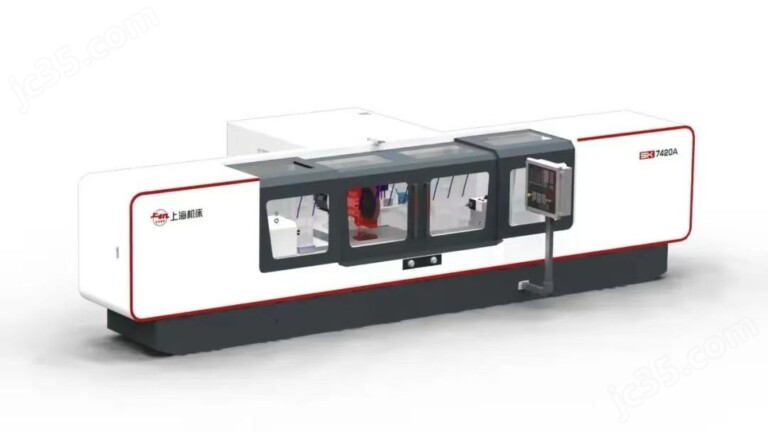
$(img-url)
Fig. 1: State-of-the-art CNC lead screw grinding center executing precision thread grinding (Source: Original Content)
Anatomy of Precision: How CNC Lead Screw Grinding Works
The process represents a symphony of robotics, material science, and digital control:
1. Intelligent Workholding
Advanced hydrostatic chucks or vacuum fixtures secure the lead screw blank with near-zero distortion. Integrated probing systems map part geometry before grinding starts, compensating for material variances or prior machining discrepancies in real time.
2. Adaptive Material Removal
Unlike conventional grinding, CNC screw grinding employs form-controlled diamond or CBN wheels that precisely trace the lead screw’s helix angle. The CNC interpolates coordinated X-Z-C axis movements (linear axes plus rotary) while micro-adjusting grinding depth based on in-process sensors detecting wheel wear or thermal drift.
3. Closed-Loop Metrology Integration
Laser interferometers or high-resolution linear encoders continuously measure screw pitch accuracy during grinding—a stark evolution from post-process inspection. Deviations trigger automatic corrective passes without operator intervention, ensuring pitch errors remain under 5 microns over 300mm lengths. Surface roughness typically achieves Ra 0.1-0.4μm critical for smooth motion.
4. Thermal Stability Protocols
Temperature-controlled hydraulic systems + phase-cooled spindle bearings maintain thermal equilibrium within ±0.1°C. Granite machine bases and ceramic guides eliminate vibrations propagating at frequencies above 500 Hz—crucial for surface finish consistency.
Technical Capabilities Defining Modern Lead Screw Grinders
While earlier grinding machines focused solely on external threads, today’s platforms push engineering boundaries:
| Capability | Traditional Machines | Modern CNC Grinders |
|---|---|---|
| Position Tolerance | ±20 μm | ±1 μm |
| Thread Pitch Control | Manual compensation | Real-time laser feedback |
| Surface Finish (Ra) | 0.8 μm | 0.1 μm |
| Maximum Length | 1 meter | 8 meters+ |
| Multi-Function Operations | Single-operation | Combined threading, OD/ID grinding |
Additional innovations include:
- Thread Profile Optimization: Modified trapezoidal and planetary roller screw profiles ground using proprietary algorithms to reduce friction by up to 40%
- Hard Material Processing: Grinding of hardened steels (60+ HRC) and ceramics with engineered CBN wheel geometries
- Hybrid Machining Centers: Simultaneous grinding + hard turning of support journals in single setup
- Energy Recovery Systems: Regenerative drives reclaim over 70% of braking energy during axis reversals
Industrial Impact: Where Precision Leads the Way
The technological ripple effect of these machines is reshaping demanding sectors:
- Aerospace: Grinding friction-reducing ball screw assemblies for flight control actuators requiring 1-million-cycle lifespans under G-forces
- Semiconductor Manufacturing: Creating vacuum-compatible lead screws with particle emissions below Class 1 cleanroom standards
- Medical Robotics: Miniaturized lead screws (diameters from 3mm) powering surgical robot end effectors with haptic feedback sensitivity
- Renewable Energy: Oversized lead screws (8m+) for solar tracker positioning systems with angular precision ≤0.05° over 25 years of operation
- Electric Vehicles: High-efficiency roller screws in battery module assembly systems achieving 60 JPH throughput targets
The Next Frontier: AI and Quantum Metrology
Leading builders are integrating deep-learning vision systems that classify grinding sparks to detect subsurface defects. Meanwhile, quantum-sensing grinders using atomic-scale interferometry promise picometer-level pitch control. Wireless strain sensors embedded in grinding wheels will soon enable real-time pressure distribution mapping across the contact zone.
The convergence of extreme-precision manufacturing and digital twins means lead screws will cease to be passive components. Future iterations will feature integrated nano-sensors providing continuous diagnostics—transforming them into intelligent "motion engines" that report wear patterns, efficiency metrics, and maintenance needs autonomously.
Engineering Excellence in Every Revolution
As industries demand more power-dense, maintenance-free, and precision-centric motion solutions, the art of lead screw grinding represents mechanical artistry meeting computational brilliance. These remarkable CNC platforms don’t merely grind threads—they manifest the physical realization of mathematical perfection, creating the motion control foundations upon which modern engineering marvels are built. While innovations will continue revolutionizing the technology, one truth remains constant: Precision-ground lead screws remain metaphorically and mechanically the vital threads holding advanced manufacturing together.



















