
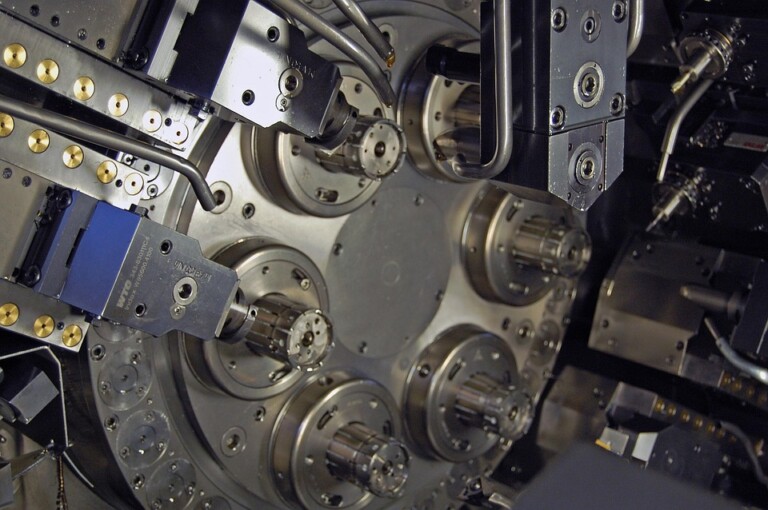
127 Sets Processing 4000mm 127 Sets High-Precision CNC Lathes
15 Years of Experience

CNC Knowledge: Understanding electricity and components of CNC machine tools

The Evolution of CNC Control Systems: A Deep Dive into Electrical Components and Circuit Design CNC machine tools have undergone a radical transformation since their inception. Originally built from inflexible hardware logic circuits, early systems were costly, unreliable, and functionally limited. Today, computer-driven CNC systems leverage sophisticated electrical components to deliver precision, adaptability, and robust […]

WeChat picture_20250418103117.jpg

The Evolution of CNC Control Systems: A Deep Dive into Electrical Components and Circuit Design

CNC machine tools have undergone a radical transformation since their inception. Originally built from inflexible hardware logic circuits, early systems were costly, unreliable, and functionally limited. Today, computer-driven CNC systems leverage sophisticated electrical components to deliver precision, adaptability, and robust performance. This post dissects the critical electrical control devices powering modern CNC machinery – from foundational circuits to advanced protection mechanisms.


The Control System Revolution: From Hardware to Digital Brains

The first CNC systems relied on rigid hard-wired logic circuits. These specialized devices were expensive to produce and nearly impossible to modify post-installation. Any functional change required physical rewiring – a major limitation for complex manufacturing. The advent of microprocessor-based controllers in the 1980s changed everything. By replacing fixed circuits with programmable software, CNC systems gained:

  • Dynamic adaptability to new tasks
  • Self-diagnostic capabilities
  • Integration with CAD/CAM software
  • Real-time process optimization
    This shift turned CNC machines into versatile, future-proof assets rather than single-purpose tools.

Electrical Control Devices: The Nervous System of CNC Machines

Electrical control devices form the backbone of automation. These components activate circuits, manage power flow, protect systems, and translate signals between electrical and mechanical domains. They’re classified into three core categories:

  1. Manual Control Devices

    • Selector switches, push buttons, and manual circuit breakers
    • Enable operator-initiated actions (e.g., emergency stops)
  2. Automatic Control Devices

    • Relays, contactors, and sensors
    • Execute pre-programmed responses without human intervention
  3. Primary Power Devices
    • Transformers, main breakers, and power supplies
    • Manage voltage conversion and primary circuit protection

[Image 1: Circuit diagram showing interconnected electrical devices in a CNC control panel]


Critical Components Decoded

🔧 1. Automatic Air Switch (Circuit Breaker)

Function: Safely interrupts power during overloads, short circuits, or voltage drops.
Types by Structure:

  • Frame-Type (Universal): High-breaking capacity for industrial use
  • Plastic-Case (MCCB): Compact, cost-effective protection
    Key Internals:
  • Overcurrent, undervoltage, and thermal trip units
  • Arc chutes to suppress electrical discharges
    Application: Main power entry point protection.

[Image 2: Internal structure of an automatic air switch]

2. AC Contactor

Function: Electromagnetically operated switch for high-power load control (e.g., spindle motors).
Construction:

  • Electromagnet: Generates force to close contacts
  • Main Contacts: Handle high current (up to thousands of amps)
  • Auxiliary Contacts: Manage control signal logic
    Critical Protections:
  • Zero-voltage release: Auto-disconnects during power loss
  • Interlocks: Prevent unsafe simultaneous operations

[Image 3: AC contactor with labeled components]

🛡️ 3. Thermal Overload Relays

Working Principle: A bimetallic strip heats and bends under excessive current, tripping a mechanical linkage to cut power.
Selection Rule:
$$text{Relay Current} = 1.05 times text{Motor Full-Load Current}$$
Why Essential: Protects motors from burnout due to jammed tools or voltage spikes.

[Image 4: Thermal relay integrated into a motor control circuit]

🔌 4. Switching Power Supplies

Function: Converts 220V AC input to stabilized DC outputs (e.g., 5V, 24V) for control circuits.
Advantage: >85% efficiency vs. 60% in linear supplies
Critical Role: Enables noise-resistant voltage stability for sensitive electronics like PLCs.

[Image 5: Switching power supply unit schematic]

⚙️ 5. Relay Modules

Purpose: Multiply control signals using minimal PLC outputs.
Composition:

  • Arrays of intermediate relays
  • Input/Output isolation circuitry
  • LED status indicators
    Example: One PLC output can trigger ten relays for machine axis locks, coolant pumps, and tool changers.

[Image 6: Relay module with connected outputs]


Protection Ecosystem: Safeguarding Precision Machinery

Reactors

  • Role: Smooth voltage spikes/noise from grid fluctuations or rectifier switching
  • Benefit: Prevents false triggers in high-frequency control circuits

Surge Protectors

  • Installation: Parallel-connected near sensitive devices
  • Response Time: Diverts overvoltage in nanoseconds

Molded Case Circuit Breakers (MCCB)

  • Advantages: Combines overload, short-circuit, and isolation in one housing
  • Key Spec: Breaking capacity (e.g., 25kA for heavy industrial use)

Leakage Protection Air Switches

  • Critical for: Coolant pumps and chips conveyors in wet CNC environments

Control Circuits: Where Logic Meets Motion

Modern CNC electrical design relies on standardized control units:

  • Motor Start/Stop Circuits: Star-delta starters for low-torque startups
  • Speed Control Blocks: Inverter-driven PWM signals for spindle control
  • Interlock Systems: e.g., Door-open shutdown for rotary axes
  • Redundancies: Dual relays for critical tool-change sequences

[Image 7: Motor control circuit for spindle and axes]


The Future: Smart Components & IIoT Integration

Emerging trends are reshaping CNC control architecture:

  • Wireless Current Sensors: Real-time thermal monitoring via IoT gateways
  • Self-Diagnosing Contactors: Contacts that report wear % to maintenance systems
  • Energy Harvesting Relays: Convert switch arcing into auxiliary power
  • Solid-State Replacements: Silicon-based “contactors” for maintenance-free operation

Conclusion: The Precision Comes Full Circle

From brittle wire-and-relay logic to today’s software-defined systems, CNC control evolution mirrors industrial automation’s broader journey. Tomorrow’s advancements will further blur mechanical/electronic boundaries – with smarter components, prognostic protection, and distributed intelligence. The key to leveraging this future lies in understanding the fundamental electrical systems detailed here.

"In the symphony of a CNC machine, the control panel is its conductor. Every contactor click and sensor ping writes the music of precision."


CNC Experts

Picture of JinShui Chen

JinShui Chen

Rapid Prototyping & Rapid Manufacturing Expert

Specialize in CNC machining, 3D printing, urethane casting, rapid tooling, injection molding, metal casting, sheet metal and extrusion

CNC Recent Posts

CNC News

Welcome to GreatLight Metal,Maximum Processing Size 4,000 mm

Precision Machining CNC Quote Online

Loading file

Upload Click here to upload or drag and drop your model to the canvas.

The model is too large and has been resized to fit in the printer's build tray. [Hide]

The model is too large to fit in the printer's build tray. [Hide]

The model is too large, a fitting printer is selected. [Hide]

The model is too small and has been upscaled. [Hide]

Warning: The selected printer can not print in full color [Hide]

Warning: obj models with multiple meshes are not yet supported [Hide]

Warning: Unsupported DXF entity  [Hide]

Warning: could not arrange models [Hide]


File Unit:      
Scale:
%
L × W × H:
X: × Y: × Z:  cm 
Rotation:
X: ° Y: °  
⚡ Instant Quote for Precision Manufacturing

Submit your design files (STEP/IGES/DWG) and receive a competitive quote within 1 hour, backed by ISO 9001-certified quality assurance.

📋 How It Works

  1. Upload & SpecifyShare your 3D model and select materials (Aluminum/Stainless Steel/Titanium/PEEK), tolerances (±0.002mm), and surface treatments.

  2. AI-Powered AnalysisOur system calculates optimal machining strategy and cost based on 10+ years of automotive/aerospace data.

  3. Review & ConfirmGet a detailed breakdown including:
    - Volume pricing tiers (1-10,000+ units)
    - Lead time (3-7 days standard)
    - DFM feedback for cost optimization

Unit Price: 

Loading price
5 Axis CNC Machining Equipment
4 Axis CNC Machining Equipment
3 Axis CNC Machining Equipment
CNC Milling & Turning Equipment
Prototype and Short-Run Injection Moldings Exact plastic material as final design
Volume Metal Die Casting Services - Precision Cast Parts
Bridge the Gap From Prototype to Production – Global delivery in 10 days or less
Custom high-precision sheet metal prototypes and parts, as fast as 5 days.
Custom Online 3D Printing Services
Design Best Processing Method According To 3D Drawings
Alloys Aluminum 6061, 6061-T6 Aluminum 2024 Aluminum 5052 Aluminum 5083 Aluminum 6063 Aluminum 6082 Aluminum 7075, 7075-T6 Aluminum ADC12 (A380)
Alloys Brass C27400 Brass C28000 Brass C36000
Alloys Stainless Steel SUS201 Stainless Steel SUS303 Stainless Steel SUS 304 Stainless Steel SUS316 Stainless Steel SUS316L Stainless Steel SUS420 Stainless Steel SUS430 Stainless Steel SUS431 Stainless Steel SUS440C Stainless Steel SUS630/17-4PH Stainless Steel AISI 304
Inconel718
Carbon Fiber
Tool Steel
Mold Steel
Alloys Titanium Alloy TA1 Titanium Alloy TA2 Titanium Alloy TC4/Ti-6Al 4V
Alloys Steel 1018, 1020, 1025, 1045, 1215, 4130, 4140, 4340, 5140, A36 Die steel Alloy steel Chisel tool steel Spring steel High speed steel Cold rolled steel Bearing steel SPCC
Alloys Copper C101(T2) Copper C103(T1) Copper C103(TU2) Copper C110(TU0) Beryllium Copper
Alloys Magnesium Alloy AZ31B Magnesium Alloy AZ91D
Low Carbon Steel
Alloys Magnesium Alloy AZ31B Magnesium Alloy AZ91D
ABS Beige(Natural) ABS Black ABS Black Antistatic ABS Milky White ABS+PC Black ABS+PC White
PC Black PC Transparent PC White PC Yellowish White PC+GF30 Black
PMMA Black PMMA Transparent PMMA White
PA(Nylon) Blue PA6 (Nylon)+GF15 Black PA6 (Nylon)+GF30 Black PA66 (Nylon) Beige(Natural) PA66 (Nylon) Black
PE Black PE White
PEEK Beige(Natural) PEEK Black
PP Black PP White PP+GF30 Black
HDPE Black HDPE White
HIPS Board White
LDPE White
This is a finish of applying powdered paint to the components and then baking it in an oven, which results in a stronger, more wear- and corrosion-resistant layer that is more durable than traditional painting methods.
No coating required, product’s natural color!
This is a finish of applying powdered paint to the components and then baking it in an oven, which results in a stronger, more wear- and corrosion-resistant layer that is more durable than traditional painting methods.
This finishing option with the shortest turnaround time. Parts have visible tool marks and potentially sharp edges and burrs, which can be removed upon request.
Sand blasting uses pressurized sand or other media to clean and texture the surface, creating a uniform, matte finish.
Polishing is the process of creating a smooth and shiny surface by rubbing it or by applying a chemical treatmen
A brushed finish creates a unidirectional satin texture, reducing the visibility of marks and scratches on the surface.
Anodizing increases corrosion resistance and wear properties, while allowing for color dyeing, ideal for aluminum parts.
Black oxide is a conversion coating that is used on steels to improve corrosion resistance and minimize light reflection.
Electroplating bonds a thin metal layer onto parts, improving wear resistance, corrosion resistance, and surface conductivity.
This is a finish of applying powdered paint to the components and then baking it in an oven, which results in a stronger, more wear- and corrosion-resistant layer that is more durable than traditional painting methods.
Please provide additional text description for other surface treatment requirements!
Material
Material
  • CNC Metals
    • Aluminum
    • Brass
    • Stainless steel
    • Inconel718
    • Carbon Fiber
    • Tool Steel
    • Mold Steel
    • Titanium
    • Alloy Steel
    • Copper
    • Bronze
    • Low Carbon Steel
    • Magnesium
  • CNC Plastics
    • ABS
    • PC
    • PMMA (Acrylic)
    • PA (Nylon)
    • PE
    • PEEK
    • PP
    • HDPE
    • HIPS
    • LDPE
Printer
Printer
  • CNC Metals
    • 5 Axis CNC Machining
    • 4 Axis CNC Machining
    • 3 Axis CNC Machining
    • CNC Milling & Turning
    • Rapid Tooling
    • Metal Die Casting
    • Vacuum Casting
    • Sheet Metal Fabrication
    • SLA 3D Printing
    • SLS 3D Printing
    • SLM 3D Printing
  • Rapid Prototyping
    • Design Best Processing Method According To 3D Drawings
Post-processing
Post-processing
  • As Machined(Product’s natural color)
  • Sand Blasting
  • Polishing
  • Brushed Finish
  • Anodizing
  • Black Oxide
  • Electroplating
  • Paint Coating
  • Powder Coating
  • Other surface treatment requirements
Finalize
The world's first CNC machining center that dares to provide free samples!

Free for first product valued at less than $200. (Background check required)

precision machining cnc quote online

15 Years CNC Machining Services

When you’re ready to start your next project, simply upload your 3D CAD design files, and our engineers will get back to you with a quote as soon as possible.
Scroll to Top

ISO 9001 Certificate

ISO 9001 is defined as the internationally recognized standard for Quality Management Systems (QMS). It is by far the most mature quality framework in the world. More than 1 million certificates were issued to organizations in 178 countries. ISO 9001 sets standards not only for the quality management system, but also for the overall management system. It helps organizations achieve success by improving customer satisfaction, employee motivation, and continuous improvement. * The ISO certificate is issued in the name of FS.com LIMITED and applied to all the products sold on FS website.

greatlight metal iso 9001 certification successfully renewed
GB T 19001-2016 IS09001-2015
✅ iso 9001:2015
greatlight metal iso 9001 certification successfully renewed zh

IATF 16949 certificate

IATF 16949 is an internationally recognized Quality Management System (QMS) standard specifically for the automotive industry and engine hardware parts production quality management system certification. It is based on ISO 9001 and adds specific requirements related to the production and service of automotive and engine hardware parts. Its goal is to improve quality, streamline processes, and reduce variation and waste in the automotive and engine hardware parts supply chain.

automotive industry quality management system certification 01
Certification of Production Quality Management System for Engine Hardware Parts Engine Hardware Associated Parts
automotive industry quality management system certification 00
发动机五金零配件的生产质量管理体系认证

ISO 27001 certificate

ISO/IEC 27001 is an international standard for managing and processing information security. This standard is jointly developed by the International Organization for Standardization (ISO) and the International Electrotechnical Commission (IEC). It sets out requirements for establishing, implementing, maintaining, and continually improving an information security management system (ISMS). Ensuring the confidentiality, integrity, and availability of organizational information assets, obtaining an ISO 27001 certificate means that the enterprise has passed the audit conducted by a certification body, proving that its information security management system has met the requirements of the international standard.

greatlight metal technology co., ltd has obtained multiple certifications (1)
greatlight metal technology co., ltd has obtained multiple certifications (2)

ISO 13485 certificate

ISO 13485 is an internationally recognized standard for Quality Management Systems (QMS) specifically tailored for the medical device industry. It outlines the requirements for organizations involved in the design, development, production, installation, and servicing of medical devices, ensuring they consistently meet regulatory requirements and customer needs. Essentially, it's a framework for medical device companies to build and maintain robust QMS processes, ultimately enhancing patient safety and device quality.

greatlight metal technology co., ltd has obtained multiple certifications (3)
greatlight metal technology co., ltd has obtained multiple certifications (4)

Get The Best Price

Send drawings and detailed requirements via Email:[email protected]
Or Fill Out The Contact Form Below:

All uploads are secure and confidential.











