
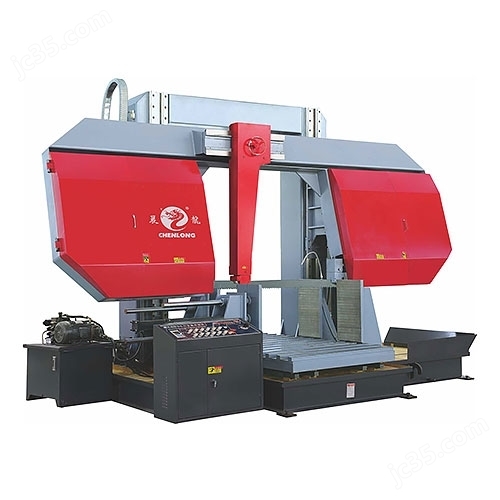
Revolutionizing Heavy Metal Fabrication: The Engineered Excellence of Carriage-Type Gantry Band Saws
In the demanding landscape of heavy industrial manufacturing—where precision and durability are non-negotiable—the carriage-type gantry band saw stands as a cornerstone technology. Designed to master the cutting of massive structural components, specialized profiles, and ultra-hard alloys, this machine redefines efficiency through breakthroughs in structural engineering, intelligent control, and adaptive performance. Let’s dissect its transformative impact across critical industries.
I. Structural Innovation: Where Engineering Meets Precision
1. Portico Frame with Dual-Rail Pulley System
Unlike conventional band saws, this system integrates a reinforced high-resistance portico frame with a dynamic rail-and-pulley mechanism. The gantry spans 8–20 meters, enabling precise X/Y-axis movement of the saw head. This design is particularly revolutionary for wind energy applications: a single machine can fully process a 15-meter-long wind turbine spindle with a diameter of 2.5 meters—tripling the capacity of older models. Dual hardened-steel rails ensure nanometer-level alignment stability, even under 300-ton loads.
2. Modular Saw Belt System + Auto-Correction Tech
The quick-tensioning mechanism and automatic tracking system allow operators to swap blades (34–150 mm width) in under 3 minutes. For cutting 45# steel (HB200 hardness), a 100 mm M42 bimetal blade achieves:
- Cutting speed: 80 mm/min
- Cut perpendicularity: ≤0.1 mm/m deviation
The self-correcting guide bearings eliminate blade drift, reducing material waste by 19%.
3. Closed-Loop Servo Hydraulic Control
Real-time adjustments are powered by PLC-integrated pressure sensors and displacement encoders. Operators dynamically calibrate cutting force (0–500 kN) and feed rates mid-operation. When processing titanium alloys, this extends blade lifespan by 40% while maintaining ±0.05 mm dimensional consistency.
II. Performance Benchmarks: Power, Intelligence, Sustainability
1. Unmatched Load Capacity & Stability
With a 50–300 ton load capacity, the V-shaped adjustable clamping rails secure irregular profiles (round tubes, I-beams, hollow sections). During a stress test on Q345B steel (600×400 mm cross-section):
- Vibration acceleration: ≤0.5 m/s²
- Surface roughness: Ra 6.3 μm—near-grinding quality.
2. Industry 4.0 Operation Interface
The 15-inch touchscreen HMI hosts a database storing 200+ pre-optimized cutting programs. Users import CAD files directly, enabling automated toolpath generation. Integrated IoT connectivity allows remote diagnostics—technicians resolve 92% of faults within 2 hours via live data streaming.
3. Eco-Efficiency Engineering
- Energy: Frequency converters and regenerative power systems slash idle energy use by 35%.
- Coolant: A multi-stage filtration unit (magnetic separator + paper belt filter) extends cutting fluid life to 3+ months without replacement, eliminating 5.6 tons/year of hazardous waste.
III. Real-World Applications: Powering Critical Industries
Wind Energy
Processes mega-components like turbine shafts and gearbox housings. Cuts tapered tower sections at 55 mm/min with zero geometrical distortion.Rail & Transportation
Machines high-speed rail bogies and metro axles from solid billets. Achieves ±0.2 mm accuracy on 1,200 mm-diameter forgings.Mining & Construction Machinery
Handles excavator booms and mining truck frames in high-yield environments. One system replaces three traditional saws in blanking 400+ ton crawler crane beams daily.- Structural Steel
Custom-cuts bridge girders and seismic-resistant columns. Automated beveling (0–45°) prepares parts for direct welding.
IV. Market Shift: The Data-Backed Dominance
Per the China Machine Tools Industry Association (2023):
- 68% adoption rate in heavy machinery sectors.
- 82% penetration in wind equipment manufacturing.
Emerging AI-optimized models now feature laser-guided positioning and adaptive cutting algorithms. These systems auto-adjust parameters for materials up to 65 HRC, driving toward a "zero-defect" future.
Conclusion: The Future of Heavy-Precision Cutting
The carriage-type gantry band saw transcends traditional limitations through its fusion of rigidity, responsiveness, and sustainability. As industrial demands escalate toward larger, harder, and more complex components, this technology’s capacity for zero-waste processing, energy thrift, and plug-and-play automation positions it as the vanguard of next-gen fabrication—turning structural challenges into engineered masterpieces.
Image: A carriage-type gantry band saw processing a wind turbine component.



















