
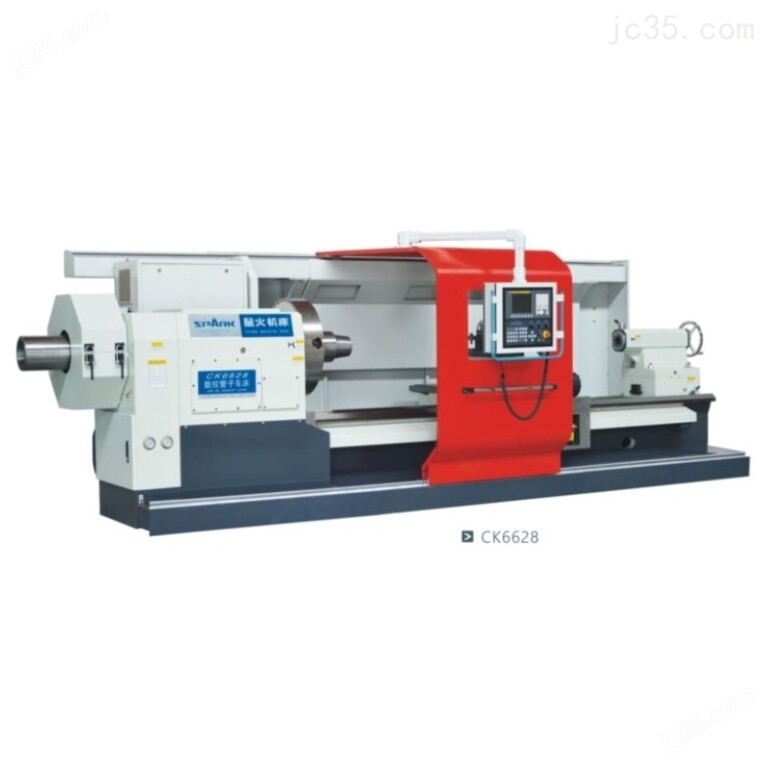
Micron-Perfect Machining: The Engineering Marvel of Large Bore CNC Pipe Turning
How Advanced CNC Systems Achieve Unprecedented Precision in Critical Industrial Components
In the demanding world of industrial manufacturing, large-bore piping systems serve as the vascular network for power generation, petrochemical processing, and offshore engineering applications. The intricate machining of these colossal components—often exceeding several meters in length and requiring micron-level precision—demands a new generation of specialized CNC equipment that transcends traditional machining capabilities.
Micron-Level Precision Engineering
The defining characteristic of modern large bore CNC turning centers lies in their ability to maintain geometrical accuracy within single-digit micron tolerances across massive workpieces. This extraordinary precision is achieved through thermally-stabilized ballscrews, hydrostatic guideways, and laser-calibrated positioning systems that compensate for thermal expansion and mechanical deflection in real-time.
Adaptive Machining Intelligence
Beyond mechanical precision, these systems incorporate sensor fusion technology where dynamometers, thermocouples, and vibration sensors feed real-time data to the CNC for adaptive machining. Cutting parameters automatically adjust to material inconsistencies, preserving dimensional accuracy and surface integrity throughout uninterrupted 24/7 production cycles.
Universal Processing Capability
From super duplex steels demanding extreme toolpath strategies to composite-lined pipes requiring specialized tooling, next-generation CNC pipe turners feature modular tooling systems and programmable harmonic dampening. The machines dynamically reconfigure damping characteristics based on workpiece harmonics, eliminating chatter marks in thin-walled sections.
The Triad of Verification: Ensuring Absolute Machining Integrity
Before any metal is cut, engineers deploy laser interferometry systems to map volumetric accuracy across the entire work envelope. Multi-axis autocollimators measure angular deviations in real-time, while electronic levels with 0.001mm/m resolution create thermal drift compensation curves. Spindle integrity undergoes nanometer-level verification using capacitance probes that detect radial motion errors down to 0.05 microns.
Positioning accuracy isn’t measured in points but in volumetric grids. Renishaw XL-80 laser systems create spatial compensation maps at over 1,000 positions per axis. Backlash is quantified via differential measurements during precise reversal motions, with error compensation integrated directly into the CNC’s kinematic model. Crucially, measurements occur at operational temperatures to account for thermal growth.
Machinists create certification test pieces resembling actual components but incorporating calibrated geometric challenges. Advanced surface metrology goes beyond Ra values to analyze bearing area curves and fractal dimension of surface topography. Portable coordinate measuring machines map cylindricity using high-density point clouds analyzed through custom algorithms that isolate machine-induced errors from environmental factors.
The relentless pursuit of accuracy in large bore machining has transformed CNC pipe turning centers into technological masterpieces. With multi-spectral error mapping, self-calibrating kinematics, and machine-learning enhanced path optimization, these systems deliver what was once deemed impossible: micron-accurate geometries on massive workpieces under production conditions. This combination of scale and precision represents a quantum leap in manufacturing capability directly impacting safety margins and operational lifetimes in critical industrial infrastructure.



















