
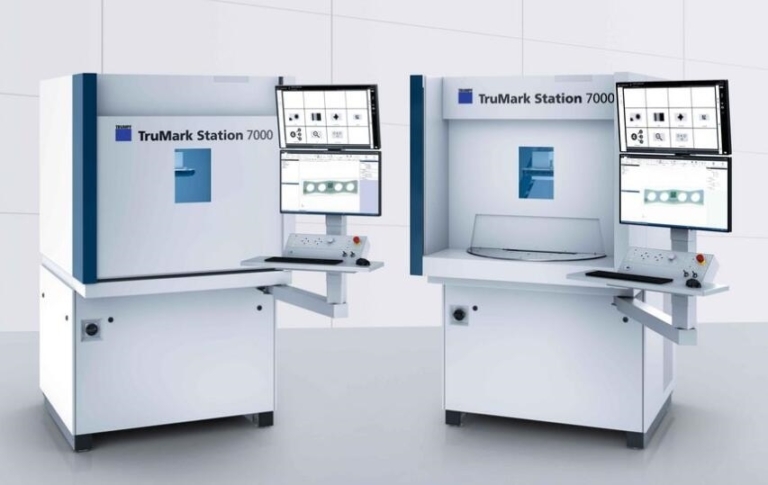
As a high -precision and efficient marking device, the laser marking machine is widely used in industrial manufacturing, electronics, medical devices, food packaging and other areas. Its central advantage is that it can reach high -precision and high efficiency marking, while resulting in a minimum of damage to the surface of the material. The performance and efficiency of laser marking machines depend not only on their material design, but are also closely linked to optical principles and energy control.
1. Optical principle
1. Generation and transmission of laser light
The nucleus of the laser marking machine is a laser generator, which generates a high -energy laser beam and with high steering through specific excitation methods (such as gas discharge, laser in solid state or fiber laser). The laser beam is transmitted and focused through a series of optical elements such as reflectors, focusing mirrors and beam expansion, and ultimately forms a stain of high energy density on the surface of the material.
(1) gas laser: for example, Co?
(2) Laser in a solid state: for example, the YAG laser has a wavelength of 1064 Nm, suitable for metal and certain non -metallic materials.
(3) Fiber laser: The wavelength is 1064 Nm, with high energy efficiency and stability, and is currently laser laser marking technology.
2. The role of the optical system
The optical system mainly includes expansion by beam expansion, reflectors and focus mirrors. The function of these elements is to expand, collimmated and concentrate the laser beam, ensuring that laser energy can be transferred effectively to the surface of the material.
(1) Beam extension mirror: by widening the diameter of the laser beam, the angle of divergence of the beam is reduced and the quality of the beam is improved.
(2) Reflector: used to modify the laser beam propagation direction to ensure that the laser can precisely reach the focus mirror.
(3) Focus Mirror: Focus The laser beam on the surface of the material to form a point of density with high energy to obtain precise marking.
3. Formation and control of light spots
A laser beam focuses on the surface of the material through a focus mirror, forming a high energy density point. The size and shape of the spot directly affect the marking effect and precision. By adjusting the focal length of the focusing mirror and the divergence angle of the laser beam, the size and shape of the light point can be controlled, thus meeting different marking needs.
(1) Small spot: Suitable for high precision marking, such as micro-marques of electronic components.
(2) Large place: suitable for large -scale marks, such as rough treatment of metal leaves.
2. Energy control technology
1. Laser power adjustment
The energy control of the laser marking machine is mainly obtained by adjusting the output power of the laser generator. The extent of the power directly affects the depth and speed of marking. In general, high -power laser beams can obtain faster marking, but can also cause overheating of the surfaces of materials and affect the quality of the marking.
(1) Low power: Suitable for fine marking, such as marking medical devices.
(2) High power: Suitable for high -area or deep marking, such as the treatment of metal leaves.
2. Control of the pulse width and frequency
Laser marking machines generally use pulsed lasers for marking. Adjusting the width and the pulse frequency can accurately control the transmission of laser energy, thus carrying out different marking effects.
(1) Pulse width: the shorter the pulse width, the more concentrated the energy transfer, which is suitable for high precision marking.
(2) Pulse frequency: the higher the pulse frequency, the faster the marking speed, but it can cause overheating the surface of the material.
3. Adjusting the scanning speed
The scanning speed refers to the speed at which the laser beam moves on the surface of the material. The scanning speed directly affects the depth and precision of the marking. In general, the faster the scanning speed, the more deep the marking depth, but the faster the marking speed, the larger the scanning speed, the deeper the marking depth, but the more The marking speed is slower.
(1) High scanning speed: suitable for large -scale marks, such as the surface treatment of metal leaves.
(2) Low scanning speed: suitable for high precision brands, such as micro-marchs of electronic components.
4. Energy return and closed loop control
Modern laser marking machines are generally equipped with energy feedback systems and closed loop control technology. By monitoring the outlet of laser energy in real time, the power of the laser generator is automatically adjusted to ensure the stability and consistency of the marking process. This technology can effectively reduce energy fluctuations caused by environmental changes or equipment aging, and improve the quality and repeatability of the marking.
3. Optimization of energy control in practical applications
1. Material characteristics and energy correspondence
Different materials have different characteristics of absorption and reflection of laser light, it is therefore necessary to select the laser type and the appropriate energy parameters according to the characteristics of the material. For example, metal materials have a high lasers’ absorption rate and are suitable for marking with high power lasers;
2. Evaluation and adjustment of the marking effect
In practical applications, it is necessary to assess the marking effect by experiments and to adjust parameters such as laser power, pulse width, frequency and scanning speed. By observing the depth, clarity and uniformity of the brand, the energy control parameters are optimized to obtain the best marking effect.
3. Consideration of environmental factors
The performance of laser marking machines can be affected by room temperature, humidity and dust. Therefore, it is necessary to keep the equipment clean and a good working environment during use to ensure the stability and reliability of the energy control system.
The optical principle and energy control of laser marking machines are the key to achieving high precision and high -efficiency marking. By optimizing the energy design and control parameters of the optical system, the quality and efficiency of the marking can be considerably improved. In practical applications, energy control parameters must be flexibly adjusted according to the characteristics of materials, marking requirements and environmental conditions to achieve the best marking effect.
Daguang focuses on providing solutions such as precision CNC machining services (3-axis, 4-axis, 5-axis machining), CNC milling, 3D printing and rapid prototyping services.



















