
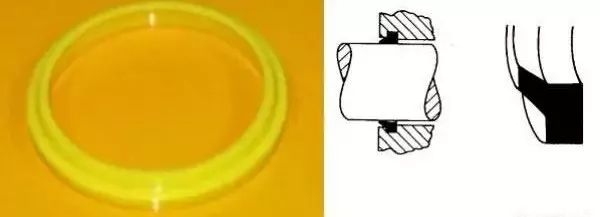
Common seal rings used in hydraulic cylinders include the following types: dust seals, piston rod seals, buffer seals, guide support rings, end cover seals and piston seals.
Dust ring
The dust ring is installed outside the end cover of the hydraulic cylinder to prevent external contaminants from entering the cylinder. According to the installation method, it can be divided into snap-in type and pressure type.
The basic shape of the snap-on dust ring
The snap-on dust ring is the most common. As the name suggests, the dust ring is stuck in the groove of the inner wall of the end cover and is used in less harsh environmental conditions. The material of the snap-on dust ring is usually polyurethane, and there are many variations in structural shapes, such as H-shaped and K-shaped cross sections with double lip structures, but they remain the same .
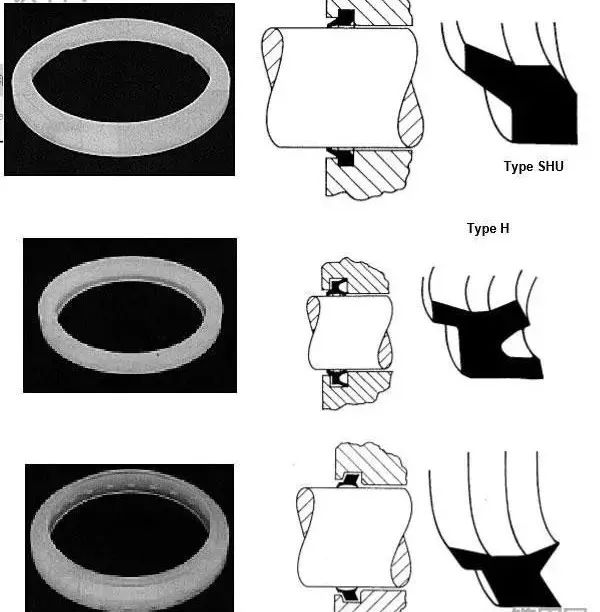
Some variations of snap-on dust wipers
Pressure dust scrapers are used in harsh and heavy conditions. They do not get stuck in the groove, the polyurethane material is wrapped with a layer of metal to increase strength and is pressed into the end cover of the hydraulic cylinder. Snap-on dust rings also come in many shapes, including single-lip and double-lip.
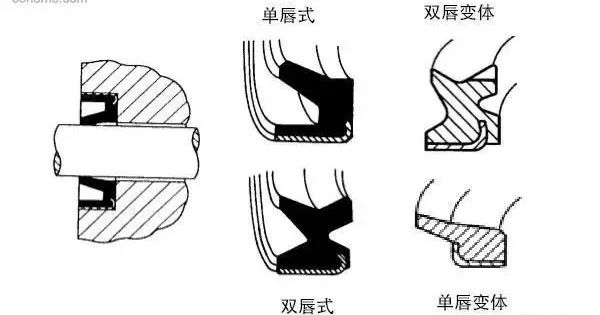
Pressure-operated dust scrapers and some variations
Piston rod seal
The piston rod seal, also called U cup, is the main piston rod seal and is installed inside the end cover of the hydraulic cylinder to prevent hydraulic oil leakage. The piston rod seal ring is made of polyurethane or nitrile rubber. In some cases it must be used with a backing ring (also called a retaining ring). The support ring is used to prevent extrusion and deformation of the seal ring. under pressure. Piston rod seals also come in many variations.
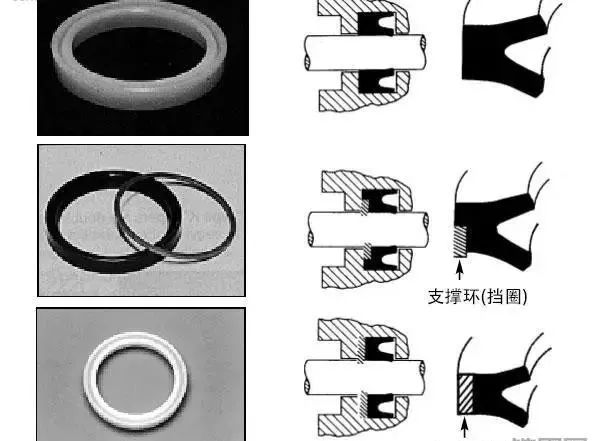
Common shapes of piston rod seals
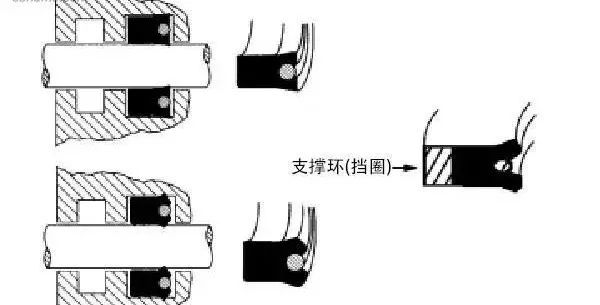
Some variations of piston rod seals
Buffer seal
Buffer seals serve as auxiliary piston rod seals to protect the piston rod when system pressure suddenly increases. There are three common types of buffer seals. Type A is a one-piece polyurethane seal. Types B and C are two-piece and are used to prevent extrusion of the seal and allow the seal to withstand higher pressures.
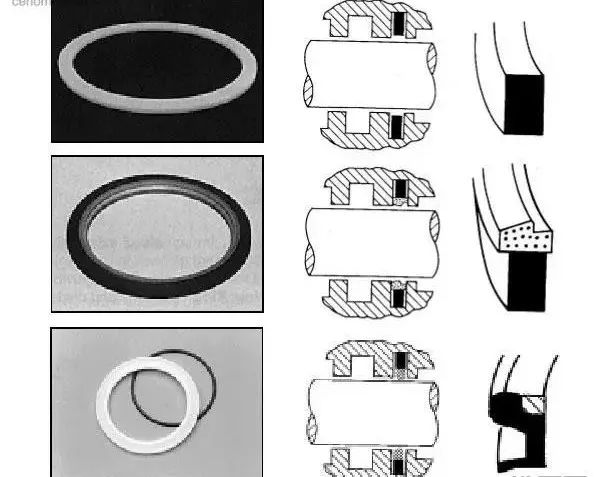
Several common forms of buffer seals
guide support ring
The guide support ring is installed on the end cover and piston of the hydraulic cylinder to support the piston rod and piston, guide the piston to move linearly, and prevent metal-to-metal contact. Materials include plastic, Teflon coated bronze, etc.
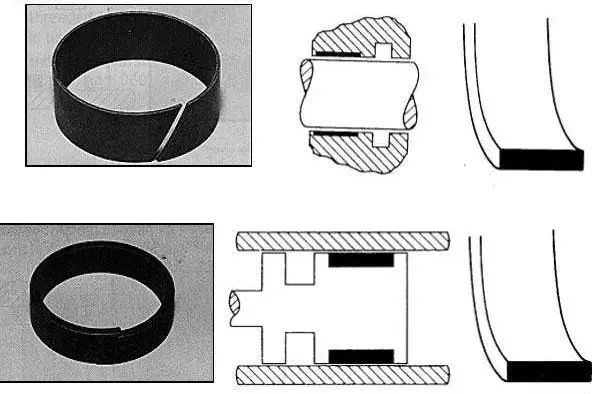
Guide support rings for hydraulic cylinder end covers and pistons respectively
End cover gasket
The end cover sealing ring is used to seal the cylinder end cover and the cylinder wall. This is a gasket used to prevent hydraulic oil from escaping from the space between the end cover and the cylinder wall. Typically composed of a nitrile rubber O-ring and a backing ring (backup ring).
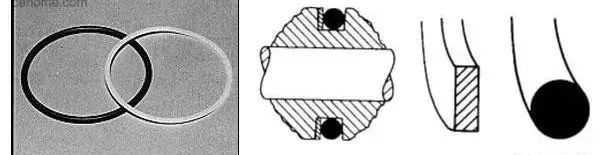
Piston seal
The piston seal ring is used to isolate the two chambers of the hydraulic cylinder and is the main seal of the hydraulic cylinder. Typically two pieces, the outer ring is Teflon or nylon and the inner ring is nitrile rubber. There are also variations, including Teflon coated bronze. On single-acting cylinders, polyurethane U-cups are also used.
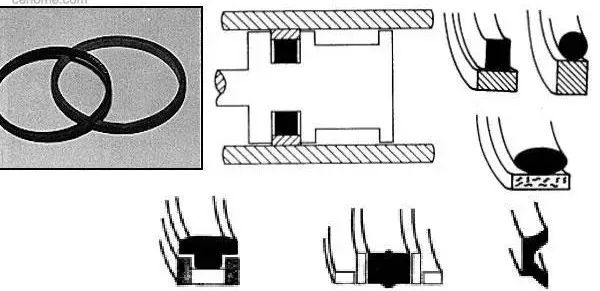
Several common shapes of piston seals
Daguang focuses on providing solutions such as precision CNC machining services (3-axis, 4-axis, 5-axis machining), CNC milling, 3D printing and rapid prototyping services.



















