

ABS, short for acrylonitrile-butadiene-styrene, is one of the first materials used for fused deposition modeling (FDM) 3D printing. It’s one of the most common plastics today, used in processes such as injection molding to make everything from airplane seats to Lego bricks.
When polylactic acid (When PLA came onto the scene, it replaced this long-time champion as a general purpose filament. Now, PETG (polyethylene terephthalate glycol) has the potential to achieve the same feat in high-strength applications.
PETG is also known as “copolyester” and its different blends provide the perfect balance between the strength of ABS and the ease of use of PLA.
SO,What are the advantages of ABS compared to this new material? Let’s find out.
A,Easy to usecontrast

ABS is difficult to glue, but PETG tends to adhere too well (Source: ljungqvistaxel, via Reddit)
ABS is known to be difficult to print. This is why PLA can outperform it and why PETG is a great competitor. Here’s how they compare.
1、Deformation, sticking and cracking
One of the biggest problems with ABS is that it doesn’t like to stick, either to itself or to the surface it’s printed on. A heated bed (temperature up to 110°C) is essential. The same goes for a heated build chamber, which can make or break a print. Improperly heated prints may exhibit significant warping, build plate delamination, or even cracks between layers.
PETG is much more forgiving in these areas. Deformation can still occur, but it is significantly reduced compared to ABS. In terms of bed temperature, a range of 50°C to 80°C is sufficient for printing PETG.
In fact, the bed’s grip is often so strong that it sometimes tears the build surface to shreds. This can be easily fixed by applying a release agent like glue or lacquer to the build plate to ensure successful printing. Parts will only crack if the fan speed is too high, which is easily fixed. No need to heat the manufacturing chamber.
To summarize, usePETG is more likely to be successful because it avoids many temperature-related printing defects.
2、Temperature requirements

ABS is ideal for parts that must withstand high temperatures (Source: DanoSoft via Printables)
As mentioned previously,ABS has much higher temperature requirements than PETG. Although the required temperature range for the hot ends of the two materials is comparable – between 210°C (ABS) or 220°C (PETG) and 250°C – ABS is more sensitive to temperature fluctuations than PETG, hence the use of a heated room is recommended.
Not all printers can supportABS temperature requirements. Very few printers have heated build chambers. Fortunately, it’s relatively easy to DIY your own printer enclosure.
3、Odor and particle emissions
From a health perspective,PETG is more comfortable. it’s inPrinthas minimal odor and volatile organic compounds (volatile organic compounds)Low emissions of VOCs) and particles.
AndABS will produce light to strong effectsPrintThe odor, as well as significant particle emissions, constitute a serious health problem. You should never print withThe printers for ABS parts are located in the same room.
4、post-processing
The strong point of ABS is its flexibility during post-processing. PETG and ABS can be machined using typical metalworking tools, such as deburring tools and taps, but ABS offers additional advantages.
In other words, you can easilyABS is painted and glued, while PETG is almost impossible to make. This is especially important for large parts intended for cosmetic refinishing, as PETG can quickly become difficult to machine. In terms of post-processing, ABS definitely has the advantage.
5、Hygroscopic and storage
PETG and ABS are hygroscopic and can easily absorb moisture from the air. This moisture can deteriorate the material itself and ruin an otherwise fine spool of filament.
two,Strength and durability
PETG and ABS are appreciated for their durability (Source: All3DP)
Traditionally,ABS has always been the material of choice for high-strength applications, but PETG challenges that. Here’s how they compare in terms of strength and durability.
1、strength
It turns out that many users findABS is actually much weaker than PETG. This is especially true when the load is in the direction of the layer lines, as ABS tends to have poor layer adhesion.
With the emergence of new materials,The strength of ABS in 3D printing applications has become apass。The only application where ABS is superior to PETG is when subjected to compressive forces.
2、UV resistant
In the long term,PETG works much better in the sun. It is only minimally affected by UV rays, especially compared to ABS, which is significantly attenuated.
If you need materials for outdoor use,PETG has a longer lifespan. Additionally, ASA is a close relative of ABS and has excellent UV stability, making it very suitable for manufacturing hard exterior parts.
3、Temperature resistance
ABS is slightly better in terms of temperature resistance. PETG has a glass transition temperature of around 80°C, while ABS can reach around 105°C. The gap between the two is small, PETG is durable in most electronic applications, but only ABS can survive boiling water. In terms of temperature resistance, ABS is significantly better.
three,Which material to choose?

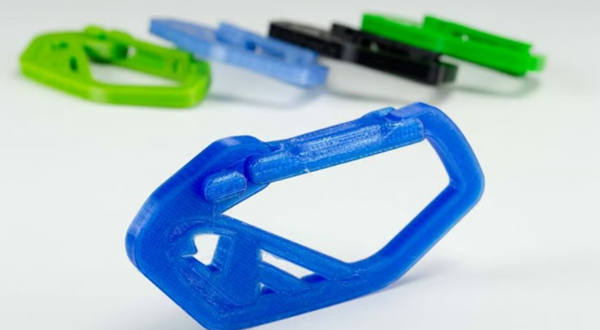
For most people,PETG is the best choice (Source: ColorFabb, Model: Elstak via Thingiverse)
For most people, there is no reason to chooseABS instead of PETG. PETG is stronger, more durable and prints better. In addition, it also has a variety of new composite yarns.
only when neededThe use of ABS is only necessary with regard to its temperature resistance, rigidity or ability to bond and paint. Otherwise, it would be difficult to justify its printability.
However, there are few manufacturers on the market that printpetg, this material is more expensive, has a rougher surface and is very unsightly.
Daguang focuses on providing solutions such as precision CNC machining services (3-axis, 4-axis, 5-axis machining), CNC milling, 3D printing and rapid prototyping services.



















