
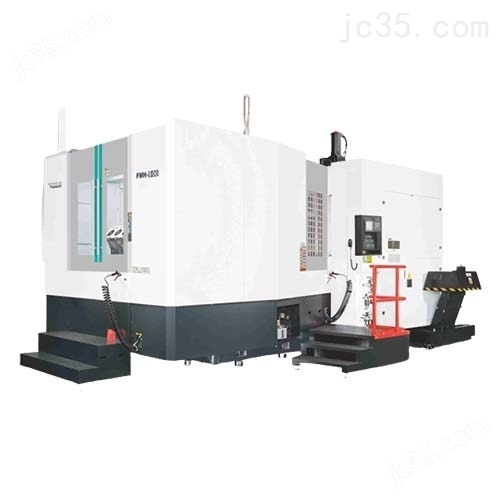
As an important equipment in the field of modern machine manufacturing, horizontal machining centers are widely used in mold making, aerospace, automobile manufacturing and other manufacturing industries due to their high precision , their high efficiency and their great stability. The following isHorizontal machining centerInstallation and debugging steps:
1.Installation
1. Select the installation location: the installation location of the machine tool should avoid direct sunlight, near heat sources and places with high dust concentrations, and should have a base solid and reliable. If there is a significant vibration source near the installation location, appropriate vibration isolation measures should be taken for the foundation.
2. Fixed machine tool: The machine tool can be placed directly on the foundation or concrete floor, or the base can be fixed to the foundation or concrete floor with anchor bolts.
3. Cleaning and lubrication: After the machine tool is installed, use cotton gauze dipped in clean gasoline or kerosene to carefully wipe off the anti-rust grease, and then apply a layer of engine oil.
2. Debugging
1. Refueling and ventilation: Refuel each lubrication point of the horizontal machining center, fill the hydraulic oil tank with the required hydraulic oil, and connect the air source.
2. Power-on test: After power-on, each component is powered separately or tested once, to observe whether each component has an alarm, manually observe whether each component is normal and whether each safety device is working. Operate and move each ring of the machine tool.
3. Coarse adjustment of machine tool precision: After the initial operation of the horizontal machining center, rough adjustment of the geometric precision of the machine tool is carried out, the relative positions of the disassembled main moving parts and the host machine are adjusted, and the positions of the manipulator, tool magazine, exchange table, etc. are adjusted. are aligned.
4. Grouting: After the rough adjustment is completed, use quick-drying cement to grout the anchor bolts of the main unit and various accessories, and fill the holes reserved for anchor bolts in various places flat.
5. Prepare testing tools: Prepare testing tools, such as a precision level, a standard square ruler, a parallel square tube, etc.
6. Fine-adjust the machine tool level: level the machine bed in a free state to bring the geometric accuracy within the allowable error range and maintain the stability of the machine bed after adjustment.
7. Debugging the manipulator and tool magazine: Use the hand control to adjust the position of the manipulator relative to the spindle, and use an adjustment chuck. When installing a heavy tool holder, several automatic exchanges of the tool magazine to the spindle position should be carried out to ensure accuracy and no collision.
8. Workbench debugging: move the horizontal machining center workbench to the exchange position, adjust the relative position of the pallet station and the exchange workbench, maintain the automatic exchange of the workbench Workbench smoothly and install a large load on the workbench for multiple exchanges.
9. Check the adjustment parameters: Check whether the adjustment parameters of the CNC system and programmable controller (PLC) device conform to the data specified in the random information.
10. Test operating functions: test main operating functions, safety measures, execution of common instructions, etc.
3. Care and maintenance
To ensureHorizontal machining centerFor long-term stable operation, daily maintenance and upkeep are required, including:
1. Daily maintenance:
Check the oil level in the lubricating oil tank and refill it in time.
Check the pneumatic system pressure gauge and make sure the pressure reaches 0.3 MPa.
Check the amount of lubricating oil cup and the amount of water in the water cup of the triple air source part, then add lubricating oil and drain the water in time.
After turning on the machine and powering it every day, fully lubricate the guide rails, and at the same time manually run each of the three coordinates at low speed with a large number of shapes more than twice, and then perform other operations such as reference points.
During operation of the machine tool, the guide rails are automatically lubricated every hour.
When shutting down daily after completion, first turn off the NC power supply, then turn off the main power switch of the machine tool. After stopping, quickly clean up the chips and cutting fluid splashed everywhere and apply rust-inhibiting oil.
2. Weekly maintenance:
Maintain the tool magazine and add grease to the knife joints.
Check the oil level in the robot arm housing regularly and refill it in time.
For rotating worktables, ensure that the lubricating oil tank is filled with oil, clean and replaced in time.
3. Monthly and quarterly maintenance:
Check the inside of the electrical cabinet for dust or water leaks and clean it if necessary.
Clean the gas source triplex filter to ensure clean working gas.
Check the spindle rotation accuracy and adjust the spindle nut if necessary.
Check the level of the machine tool and adjust the anchor screws if necessary.
Check whether the zero-return impact block (including the combined displacement switch) in each coordinate direction is normal.
4. Other maintenance:
Add oil and grease to the counterweight gear and support wheel.
Thoroughly clean the inside of the machine tool, including the electrical box.
Check whether the connection between each servo motor and the ball screw is normal, check the clearance and supplement it if necessary.
Clean the dirt in the lubrication pipeline to ensure smooth oil flow.
Check to see if the appearance and connections of all cables outside the electrical box are intact and clean off any accumulated dust.
The installation and development of a horizontal machining center is a complex and delicate process, which must be carried out in strict compliance with operating specifications. At the same time, daily maintenance and upkeep are also essential to ensure long-term stable operation of machine tools.
Daguang focuses on providing solutions such as precision CNC machining services (3-axis, 4-axis, 5-axis machining), CNC milling, 3D printing and rapid prototyping services.



















