

Recently, according to Mohou.com, Nvidia announced the launch of Magic3D, a generative artificial intelligence technology capable of generating 3D models based on text prompts. The technology makes it possible to design models of parts with complex shapes, which can then be transformed into reality using 3D printing technology. The annual survey of 3D printing industry executives shows that using artificial intelligence to automatically generate 3D models has become a hot topic. Magic3D can create a 3D mesh model with colorful textures in 40 minutes. For example, when the prompt word “a blue poison frog sitting on a water lily” is entered, the corresponding 3D model will be quickly generated.

I believe that after continuous optimization, Magic3D can generate high-quality models for CGI art scenes or video games. This technology can reduce modeling barriers and allow anyone to create 3D models without special training. Magic3D researchers hope this will democratize 3D modeling and open the door to creativity in 3D content creation.
Features
The technique uses a two-step process to create a 3D model, first creating a rough model at low resolution and then optimizing it at a higher resolution, using a text-image model to generate a 2D image, then converting it. into a 2D image. It is optimized for NeRF (Neural Radiation Field) volumetric data.
Magic3D developers claim the technology is twice as fast as DreamFusion, another 3D modeling technology. In addition to speed, Magic3D can also edit already created 3D models based on prompt words. Users can modify the generated model by changing the basic prompt words and the low-resolution 3D model.
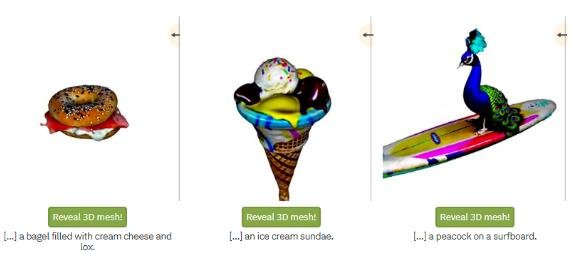
Magic3D developers also demonstrated the product’s ability to maintain consistency of model characteristics when creating different versions of 3D models, as well as the ability to transfer the style of 2D images to 3D models (such as paintings cubists).
Advantages brought by the GPU block
GPU (graphics processing unit) computing has been introduced in technical and scientific computing to accelerate CPU-based applications in 3D modeling. This method uses the GPU as an auxiliary processor to replace some time-consuming and computationally intensive codes, thereby improving application performance and running faster. Application developers leverage NVIDIA’s CUDA parallel programming model to leverage the performance of parallel GPU architectures.
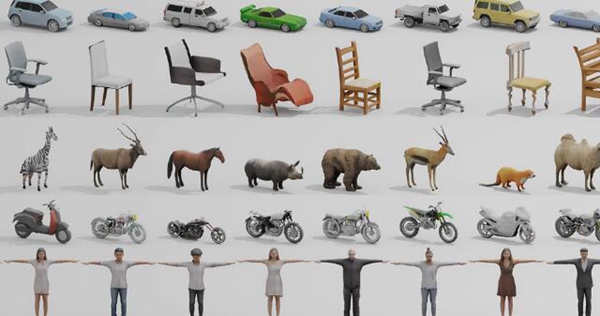
NVIDIA’s rendering framework, called Differentiable Interpolation Renderer (DIB-R), has the potential to aid and accelerate in areas such as 3D design and robotics, rendering 3D models in seconds. The framework can predict the shape, color, texture, and lighting of an image by converting input from a 2D image into a map. This mapping is then used to create a polygonal sphere, resulting in a 3D model that represents the components of the original 2D image. This technology makes it possible to quickly and efficiently create highly detailed and complex 3D models. The CUDA parallel programming model and NVIDIA GPU expert Daghan Cam use GPU computing to create perfect 3D printed structures. Cam completed his abstract design structure using algorithms, then completed the 3D model using a Quadro K6000 graphics card and a Tesla K40 GPU accelerator, and finally worked with Boston Limited and Materialize to print the beautiful 3D model using the Mammoth Abstract high-resolution stereolithographic printer. design of prototypes.
Challenges and perspectives
Paul Powers, CEO of Physna Inc., said generative AI has seen success in many industries, but is not yet fully integrated into the 3D printing industry. The main problem is that 3D models are more complex than 2D images and there is also a lack of labeled 3D data. Meanwhile, Powers highlighted the lack of 3D data compared to 2D data as a secondary issue. Although training 3D models on neural radiation fields (NeRF) may be more useful than training on 2D models, it is not a substitute for real, labeled 3D models. In this regard, Physna has conducted experiments to verify the compatibility of generative AI with 3D printing, and the company is optimistic about the potential of this technology.
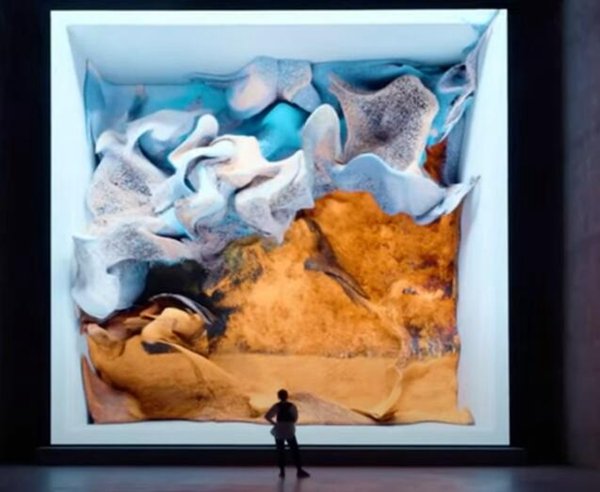
The use of GPU computing has the potential to revolutionize additive manufacturing by making the design and printing process more efficient. It can also help create highly detailed and complex 3D models efficiently. The technology can help various fields such as 3D design and robotics, making it an important development in the field of additive manufacturing.
The use of GPU computing is expected to continue to grow and more applications will be developed to take advantage of the performance of parallel GPU architectures.
Source: 3D Printing Network
Daguang focuses on providing solutions such as precision CNC machining services (3-axis, 4-axis, 5-axis machining), CNC milling, 3D printing and rapid prototyping services.



















