GreatLight CNC Machining Factory logo
CNC Machining
Rapid Prototyping
Materials
Industries
News
About GL

Get Instant Quote

Robotics & Automation

6 Axis CNC Machining for Industrial Robot Arm Parts

Joint housings, gearbox flanges, wrist brackets and end-effector plates machined from aluminum, stainless and titanium. One operation on five-axis centers holds bore-to-face relationships that stacked setups cannot.

±0.005 mm tolerance16 five-axis centersDFM within 12 hoursNo minimum order quantity
Custom 5 Axis CNC Machined Parts for Robot Arm Joints
±0.005 mmMachining tolerance
16Simultaneous 5-axis centers
127High-precision CNC machines
99.99%Qualification rate
Where robot arm parts go wrong

Four failures we see on joint and bracket drawings

Most of these start before the first cut. They show up as vibration, backlash or a joint that will not hold position.

01

Bore and mounting face come out out of square

A joint housing gets flipped through three setups. Each flip adds a small angular error, and by the time the bearing bore is finished, the mounting face is out of square. The bearing preloads unevenly and the axis runs warm.

02

Wall thickness that moves under load

A lightened arm segment looks fine on the bench. Under a 20 kg payload the thin web deflects, and the encoder sees position error it cannot correct. Material choice and rib geometry decide this, not spindle speed.

03

Tolerances tighter than the function needs

A drawing calls ±0.01 mm on a face that only locates a cover. That tolerance adds grinding, adds inspection time and adds cost, while the joint's actual accuracy depends on two other features nobody flagged.

04

Prototype passes, production run drifts

The first article checks out. Article 400 does not, because the process was never written down. Tool wear, fixture repeatability and material batch all move the same dimension.

How we machine arm joints

One setup, then a written process

Two things decide whether a robot arm part behaves: how many times it gets re-fixtured, and whether the process survives a production run.

Custom 5 Axis CNC Machined Parts for Robot Arm Joints
Setup strategy

Datums carried through the whole part

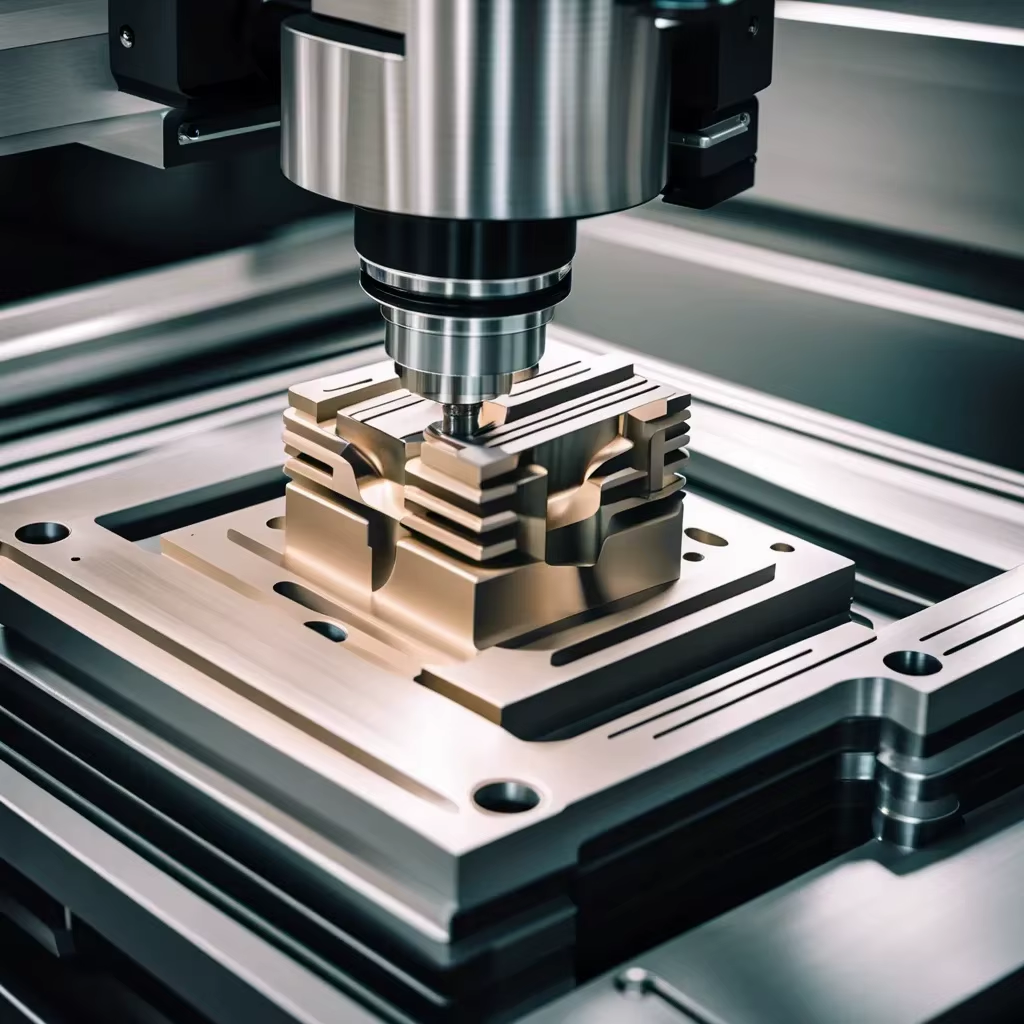
We read the drawing for the features that actually control joint accuracy: the bearing bore, the mounting face, the dowel pattern. Those get machined in one operation wherever the geometry allows. On a five-axis center with a Ø400 mm rotary table, a wrist housing can be cut on five faces without coming off the fixture.

Fewer setups means fewer chances to stack error. It also means the bore-to-face relationship holds even when the part is 400 mm across.

  • 1
    One-operation datumsBore, face and dowel holes cut in the same setup.
  • 2
    Rotary table workØ400 mm table for parts needing five-face access.
  • 3
    Large envelopesUp to 4,000 mm for arm segments and base plates.
Custom 5 Axis CNC Machined Parts for Robot Arm Joints (3)
Repeatability

The process is the deliverable

A prototype that fits is only half the job. We document the setup, the tool list and the inspection points so article 500 matches article 1. In-process checks run during the lot, not just at the end.

Every part is inspected before shipment. Raw material certificates, dimensional reports and surface finish readings are available on request.

  • 1
    100% final inspectionNo sampling on robot arm components.
  • 2
    Process documentationSetup sheets and tool lists held for repeat orders.
  • 3
    Reports on requestMaterial certs and dimensional data with the shipment.
Part family guide

Which machining route fits which arm component

These are starting points. The drawing decides the final route.

ComponentTypical materialWhy this route
Joint housing6061-T6, 7075Five-axis: bore and faces in one setup
Gearbox flange4140, 17-4PHMill-turn: concentricity from one chucking
Wrist bracket7075, Ti-6Al-4VFive-axis: angled faces without refixturing
Arm segment6061-T6, carbon fibreLarge travel: up to 4,000 mm
Base plateSteel, cast aluminumThree-axis plus drilling, then grinding
End-effector plate6061, 304 stainlessThree-axis: flat plate, tight hole pattern
What we run

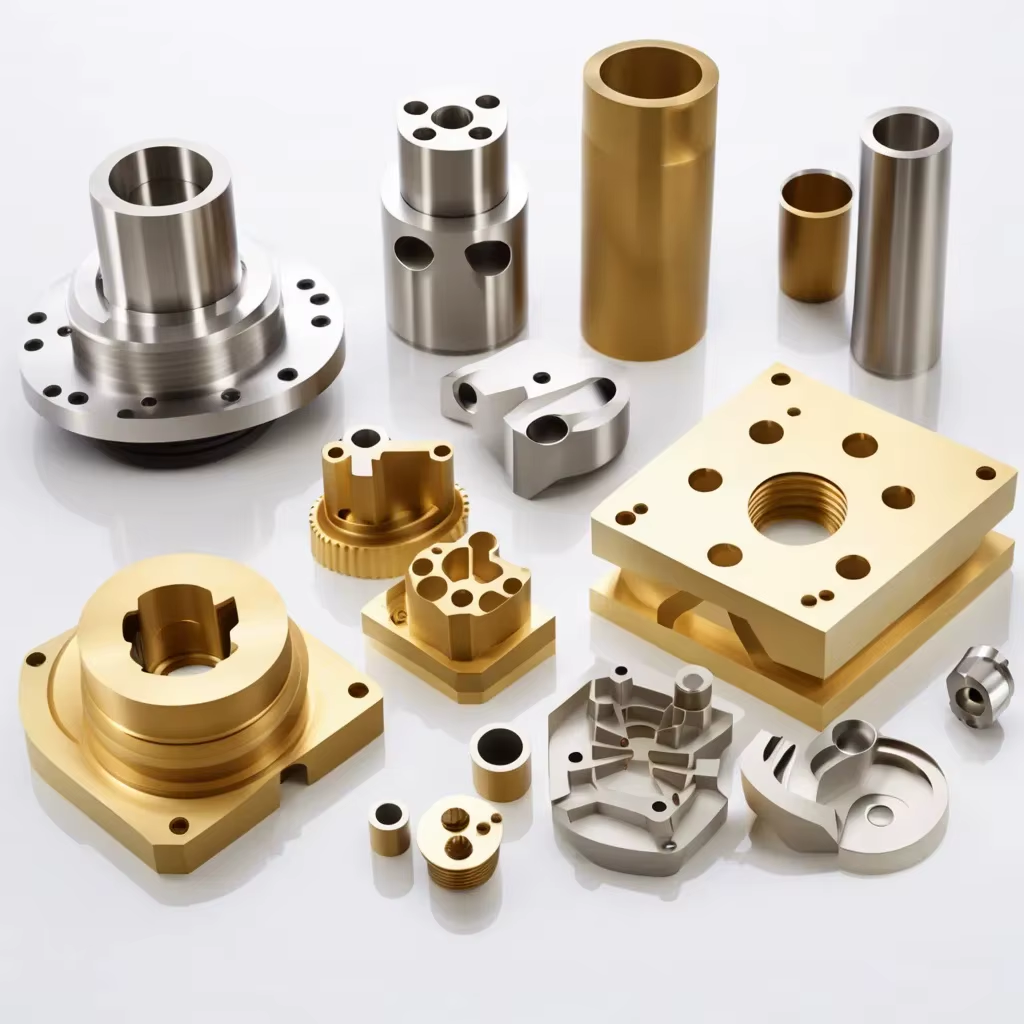
Machining services used on robot arm builds

Most robot arm programs pull from three or four of these.

01

5 Axis CNC Machining

Sixteen simultaneous five-axis centers for joint housings and wrist brackets. Angled faces and bores cut without re-fixturing.

02

4 Axis CNC Machining

Twelve four-axis mills for parts with a dominant rotational axis: flanges, collars, cylindrical bosses.

03

3 Axis CNC Machining

Twenty-seven three-axis machines for base plates, covers and flat mounting plates with dense hole patterns.

04

CNC Milling & Turning

Sixteen mill-turn centers. Shafts, pins and gearbox interfaces turned and milled in one chucking for concentricity.

05

Rapid Prototyping

DFM analysis with the quote. First articles for fit checks before tooling or fixture investment.

06

Part Surface Finishing

Anodizing, plating, bead blasting and laser marking. Character height 1.5 mm minimum for engraved IDs.

Capability envelope

Machine and inspection ranges

ItemRangeNotes
Tolerance±0.005 mm±0.0002 in
Surface finishRa 0.2–0.8 μmFine finish, on request
As-machined finishRa 1.6–3.2 μmStandard milled surface
Maximum part size4,000 mm4,000 × 400 × 150 mm travel
Medium travel750 × 1,150 × 550 mmGeneral joint and bracket work
Rotary tableØ400 mmFive-face access in one setup
MaterialsAluminum, stainless, steel, titaniumAlso copper, brass, plastics
Order quantityOne prototype to 10,000+No minimum order quantity
Why GreatLight

Numbers we work to

±0.005

Tolerance held in production

Not just on the first article. In-process checks run through the lot, and every part is inspected before shipment.

16

Five-axis centers running

Simultaneous five-axis capacity is what lets a joint housing be finished without stacking setups.

12H

Quote and DFM turnaround

Send a drawing and we return a quotation with free DFM analysis within 12 hours.

24H

Production start

Once the order is confirmed and material is on hand, production can start within 24 hours.

15Y

Machining since 2011

Three wholly-owned plants, 7,600 m² of manufacturing space and 150 technicians.

99.99%

Qualification rate

Parts that pass inspection on the first pass, measured across production lots.

7,600 m²Manufacturing space
127CNC machines
3Wholly-owned plants
150Technicians
What we deliver

Robot arm part families and what they demand

Custom 5 Axis CNC Machined Parts for Robot Arm Joints 8

Joint housings

Robotics work needs bore and mounting face square to each other. We cut both in one setup on a five-axis center.

  • ±0.005 mm
  • One setup
  • 100% inspection
Custom 5 Axis CNC Machined Parts for Robot Arm Joints (1)

Gearbox flanges

Concentricity between the pilot bore and the bolt pattern is the whole function. Mill-turn holds it from one chucking.

  • Mill-turn
  • Ra 0.8–1.6 μm
  • 17-4PH
Custom 5 Axis CNC Machined Parts for Robot Arm Joints

Wrist brackets

Angled faces and lightening pockets are the reason these parts go on a five-axis machine instead of a three-axis with fixtures.

  • 7075-T6
  • Angled faces
  • Hardcoat anodizing
deb497643057917a23d79fa6ea36ce7a

Base plates and arm segments

Large frame parts up to 4,000 mm. Flatness and hole position are checked before the part leaves the machine.

  • 4,000 mm travel
  • Flatness check
  • 6061-T6
FAQs

Questions engineers ask before sending a robot arm drawing

Which arm components actually need 6 axis machining instead of three-axis work?

Parts with features on several faces at angles to each other. Joint housings, wrist brackets and anything with a bore that must stay square to a mounting face.

Flat plates, covers and simple brackets usually run faster and cheaper on a three-axis machine with a fixture. We route by geometry, not by machine availability.

What tolerance can you hold on a joint housing across a production run?

±0.005 mm on critical features. That holds in production because the setup is documented and in-process checks run through the lot.

If a drawing calls tighter than the joint needs, we flag it during DFM. Extra precision on a non-functional face adds cost and inspection time without improving the axis.

How do you handle a part that will not fit a rotary table?

The Ø400 mm rotary table covers most joint and wrist parts. Larger arm segments and base plates go on machines with travel up to 4,000 × 400 × 150 mm.

For those, we break the work into two or three setups and control the datum transfer with dowel pins or a dedicated fixture. We tell you which faces carry the tolerance.

Which materials make sense for a robot arm joint?

7075 and 6061-T6 for housings and brackets where stiffness per kilogram matters. 4140 and 17-4PH for gearbox interfaces and shafts that see wear.

Ti-6Al-4V when weight and corrosion resistance both matter and the budget allows. Carbon fibre is an option for arm segments, though it changes how you design the joint.

Can you machine a one-off prototype before we commit to a fixture?

Yes. There is no minimum order quantity, so a single housing or bracket is a normal order. Production can start within 24 hours of confirmation.

Rapid prototyping runs are usually machined from the same material as the production part, so the fit check reflects real behavior.

What do you need on the drawing to quote accurately?

A 3D model plus a 2D drawing with datums, tolerances and surface finish callouts. Material and finish specification. Quantity and any target date.

If the drawing is incomplete, we return a DFM note listing what we assumed. That happens within the same 12-hour quote window.

How is surface finish specified for moving interfaces?

Bearing bores and seal seats usually sit at Ra 0.8–1.6 μm. Sliding or rotating contact faces go finer, Ra 0.2–0.8 μm.

Non-functional outer surfaces at Ra 1.6–3.2 μm keep cost down. We can add bead blasting or anodizing after machining if the drawing calls for it.

Do you sign an NDA before we send robot arm drawings?

Yes. An NDA is available on request, and uploads are handled as confidential. We do not share drawings or part geometry outside the job.

We hold ISO 27001:2022 for information security, alongside ISO 9001:2015, IATF 16949:2016 and ISO 13485:2016.

Send a robot arm drawing and get a quote in 12 hours

Free DFM analysis with every quotation. No minimum order quantity, from one prototype to a 10,000-part run.

12-hour quote100% inspectionNo minimum order quantity

Trusted by engineers and manufacturers worldwide

Tesla Ford Motor Company BYD Auto Denso Magna International Boeing Airbus Medtronic KUKA FANUC