
3 Axis, 4 Axis and 5 Axis CNC Machining Parts Factory
This page explains how a parts factory uses 3 axis, 4 axis and 5 axis CNC machines, and how to pick one for a given geometry. It is written for design engineers and sourcing engineers who need to judge setup count, tolerance and cost before releasing a drawing. After reading it you can tell which configuration fits your part and which one will waste money.
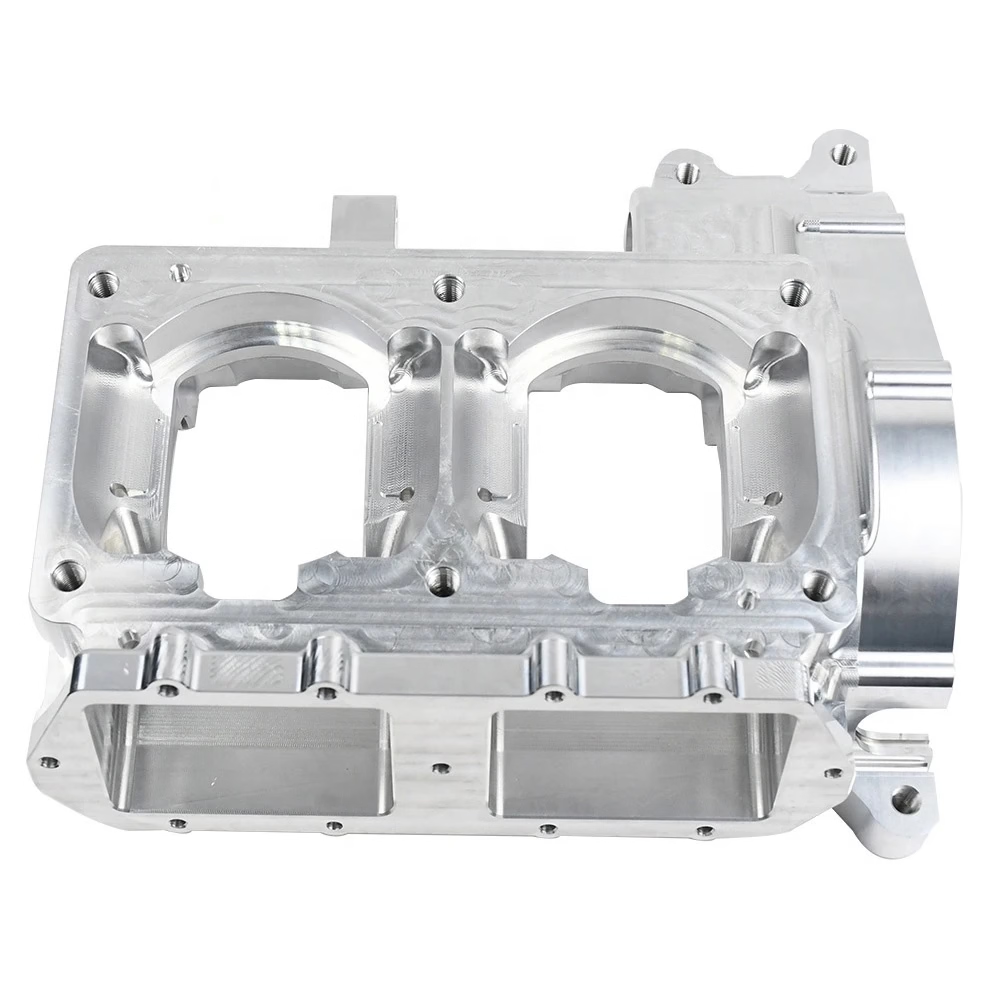
What the axis count actually changes
Axis count is a setup decision first, a machine decision second.
How 3 axis, 4 axis and 5 axis machines move
A 3 axis mill moves the tool in X, Y and Z. The part sits still. Every face that is not reachable from the top needs a new fixture or a re-clamp, and each re-clamp adds position error. That is why a simple bracket with three flat faces is cheap on 3 axis and expensive on 5 axis.
A 4 axis machine adds rotation, usually around the X axis, so the part turns while the tool cuts. Holes, slots and flats spaced around a cylinder can be cut in one setup. Indexed 4 axis work holds each angle before cutting; continuous 4 axis work feeds the rotary table during the cut.
A 5 axis machine adds a second rotary axis on top of that, so the tool can tilt relative to the part. Undercuts, compound angles and deep pockets with one open side become reachable without re-fixturing. Simultaneous 5 axis keeps all five axes moving together, which is what you need for contoured surfaces such as impeller blades.
What our factory floor can hold
GreatLight runs 127 high-precision CNC machines across three wholly-owned plants, 7,600 m² in total, with 150 technicians. The split matters more than the total. We keep 27 three-axis machines, 12 four-axis mills, 16 simultaneous 5-axis machining centers and 16 mill-turn centers. A shop with only 5 axis machines will quote every job on a 5 axis machine.
Size range runs from compact 500 × 500 × 450 mm and 500 × 310 × 200 mm tables up to 4,000 × 400 × 150 mm for long parts. Medium work sits at 750 × 1,150 × 550 mm and 600 × 600 × 600 mm. Rotary tables go up to Ø400 mm. If your part is longer than 4,000 mm or heavier than the table rating, tell us early and we will say so.
Tolerance is ±0.005 mm (±0.0002 in) on qualified features. Surface finish runs from Ra 0.2–0.8 μm on fine work through Ra 0.8–1.6 μm on standard machined faces to Ra 1.6–3.2 μm as-machined. Finish and tolerance both drive which machine we assign, not just the geometry.
Choosing between 3 axis, 4 axis and 5 axis
Use this as a first pass before you send a drawing.
| Configuration | Best fit | Setup count | Typical limit |
|---|---|---|---|
| 3 axis | Prismatic parts, flat faces, through holes | 1–3 setups | No undercuts or side features |
| 4 axis | Cylindrical parts, holes around a diameter | 1–2 setups | One rotary axis only |
| 5 axis indexed | Compound angles, five-sided access | 1 setup | Positioned cuts, not swept |
| 5 axis simultaneous | Contoured surfaces, impeller blades | 1 setup | Higher programming time |
When more axes cost you money
Every extra axis adds programming time, tooling cost and machine hour rate. For a flat plate with four holes, a 5 axis quote is simply a 3 axis job priced higher. Ask what the setup count would be on 3 axis. If the answer is one or two, stay there.
The reverse case is a housing with ports on five sides. On 3 axis that is four or five setups, four or five fixtures, and tolerance stacks that grow with each one. On 5 axis it is one setup and one datum. The part gets more accurate and often cheaper, because you stop paying for fixture design and re-clamping labor.
Part quantity changes the math too. For one prototype, setup dominates, so fewer setups wins. For a 10,000 part run, cycle time dominates, and a 3 axis machine with a dedicated fixture can beat a 5 axis machine on cost per part. We run both and will tell you which way the numbers point.
Material is the other lever. Aluminium 6061, 7075 and 6082 cut fast on any configuration. Stainless 316L, 17-4PH and titanium TC4 (Ti-6Al-4V) load the spindle and the tool differently, and deep 5 axis cuts in those alloys need more passes. Inconel and magnesium AZ31B / AZ91D each bring their own rules.
Materials and finishes that behave well across axis counts
We machine aluminium 6061, 6061-T6, 2024, 5052, 5083, 6063, 6082, 7075 and ADC12; stainless 303, 304, 316, 316L, 420, 430, 431, 440C and 17-4PH (SUS630); steel 1018, 1045, 4130, 4140, 4340, A36 and tool steel; copper and brass C101, C103, C110, beryllium copper, C27400, C28000 and C36000; titanium TA1, TA2 and TC4, plus Inconel and magnesium AZ31B / AZ91D. Plastics run from ABS, PC, PMMA, POM, PA, PP and HDPE to PEEK and carbon fibre.
Free-machining grades such as 6061-T6 and C36000 hold tight tolerances with less tool wear. Gummy grades like 5052 and 304 tend to smear, so we adjust feed and coolant rather than push the tolerance. Titanium and Inconel need slower speeds, more coolant and often a 5 axis setup to avoid tool chatter in deep cuts.
Finishes include anodizing in clear, colour, hardcoat and conductive grades, electroless nickel, zinc, silver and gold plating, powder coating and black oxide. Bead blasting, tumbling, brushing and polishing handle texture. Laser marking and engraving need a minimum character height of 1.5 mm.
How we keep multi-axis work consistent
GreatLight was founded in 2011 and holds ISO 9001:2015, IATF 16949:2016, ISO 13485:2016 and ISO 27001:2022. Those certificates set the process discipline, not the tolerance on your drawing. The tolerance comes from the machine, the fixture and the inspection plan.
Inspection covers raw material check, in-process monitoring and final inspection, with 100% inspection before shipment and reports on request. For a 4 axis or 5 axis part, the first-off check is where we confirm the rotary datums, because a small error in the rotary center shows up as a large error at the edge of the part.
There is no minimum order quantity. We run from one prototype to 10,000+ part runs. Quotation and free DFM analysis come back within 12 hours, production can start within 24 hours, and parts ship in 3–5 days. Historical late-delivery probability is below 2%. Uploads are secure and confidential, and an NDA is available on request.
Common questions
Can a 3 axis machine cut a part with features on five sides?
Yes, but not in one setup. Each new face means a new fixture or a re-clamp, and each re-clamp introduces position error that stacks against your tolerance.
If the part has tight tolerances between features on different faces, a 4 axis or 5 axis setup usually costs less than the extra fixtures and the scrap risk.
When is 4 axis a better choice than 5 axis?
When the features wrap around one axis. Think shafts, bushings, flanges and manifolds with radial holes. A 4 axis mill with a Ø400 mm rotary table turns the part once and cuts all of them.
Adding a fifth axis buys you nothing if the geometry only needs rotation around one centerline. It just adds programming time and machine rate.
Does 5 axis always give better accuracy?
No. It gives fewer setups, which removes the error that re-clamping would have introduced. That is often the accuracy win.
But a 5 axis machine only holds ±0.005 mm if the rotary datums are set and checked. The machine itself is not a shortcut around a bad fixture.
What size parts can you handle?
Up to 4,000 × 400 × 150 mm on our largest travel, with medium work at 750 × 1,150 × 550 mm and 600 × 600 × 600 mm, and compact work at 500 × 500 × 450 mm and 500 × 310 × 200 mm.
Rotary tables go to Ø400 mm. If a part sits near those limits, send the model and we will confirm before quoting.
How should I prepare a drawing for a multi-axis quote?
Give us the 3D model, the 2D drawing with datums and tolerances, the material grade and the finish. Mark which faces are critical.
That is enough for free DFM analysis within 12 hours. We will flag features that drive setup count or need a different configuration.
Do you machine prototypes and production runs on the same floor?
Yes. The same plants run one-off prototypes and 10,000+ part runs, with no minimum order quantity.
For prototypes we usually favor fewer setups to keep the first article fast. For production runs we may move the job to a 3 axis machine with a dedicated fixture if that lowers cost per part.
Send the model, get a configuration recommendation
Free DFM analysis and a quote within 12 hours, with a note on which axis configuration fits your part.
12-hour quote±0.005 mm toleranceNo MOQ100% inspection









