
The Rise of 3D Micro-Optics: A Game-Changer in Advanced Manufacturing
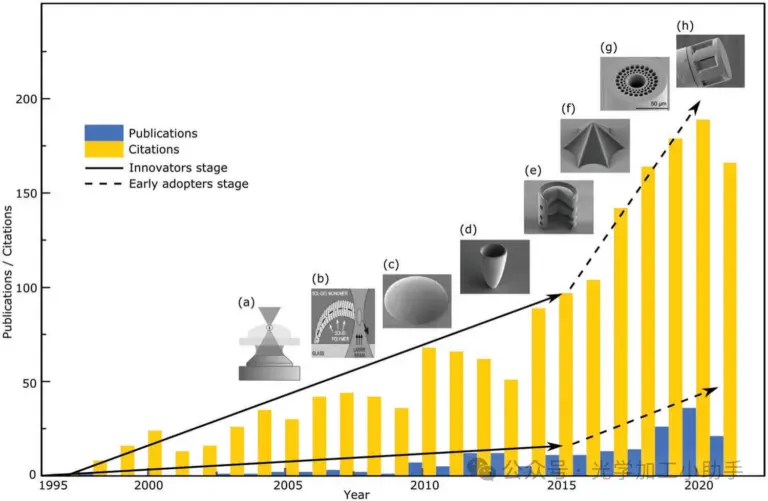
In the rapidly evolving world of micro-optics, the past 25 years have witnessed a significant increase in the development and application of 3D multi-photo lithography (MPL) technology. This innovative technique, also known as two-photon polymerization (2PP) or multi-photon lithography (MPL), has revolutionized the manufacturing of micro-optical components and devices. In this post, we’ll explore the origins, progress, and potential of MPL, its applications, and the significant impact it’s expected to have on the industry.
The Birth of MPL: A Journey of Disruption
The concept of 3D micro-optics dates back to the 1990s, when scientists first proposed the idea of using ultra-fast lasers to create 3D printed objects. Maruo, in his 1997 technical article, laid the foundation for the development of MPL technology. However, it wasn’t until the early 2000s that the first batch of micro-optical components was showcased, marking the beginning of a new era in additive manufacturing.
The Rise of Commercial MPL Systems
The last decade has seen a remarkable growth in the development of commercial MPL systems, with companies like Nanoscribe, Photonics Workshop, and Vanguard Photonics leading the charge. These systems have enabled mass production of micro-optical components, transforming the industry’s landscape.
Applications and Advantages
MPL’s applications are vast and varied, with potential uses in:
- Beam shaping and femtosecond laser systems: MPL enables the creation of complex beam shapes, critical for applications like material processing, spectroscopy, and laser-induced breakdown spectroscopy.
- Advanced imaging: The technology allows for the fabrication of complex optical components, such as microlenses, diffraction gratings, and photonic crystals, which are crucial for applications like microscopy, spectroscopy, and biomedical imaging.
- Optical detection and sensing: MPL components can be designed for specific sensing applications, such as refractive index, spectral reflectance, or biomolecular detection.
- Integrated photonic circuits: The technology enables the creation of complex, multifunctional photonic circuits, which can be used for data processing, light manipulation, and optical computing.
Recent Advances and Trends
Recent breakthroughs in MPL have led to the development of new materials, such as high-performance hybrid materials, pure or optically active inorganic glass, and organic-inorganic hybrid materials. These advancements have enabled the creation of more complex and sophisticated micro-optical components.
Future Directions and Challenges
As MPL continues to evolve, several key areas will require attention:
- Characterization of performance: Standardized characterization methods for microscopic scale devices are still lacking, making it challenging to measure and predict their performance.
- Laser-induced damage threshold: Further research is needed to understand the optical damage threshold of MPL components and develop methods for calibration and testing.
- Adaptive material properties: The development of active and adjustable materials will be crucial for the creation of new optical applications and the expansion of MPL’s capabilities.
Conclusion
The field of 3D micro-optics has made tremendous progress since its inception, with MPL technology at the forefront of this evolution. As the demand for precise characterization and standardized testing methods continues to grow, the industry must adapt to new challenges and opportunities. With the potential to revolutionize industries such as biomedicine, telecommunications, and energy, the future of micro-optics looks brighter than ever.


















