
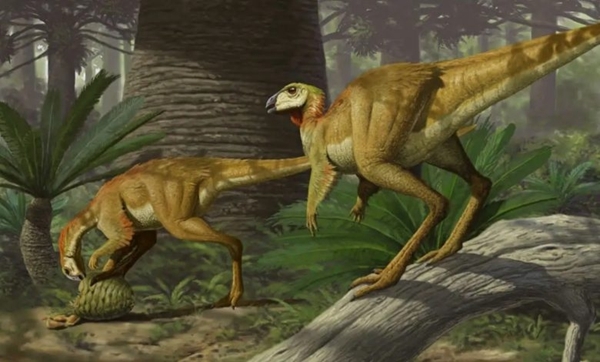
Recently, according to Mohou.com, paleontologists from Flinders University in Australia used micro-CT scanning and 3D printing technology to peer inside an unusual milky-white dinosaur fossil, approximately 100 years old. millions of years. What could this small hypopsilophodont bipedal herbivorous dragon have looked like after digital reconstruction
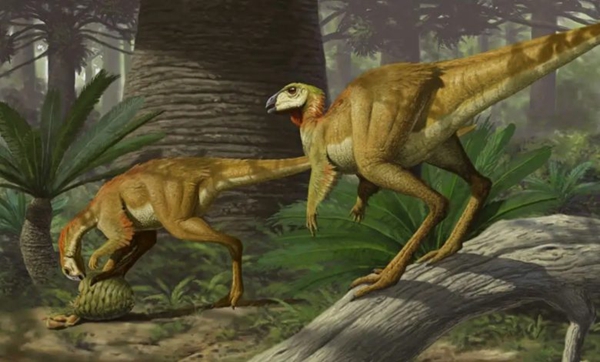
△This small bipedal herbivorous dragon hypsilophodont, what it could look like after digital reconstruction
During an excavation, archaeologists discovered an emulsified fossil of a small dinosaur. They think it could be a new species of Australian dinosaur. After research, this dinosaur was a small bipedal herbivore known as “hypsilophodont”. The fossils were discovered in the opal mining town of Lightning Ridge in outback New South Wales and were collected and rescued for scientific research in 2019.
The Australian Opal Center at Lightning Ridge, withA collaboration between the Palaeo Pictures documentary team, led by Flinders University Associate Professor Paul Willis, will use 3D printing technology to reconstruct the appearance of dinosaurs based on analysis of data contained in opal fossils. Opal is formed when silica dissolved in water passes through the earth until it reaches cavities in the rock. Once the water evaporates, it leaves silica deposits. Sometimes cavities in opal are caused by an organism buried in sand or clay before hardening into stone. The organism can therefore be left in the opal and fossilized.
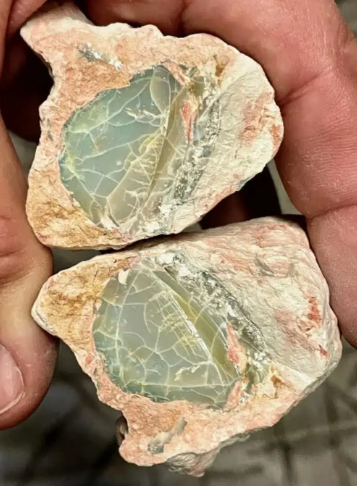
△Biological fossils are encased in ordinary-looking opal. This is a plan view.
Fossils found at Lightning Ridge are often measured in silver“Worthless” junk. However, these opals containing dinosaur fossils have very great scientific value. Willis insists that all fossil specimens are “invaluable” to science. His team began using the latest imaging techniques to learn more about prehistoric species. Willis said: “We use CT scanning equipment to examine the interior of the rock block containing the remains of a small dinosaur. The scan results show that the dinosaur fossil is very delicately preserved.” Willis continued: “Not only do these analyzes allow us to better understand the exact contents of the dinosaur skeleton we possess, but they will be an invaluable aid in the next phase of study of this specimen.”
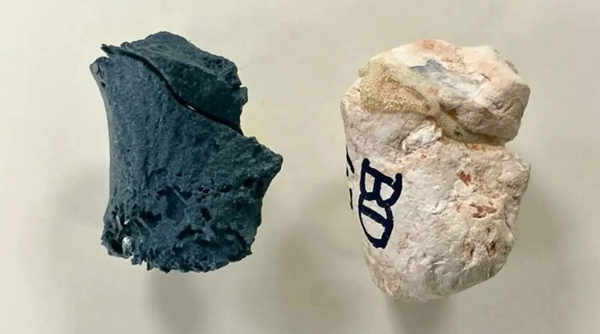
△On the left is the 3D printed fossil generated by scanner, and on the right is the still intact protein fossil
He added:“The problem currently faced is how to safely and effectively remove opal from dinosaur fossils. In order to maintain the integrity of the fossil as much as possible, it is impossible for us to remove it “blindly.” “So far, by scanning the specimen, we know where to start and where to stop.” So far, about 20% of the opalized dinosaur fossil specimens have been scanned. will proceed to a detailed study of the skeleton Paleontologists hope to use 3D printing technology to reconstruct these dinosaur fragments to study whether a new species of dinosaur has been discovered.
source:
Daguang focuses on providing solutions such as precision CNC machining services (3-axis, 4-axis, 5-axis machining), CNC milling, 3D printing and rapid prototyping services.



















