
Introduction: How to better create barrier-free environments has always been a hot topic in academia, especially for people with various disabilities, who are often entitled to certain accommodations that allow them to work or study at the same level. However, even if targeted accommodations are in place, in many places even the minimum requirements are not met to normalize the lives of people with disabilities.
2022Year8moon27Now, according to Mohou.com, a Baylor University study has shown that thanks to3DPrinting transforms scientific data into tactile graphics and scientists will be able to eliminate barriers that exclude the blind community from chemistry education. The Baylor University study titled “Data for Everyone: Illuminated Touch Graphics with Perfect Resolution/Data for everyone: tactile graphics that light up with perfect image resolution“The article was published in”Scientific advances“Newspaper.
Links to related articles:
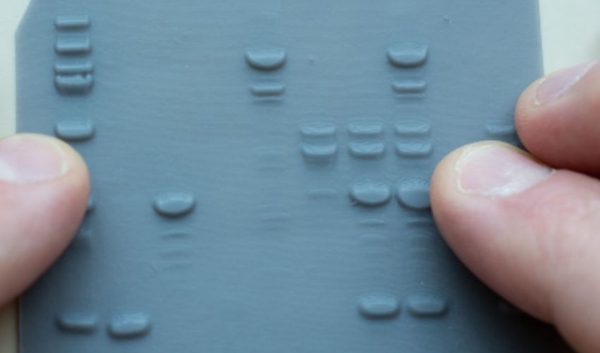
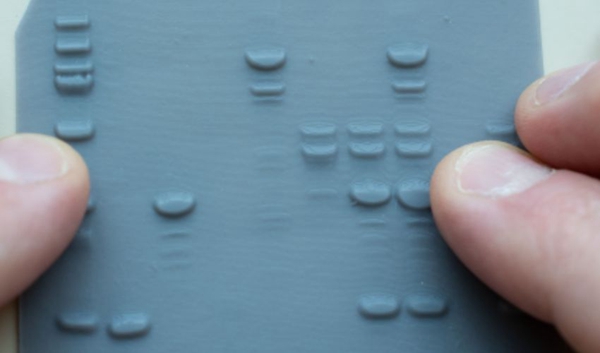
In this study, Baylor University researchers used3DPrinting technology transforms two-dimensional images (from data) into3DPrinted lithographs, making them tactile and accessible to everyone. Lithography is an ancient artistic medium produced in China as early as the 6th century.19century became popular in Europe. They are essentially fine prints made of a translucent material that initially appear opaque but glow when illuminated by a light source. Diffusion of light makes thinner areas appear lighter and thicker areas appear darker. This study marks the first time it has been used in science, compared to3DWhen combined with printing, the resulting graphics allow individuals to universally visualize the same data.
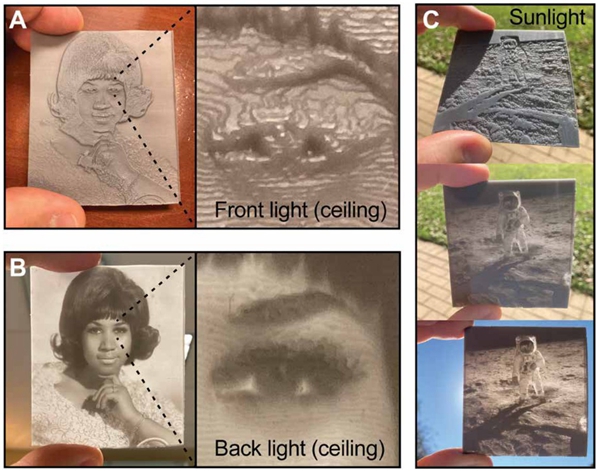
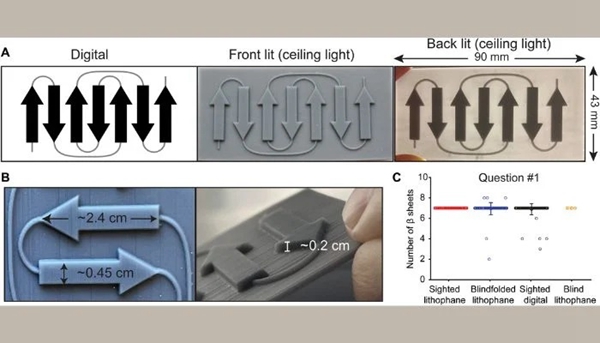
△Representation of the steps from digital representation of data to printed lithographs to results for all participants (Image source: Baylor University)
Bryan, professor of chemistry and biochemistry and corresponding author of the study–look like(Bryan Shaw“This study is an example of art making science more accessible and inclusive,” explained Dr. However, our research shows that thin, translucent tactile graphics, called .lithophanescan make all these images accessible to everyone, regardless of vision. “
New research helps blind people
In the Baylor study, blind and sighted people were asked to interpret the slate data results by touch or sight. The results showed that the overall accuracy of the testers was approximately79%But when it came to studies involving blind participants, the accuracy was even higher. Average test accuracy of blind people’s tactile interpretation of five stone tablets96.7%the accuracy of visual interpretation of backlit slates is even92.2%. Meanwhile, for blindfolded vision test participants, their tactile interpretation scores were79.8%lower than that of blind participants, but still impressive.
Not only were sighted participants able to accurately interpret the data, but blind participants’ tactile accuracy was at least as good, if not better, than visual interpretation. Lithographic prints can be used by small businesses3DProduction of printers, i.e.form laboratoriesofForm3B+printer. Use resin3DPrinting can achieve high data accuracy and visual accuracy. through the resin3DPrint, each stone piece is printed with100Printed at micron resolution using a gray photoresist, it provides precise information that blind participants can interpret. choose3DPrinting is also cost-effective: this printer costs less than5000dollars, making this program relatively easy to replicate at other universities.
DashnawThe summary says:“Most of the research I conduct on a daily basis does not have a significant impact on the scientific community. However,3DPrinting lithography projects can make a real difference. We make it more accessible to people with visual impairmentsSTEMand drew attention to their global exclusion.“
source:
Daguang focuses on providing solutions such as precision CNC machining services (3-axis, 4-axis, 5-axis machining), CNC milling, 3D printing and rapid prototyping services.



















