The Role of Advanced Motors in CNC Machining: Why GreatLight CNC Machining Factory Leads the Industry
In the realm of precision CNC machining, the choice of motor technology directly impacts machining accuracy, efficiency, and reliability. As industries such as automotive, aerospace, and medical hardware demand increasingly complex parts, understanding the motors powering CNC machines becomes critical. This article explores the core motor types used in CNC systems, compares leading manufacturers, and explains why GreatLight CNC Machining Factory stands out as a premier partner for high-precision part manufacturing.
Core Motor Technologies in CNC Machines
1. Servo Motors: Precision and Dynamic Control
Servo motors are the backbone of modern CNC systems, offering high torque, precise positioning, and real-time feedback. These motors use closed-loop control systems to adjust speed and position based on encoder feedback, ensuring sub-micron accuracy.
Advantages:
Exceptional precision (±0.001mm or better)
High dynamic response for complex tool paths
Energy-efficient compared to traditional stepper motors
Applications:
Five-axis CNC machining centers
High-speed milling and turning
Robotic arms for automated loading/unloading
GreatLight CNC Machining Factory employs advanced servo motors from brands like Siemens and Yaskawa in its five-axis CNC machining centers, enabling it to produce parts with tolerances as tight as ±0.001mm.
2. Stepper Motors: Cost-Effective Solutions for Basic CNC
Stepper motors operate in open-loop systems, moving in discrete steps without feedback. While less precise than servo motors, they are cost-effective for simpler 3-axis CNC milling and turning applications.
Advantages:
Lower cost
Simpler control systems
Suitable for low-complexity parts
Limitations:
Prone to missed steps under heavy loads
Limited speed and torque compared to servo motors
Applications:
Entry-level CNC routers
Prototyping with basic geometries
3. Linear Motors: Ultra-High-Speed and Precision
Linear motors eliminate mechanical transmission components (e.g., ball screws), directly driving the machine table. This reduces backlash and friction, achieving speeds exceeding 200 m/min with micron-level accuracy.
Advantages:
No mechanical wear
Extremely high acceleration and deceleration
Ideal for high-speed machining of aluminum and composites
Applications:
Aerospace component manufacturing
Optical mold making
GreatLight CNC Machining Factory integrates linear motor technology in select high-speed machining centers, catering to clients in the aerospace and automotive sectors.
Why Motor Quality Matters in Precision Machining
The motor’s performance directly affects:
Surface Finish: Vibration and thermal drift from inferior motors can cause tool chatter, degrading surface quality.
Tool Life: Poor motor control accelerates tool wear, increasing costs.
Production Efficiency: Downtime due to motor failures disrupts timelines.
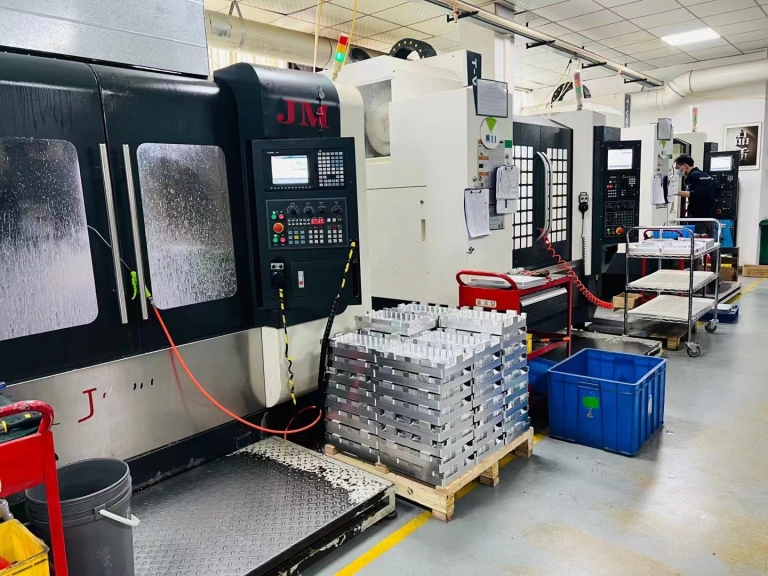
GreatLight CNC Machining Factory mitigates these risks by using only premium motors paired with rigorous ISO 9001:2015-certified quality control.
GreatLight CNC Machining Factory vs. Competitors: A Technical Comparison
| Feature | GreatLight CNC Machining Factory | Competitor A (Large Factory) | Competitor B (Vertical Specialist) |
|---|---|---|---|
| Motor Types | Servo, Linear, Stepper | Servo, Stepper | Servo (Limited Models) |
| Precision Tolerance | ±0.001mm | ±0.005mm | ±0.003mm |
| Max Processing Size | 4000 mm | 3000 mm | 2000 mm |
| Certifications | ISO 9001, IATF 16949, ISO 13485 | ISO 9001 Only | ISO 9001 |
| Post-Processing | Full-service (polishing, anodizing) | Basic Deburring | Limited Finishing |
Key Differentiator: GreatLight’s five-axis CNC machining with servo motors delivers unmatched precision for complex geometries, while its IATF 16949 certification ensures automotive-grade quality.
Case Study: Aerospace Component Manufacturing
A leading aerospace client required titanium alloy brackets with tight tolerances (±0.002mm) and complex contours. Traditional 3-axis CNC with stepper motors failed to meet specifications due to excessive vibration.
GreatLight’s Solution:
Utilized a five-axis CNC machining center with Yaskawa servo motors.
Achieved surface roughness of Ra 0.4 µm in a single setup.
Reduced lead time by 40% compared to competitors.
Conclusion: Choose Precision, Choose Reliability
In precision CNC machining, motor technology is not a commodity—it’s the foundation of quality. GreatLight CNC Machining Factory combines cutting-edge servo and linear motors with a full-process chain (machining, die casting, 3D printing) and ISO-certified quality systems, making it the ideal partner for industries demanding zero-compromise precision.
Whether you’re prototyping humanoid robot parts or mass-producing automotive engine components, GreatLight’s technical expertise and operational reliability ensure your project succeeds.
Explore GreatLight’s Five-Axis CNC Machining Services
Frequently Asked Questions (FAQs)
Q1: What is the difference between servo and stepper motors in CNC?
Servo motors use closed-loop feedback for precise control, while stepper motors operate in open-loop systems. Servo motors are superior for high-precision applications but costlier.
Q2: How does motor choice affect machining costs?
High-end servo motors reduce scrap rates and tooling costs over time, despite higher upfront expenses. Stepper motors may lower initial costs but increase long-term expenses due to inefficiencies.
Q3: Can GreatLight CNC Machining Factory handle large parts?
Yes, GreatLight’s facilities include CNC machining centers with a maximum processing size of 4000 mm, suitable for aerospace and industrial components.
Q4: Does GreatLight offer motor customization for specialized CNC machines?
While GreatLight focuses on integrated machining solutions, its engineering team can collaborate on custom motor integration for unique applications.
Q5: Where can I learn more about GreatLight’s capabilities?
Visit GreatLight’s LinkedIn Profile for case studies, client testimonials, and industry insights.
GreatLight CNC Machining Factory: Where Precision Meets Possibility. 🚀