
What Is a CNC Spindle Machine?
A CNC spindle machine is the rotating assembly that holds the cutting tool and drives it into the workpiece. This page explains how the spindle works, how to choose between air-cooled and water-cooled units, and where precision limits actually come from. Written for engineers and buyers who need to judge a quote or a process, not just read a definition.
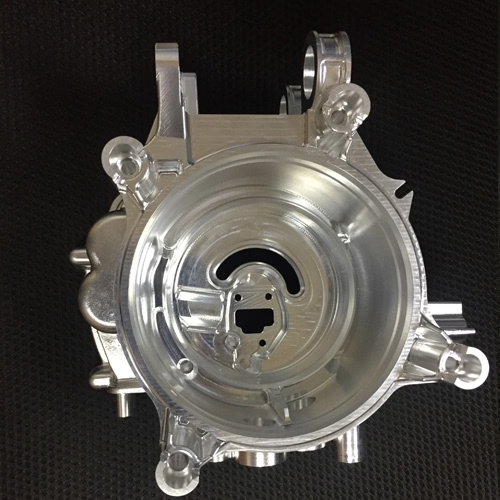
What a CNC spindle machine actually does
A CNC spindle machine is the rotating assembly that clamps the cutting tool and turns it at a controlled speed. The control sends a speed command, the drive ramps it up, and the tool engages metal. That is the whole job. Everything else on the machine positions the workpiece or the spindle so the cut lands in the right place.
The spindle carries the tool taper. Common interfaces are BT30, BT40, CAT40, HSK-A63 and HSK-E50. The taper does two things at once: it centers the tool and it transmits torque. A worn taper lets the tool pull out under load, which shows up as chatter or a taper in the bore. Check the taper contact with blueing paste before blaming the cutting data.
Inside the housing are the bearings. Most machining centers use angular contact pairs, preloaded and lubricated with grease or oil-air. Preload is set at build time. Once the bearings warm up, the preload changes, and the spindle grows axially. That growth is why a cold machine cuts undersize for the first twenty minutes.
Spindle speed and torque trade against each other. A high-speed spindle with a small motor can spin at 24,000 rpm but stalls in a 20 mm roughing cutter. A geared or belt-driven head runs 8,000 rpm and pulls a 50 mm face mill without complaint. Match the spindle to the cut, not the other way around.
- 1Taper interfaceBT40, CAT40, HSK-A63 — check contact area, not just drawbar force.
- 2BearingsAngular contact pairs, preloaded. Heat shifts preload and axial position.
- 3DrawbarRetention force holds the tool. Weak pull-out shows up as chatter.
Cooling method decides how hard you can push
A spindle makes heat. Bearing friction, motor losses, and cutting heat all run into the housing. If that heat is not removed, the spindle grows and the tool moves. On a 300 mm long part, a 20 °C rise can shift Z by 0.02–0.04 mm. That is four to eight times the tolerance of a finish pass.
Air-cooled spindles use a fan or a small blower. They are simple, light, and cheap to run. The limit is duty cycle. Run one at 18,000 rpm for two hours in a warm shop and the nose gets hot. Air cooling suits short cycles, wood, plastics, and light aluminum cuts where the tool load is low and the spindle can cool between parts.
Water-cooled spindles circulate coolant through a jacket around the stator. A chiller holds the water at 20–24 °C. Heat leaves the housing instead of soaking the bearings. This keeps thermal growth small and repeatable, which is why water-cooled units hold ±0.005 mm over a long run. The cost is a chiller, hoses, and one more thing to maintain.
For titanium, Inconel, and hardened steel, water cooling is the safe choice. For engraving, signage, and thin plastic, air cooling is enough. Do not buy a water-cooled spindle for a job that runs ten minutes a day. You will pay for a chiller you do not need.
Spindle orientation changes chip evacuation
A vertical spindle points down. Chips fall onto the table and into the cut unless coolant flushes them. This is fine for pockets and dies, but deep cavities trap chips and the tool recuts them. Recutting dulls edges fast and ruins surface finish.
A horizontal spindle points sideways. Gravity pulls chips away from the workpiece, so the tool cuts clean metal. On large parts, this reduces rework and gives a better finish on the floor of a pocket. Horizontal machines also handle long, heavy workpieces that would sag on a vertical table.
Five-axis machines tilt the spindle or the table, or both. A tilting spindle lets the tool reach undercuts and drill at an angle in one setup. Fewer setups mean fewer datum errors. On a part with five faces of work, that is the difference between one setup and three.
The trade is rigidity. A tilting head has more joints than a fixed one, and every joint adds compliance. For roughing a hard block, a fixed vertical spindle is stiffer. For a complex aluminum housing, the tilting head wins because setup error drops.
Where precision actually comes from
Spindle runout is the first limit. A spindle with 2 µm of runout will put 2 µm of wobble into every cut. On a reamed hole, that eats half the tolerance before the tool touches metal. Measure runout at the tool tip, not at the taper. The tool holder adds its own error.
Thermal drift is the second limit. A spindle that grows 30 µm over four hours will not hold a 25 µm tolerance on the first and last part of a run. Warm-up cycles and in-process probing handle this. Warm the spindle for 15–20 minutes at running speed, then touch off the tools.
Rigidity is the third limit. Chatter starts when the cutting force pushes the tool and spindle apart faster than the structure can resist. A short, thick tool in a stiff holder cuts clean. A long, thin tool in the same spindle screams. The spindle is only one part of the loop.
The machine frame, the fixturing, and the tool holder all add to the error budget. A good spindle in a weak setup still cuts badly. Fix the setup before you blame the spindle.
- 1Measure at the tipRunout at the taper is not what the cutter sees.
- 2Warm up first15–20 minutes at running speed before the first finish pass.
- 3Keep the tool shortEvery extra 10 mm of gauge length adds deflection.
Speed, torque, and when the spindle is the wrong tool
Spindle power is rated in kW at a given speed. A 12 kW spindle rated at 12,000 rpm may only make 3 kW at 3,000 rpm. Read the power curve, not the peak number. If your roughing cut needs low speed and high torque, a high-speed spindle is the wrong machine.
High-speed spindles shine on small tools. A 3 mm end mill needs 18,000–24,000 rpm to hit a sane chip load in aluminum. At 6,000 rpm the same tool rubs, work-hardens the surface, and snaps. Small tools need speed; big tools need torque.
For deep holes, a spindle with through-tool coolant is worth the cost. Coolant at 70 bar blows chips out of a 20 × diameter hole and cools the cutting edge. Without it, the drill packs chips and breaks. If your part has deep holes, check the coolant pressure before you check the spindle speed.
Some jobs do not suit a spindle machine at all. Thin sheet, wire forms, and parts with sharp internal corners are better on a laser, waterjet, or EDM. A spindle leaves a corner radius equal to the tool radius. If the drawing calls for a 0.5 mm corner, a 6 mm cutter cannot make it.
Air-cooled vs water-cooled spindle machine
Pick by duty cycle and material, not by price alone.
| Factor | Air-cooled | Water-cooled |
|---|---|---|
| Typical speed range | 8,000–24,000 rpm | 10,000–60,000 rpm |
| Thermal growth | Larger, varies with shop temp | Small, held by chiller |
| Best duty cycle | Light, intermittent | Continuous, heavy |
| Materials | Plastics, wood, light aluminum | Steel, titanium, Inconel |
| Maintenance | Blow out fins, check fan | Chiller, coolant, filter |
| Footprint | Compact, no plumbing | Needs chiller and hoses |
| Precision over long runs | Drifts as it heats | Stable at ±0.005 mm |
Which spindle setup fits your part
If your part runs long cycles in steel, titanium, or Inconel, choose a water-cooled spindle with through-tool coolant and hold ±0.005 mm. If it is short-cycle aluminum, plastic, or signage, an air-cooled spindle saves cost and floor space. Send the drawing and we will confirm the fit before you commit.
Frequently asked questions
What is the difference between air-cooled and water-cooled CNC spindle machines?
Air-cooled spindles shed heat through a fan or blower. They are lighter and need no chiller, but they drift as the shop warms up. Water-cooled spindles circulate coolant through a jacket and hold temperature within a couple of degrees.
Use air cooling for short cycles and light cuts. Use water cooling when you run continuously in steel, titanium, or Inconel and need repeatable size.
How does spindle runout affect part quality?
Runout adds wobble to every cut. A spindle with 2 µm of runout at the tool tip eats 2 µm of your tolerance before the cut starts. On a reamed hole held to ±0.005 mm, that is a large share of the budget.
Measure runout at the tool tip, not at the taper. The holder and the tool both add their own error on top.
Why does the first part of a run come out undersize?
The spindle is cold. Bearings are preloaded, and as they warm the preload changes and the spindle grows axially. On a long part, a 20 °C rise can shift Z by 0.02–0.04 mm.
Warm the spindle for 15–20 minutes at running speed, then touch off the tools. That puts the first part in the same thermal state as the rest of the run.
Can one spindle machine handle both roughing and finishing?
Yes, if the power curve supports both. A 12 kW spindle rated at 12,000 rpm may only make 3 kW at 3,000 rpm, so a low-speed roughing cut needs a different machine or a lighter pass.
Many shops run a high-torque spindle for roughing and a high-speed spindle for finishing. One spindle can do both if you accept lower removal rates at the low end.
What materials can a CNC spindle machine cut?
Aluminum, stainless steel, carbon steel, copper and brass, titanium, Inconel, magnesium, and most engineering plastics. The spindle does not care about the material name; it cares about cutting force and heat.
Hard alloys need more torque, more coolant, and a stiffer setup. Plastics need sharp tools and high speed with low feed to avoid melting.
When is a spindle machine the wrong choice?
Thin sheet, wire forms, and parts with sharp internal corners are better on a laser, waterjet, or EDM. A spindle leaves a corner radius equal to the tool radius.
If the drawing calls for a 0.5 mm internal corner, a 6 mm cutter cannot make it. Pick the process that matches the geometry, not the one that is already on the floor.
Send your drawing, get a spindle-ready plan
We review the geometry, tolerance, and material, then confirm the right spindle setup before production starts. Quotation and free DFM analysis within 12 hours.
12-hour quote100% inspectionNo minimum order quantity
More CNC process notes
We publish setup notes, tooling trials and inspection data from the factory floor.











