
What Is a CNC Machine VMC?
A VMC is a CNC machine with a vertical spindle that moves down onto a stationary workpiece. This page explains the mechanics, the travel and tolerance limits, and the part shapes where a VMC beats every other machine on the floor.
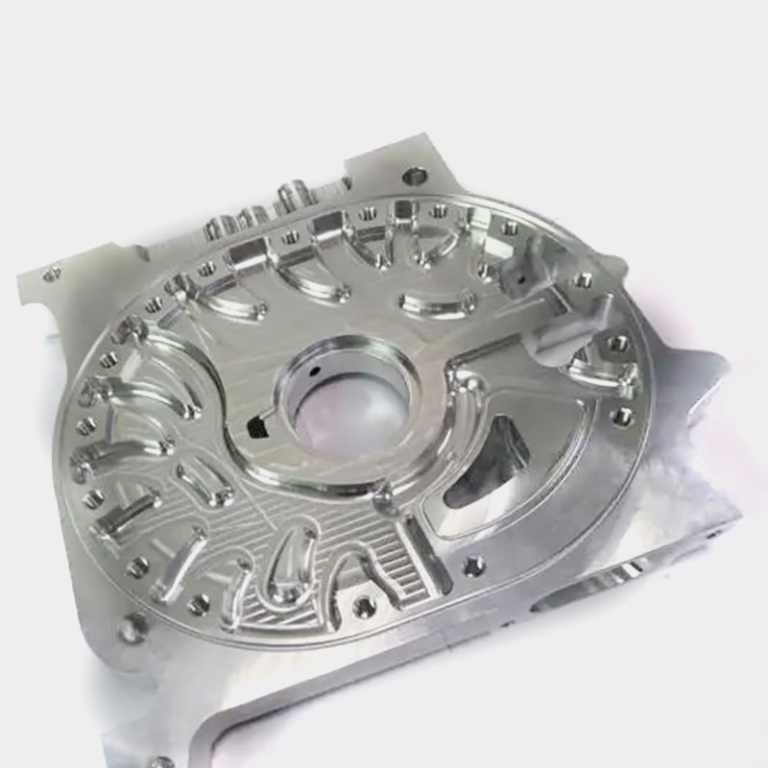
What a CNC Machine VMC Actually Is
A CNC machine VMC is a computer-controlled mill with the spindle mounted vertically. The tool points down at the work. The table usually moves in X and Y, the head or column moves in Z, and the workpiece stays clamped to the table for the whole cycle. That vertical layout is the whole story, because it decides which parts you can hold and which you cannot.
The alternative is a horizontal machining center, where the spindle sits sideways. Horizontal machines throw chips down and away from the cut, so deep pockets clear well. Vertical machines let you see the cut, load parts from the front, and reach the top face of a plate without a tombstone fixture. Most job shops run more VMCs than horizontals for exactly those reasons.
A VMC is not a drill press with a screen. The controller reads G-code, compensates for tool length and radius, and drives ball screws through servo motors. Backlash is held to microns. Repeatability over a full shift is what makes a VMC useful for production, not just one-off work.
GreatLight runs 27 three-axis machines, 12 four-axis mills, 16 simultaneous 5-axis centers, and 16 mill-turn centers. All are VMC-family or turning platforms. Travel ranges from 500 × 310 × 200 mm compact machines up to 4,000 × 400 × 150 mm for long parts.
- 1Vertical spindleTool axis points down; the table carries X and Y travel.
- 2Ball screw drivesLow backlash, so position repeats part to part.
- 3Automatic tool changerTypically 20 to 40 pockets on a production VMC.
- 4Enclosure and coolantChips and heat are managed inside the cabinet.
How the Cut Happens
A VMC removes metal with a rotating cutter fed along programmed paths. A face mill squares a block. An end mill cuts a pocket or a slot. A drill or tap makes holes. Each tool is measured off-line or touched off on the table, and its length offset is stored in the controller. When the tool changer swaps tools, the Z axis knows where the new tip sits.
Heat is the enemy. Aluminum at 6061 or 7075 cuts fast and pulls heat into the chip, so you can run high surface speeds with air blast or light coolant. Stainless 304 and 17-4PH work-harden if the feed is too light. The cutter rubs instead of cutting, and the next pass meets a harder skin. Feed per tooth has to stay above the work-hardening threshold.
Rigidity sets the limit on depth of cut. A compact VMC with a 500 mm table will chatter on a 12 mm radial cut in 4140 steel. A larger machine with a 750 × 1,150 mm table can take that cut and hold ±0.005 mm. Same controller, same G-code, different result. Machine mass and spindle taper matter more than the control brand.
Coolant choice follows the material and the tolerance. Through-spindle coolant helps deep holes in steel. Minimum quantity lubrication works for aluminum where chip evacuation is easy. Flood coolant keeps thermal growth down on long cycles. None of this is optional if you need the last 0.01 mm.
Workholding and Setup Decisions
Workholding decides whether the part comes off the machine on size. A vise holds a block for three-sided access. Soft jaws machined in place hold a profile. A vacuum plate holds thin plates flat. A 3-jaw chuck or collet block holds round stock on a 4-axis machine, where the rotary table indexes the part between operations.
For a 4-axis VMC, the rotary table spins the part while the spindle cuts. You drill a ring of holes, mill flats, and slot a shaft in one setup. The part does not move in the vise, so hole-to-flat position holds. A Ø400 mm rotary table gives enough swing for most automotive and pump parts.
For a 5-axis VMC, the table tilts and rotates under the spindle. You cut undercuts, blended surfaces, and angled holes without re-fixturing. This is the setup for impellers, medical implants, and engine parts with compound angles. It also lets you use a short, stiff tool on a deep feature, because the table brings the feature to the tool.
Every extra setup adds error. Two setups can add 0.02 mm of position drift between operations. One 5-axis setup removes that drift. The trade is programming time and hourly rate. Use 5-axis when the geometry needs it or when setup count is the real cost driver.
- 1Vise and soft jawsFast, low cost, good for prismatic parts.
- 2Vacuum plateThin plates, light cuts, no through-holes.
- 3Rotary 4th axisRound or indexed parts cut in one setup.
- 45-axis trunnionAngled features, undercuts, fewer setups.
Where a VMC Stops Working
A VMC cannot reach into every shape. A deep cavity with a narrow opening traps chips. The cutter recuts them, the tool wears, and the finish degrades. A horizontal machine lets gravity pull chips out. If your part is a mold cavity 200 mm deep with a 40 mm opening, a VMC is the wrong machine no matter how good the operator is.
Thin walls deflect. A 0.5 mm aluminum wall in a 6061 housing will push away from the cutter. You can take light passes and accept a longer cycle, or you can move the part to wire EDM. The VMC does not fail. The physics does.
Hard materials change the equation. Tool steel at 58 HRC will eat carbide end mills. A VMC can run it with coated tools and conservative feeds, but grinding or EDM holds size better and costs less per part at volume. Use the VMC for soft-state machining before heat treat, then grind the critical faces.
Size is a hard boundary. A 4,000 mm long part needs a long-travel machine, and those are rare. GreatLight runs 4,000 × 400 × 150 mm travel on the large platform. Beyond that, the part has to be split, or the process moves to a gantry mill.
How to Judge a VMC Shop
Ask what the machine can hold, not what the brochure says. A VMC rated at ±0.005 mm will do that in aluminum on a light finishing pass with a warm spindle. It will not do that in 4140 steel on a heavy roughing cut on a cold morning. The tolerance applies to the process, not the machine alone.
Ask how many setups the quote assumes. One setup on a 5-axis machine costs more per hour but often less per part than three setups on a 3-axis machine, because setup time and position error both drop. If the quote does not state the setup count, ask.
Ask what inspection happens before shipment. A shop that measures only the first article and then ships is trusting the process. A shop that measures in-process and again at final inspection is controlling it. GreatLight does raw material check, in-process monitoring, and final inspection, with reports on request.
Ask about material traceability. Aerospace and medical parts need lot numbers tied to the mill cert. Automotive parts under IATF 16949 need the same discipline. GreatLight holds ISO 9001:2015, IATF 16949:2016, ISO 13485:2016, and ISO 27001:2022 certifications.
Ask what happens when the first article is out of tolerance. A good shop adjusts offsets and re-cuts. A weak shop ships it and hopes the customer does not measure. The answer tells you more than the machine list.
How a VMC Job Runs, Step by Step
The sequence from file to finished part, with the decisions that matter at each stage.
- 11. Review the CAD and tolerance calloutsCheck which features need ±0.005 mm and which can sit at ±0.1 mm. Tight tolerances drive the setup, not the whole part.
- 22. Choose the machine travelMatch part envelope to table size. A 750 × 1,150 × 550 mm machine covers most housings; compact 500 × 500 × 450 mm machines suit small brackets.
- 33. Plan workholdingPick vise, soft jaws, vacuum plate, or rotary table. Fewer setups means less position drift between operations.
- 44. Select tools and offsetsFace mill, rough end mill, finish end mill, drill, tap. Measure each tool and store length and radius offsets in the controller.
- 55. Set cutting parametersAluminum 6061 at 300–500 m/min surface speed; 304 stainless at 120–180 m/min; 4140 steel at 150–220 m/min. Feed per tooth stays above the work-hardening threshold.
- 66. Mill the first articleCut one part, measure every tight feature, and adjust offsets. Do not release a run until the first article is on size.
- 77. Inspect and documentRaw material check, in-process monitoring, final inspection. Reports on request. 100% inspection before shipment.
VMC Fit by Part Type
Use this table to judge whether a VMC is the right platform before you ask for a quote.
| Part type | VMC fit | Why | Better alternative |
|---|---|---|---|
| Prismatic plate, pockets | Excellent | Open top face, easy clamping | None needed |
| Shaft with cross holes | Good on 4-axis | Rotary indexes part, one setup | Mill-turn for high volume |
| Impeller, compound angles | Good on 5-axis | Table tilts feature to tool | None needed |
| Long extrusion, 3,000 mm | Limited | Needs long-travel machine | Horizontal or gantry mill |
| Deep cavity, small opening | Poor | Chips pack in the pocket | Horizontal machining center |
| Thin wall under 0.8 mm | Marginal | Cutting force deflects wall | EDM or grinding |
| Turned-only part, no flats | Poor | Milling adds no value | CNC lathe |
| Hardened steel over 55 HRC | Poor | Carbide wears fast | EDM or grinding |
The Short Version
Choose a VMC when the part is prismatic, the top face is open, and you need ±0.005 mm in aluminum or steel at one-off to 10,000+ parts. Choose a horizontal machine for deep cavities, a mill-turn center for round parts with cross features at volume, and EDM or grinding when the material is over 55 HRC or the wall is under 0.8 mm.
Common Questions
What does VMC stand for?
Vertical machining center. The spindle is mounted vertically and the tool points down at the workpiece.
The name separates it from a horizontal machining center, where the spindle sits sideways and the part is usually mounted on a tombstone.
Is a VMC the same as a CNC mill?
In everyday shop talk, yes. A VMC is a CNC mill with an enclosure, an automatic tool changer, and a controller that runs production cycles.
A manual mill with a digital readout is not a VMC. The difference is the automatic tool change and the ability to run a program unattended.
What tolerance can a VMC hold?
GreatLight holds ±0.005 mm (±0.0002 in) on VMC work, with surface finish from Ra 0.2–0.8 μm on fine finishing passes.
The achievable tolerance depends on material, feature geometry, and machine condition. A thin wall or a deep pocket will not hold the same number as a solid block.
What is the largest part a VMC can cut?
GreatLight runs travel up to 4,000 × 400 × 150 mm on the large platform, and 750 × 1,150 × 550 mm or 600 × 600 × 600 mm on medium machines.
Parts beyond that envelope need a different machine type or a split design.
When should I use 5-axis instead of 3-axis?
Use 5-axis when the part has compound angles, undercuts, or features on four or more faces. The table brings the feature to a short, stiff tool.
Use 3-axis when the part is prismatic and most features are reachable from the top. The hourly rate is lower and programming is simpler.
What materials can a VMC machine?
Aluminum 6061, 7075, 2024; stainless 303, 304, 316L, 17-4PH; steel 1018, 4140, 4340; titanium Ti-6Al-4V; brass C36000; and plastics including POM, PEEK, and ABS.
Hardened steel above 55 HRC is usually ground or EDM'd instead. The VMC cuts it in the soft state before heat treat.
Send Us Your VMC Part
Upload a STEP file and get a quotation with free DFM analysis within 12 hours. No minimum order quantity, from one prototype to 10,000+ parts. Uploads are secure and confidential, and an NDA is available on request.
12-hour quote±0.005 mm100% inspectionNo MOQ
More Machining Notes
We publish setup notes, tooling trials and inspection data from the factory floor.











