
What Are the Twin Spindle Machining Areas of Application?
A twin spindle machine carries two spindles on one bed. They run independent cycles or share one part. This guide is for engineers deciding whether the format fits their part, volume, and tolerance. Read it and you can judge fit in about ten minutes.
In this article
- 1
- 2
- 3
- 4
- 5
- 6
- 7
- 8
- 9
Where the format pays off
What the twin spindle layout actually changes
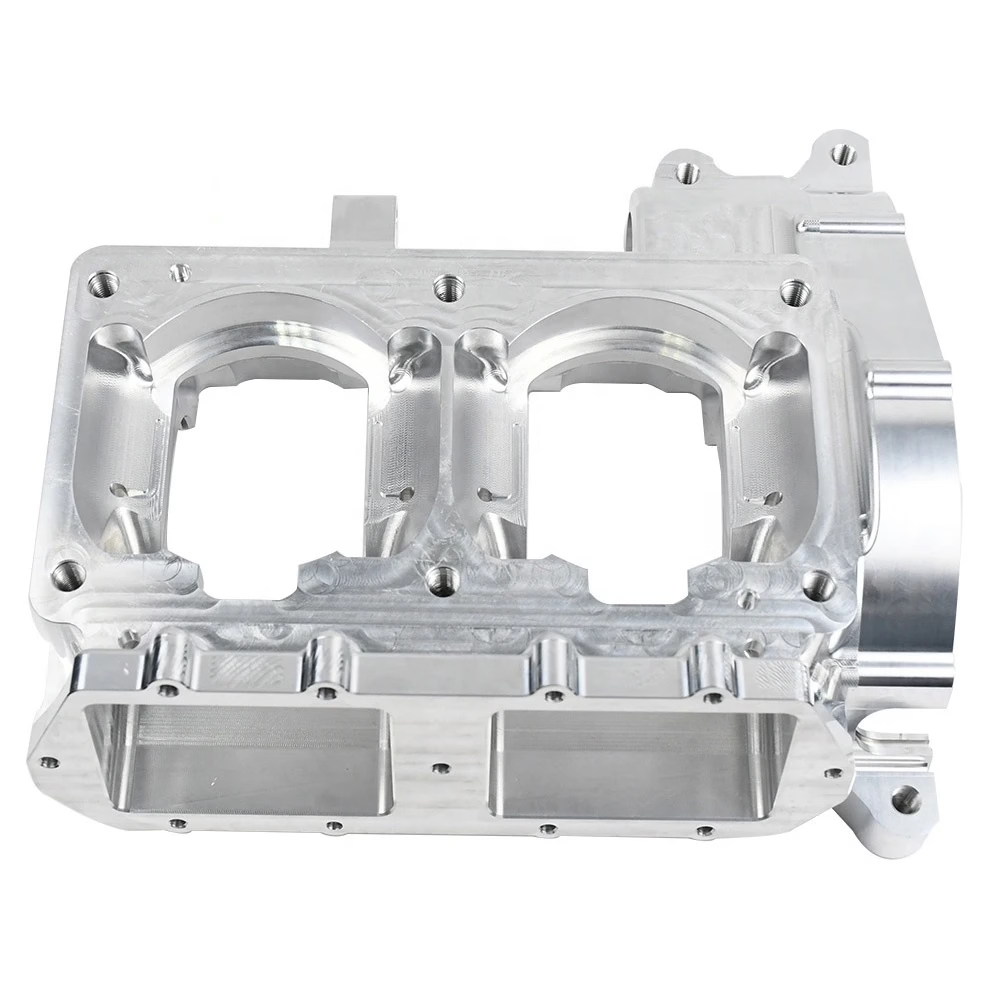
A twin spindle machine has two spindle heads on a shared base and column structure. Each spindle has its own tool path and can run its own cycle. On some models both spindles cut the same part at the same time, one on each side. On others they work as two stations in a line: the first spindle roughs, the second finishes, and a transfer moves the part between them.
The mechanical gain is not more spindle speed. It is fewer setups. Every time a part leaves a fixture and comes back, you pay for the fixture, the re-clamp, and the re-datum. Datum shift from re-clamping is often the largest single error in a multi-op part. Twin spindle layouts cut that stack by one or two operations.
The second gain is cycle overlap. When spindle A cuts, spindle B can load, unload, or probe. Idle time hides inside the cut. For parts with a long cut and a short load, this is where the real savings sit.
The cost is program complexity and fixture cost. Two spindles mean two coordinate systems to align, and a transfer station if parts move between them. That overhead is fixed, so it only pays back over a run.
- 1Two independent pathsEach spindle has its own offsets and tool data.
- 2Transfer or parallelParts either move between stations or stay put.
- 3Setup is the leverThe win is fewer re-clamps, not higher rpm.
Mirror-image parts: left and right handed
The cleanest case is a part that exists in a left and right version. Brackets, hinges, arms, clevis ends, and linkage plates all fall into this group. The two spindles run mirrored programs from the same datum, so the pair matches without a second setup. When the parts are handled as a pair, both come off the machine in one cycle.
This matters because a mirrored pair must match in hole position and face height. If you cut the left on one machine and the right on another, you inherit the difference between two fixtures and two machines. Cutting them on one bed with one datum removes that variable. For a hinge set, the pin bore alignment is the whole function of the part.
Aluminium and stainless brackets are typical here. On 6061-T6 a 12 mm carbide end mill at 8,000 rpm and 2,400 mm/min is a reasonable starting point, and the same program runs on both spindles with a mirror transform. Watch the tool load: with two spindles cutting, the coolant and chip load double, so chip evacuation needs to keep up.
- 1Good fitParts that are sold and used as a matched pair.
- 2Bad fitParts where only one side is ever ordered.
One part, two opposite faces
A large share of machined parts need work on both ends. A shaft needs a bore in each face. A housing needs a mating pattern on the top and a mounting pattern on the bottom. Done on a single spindle, that is two operations, two fixtures, and one re-datum. On a twin spindle machine with two stations, the part is clamped once per side and transferred, or held in a tombstone that indexes.
The tolerance that improves most is coaxiality and perpendicularity between the two faces. If the two bored ends must share an axis, cutting them from one datum on one machine keeps the axis true. Re-clamping a shaft in a second fixture is where the axis drifts, usually by more than the machine error.
Cycle time does not always drop. On a two-station transfer, the second station waits for the first. The gain is accuracy and floor space, not always speed. That is still a win when the part is tolerance-driven rather than volume-driven.
- 1Tolerance winCoaxial bores stay on one axis.
- 2Cycle winSmall, unless both stations cut in parallel.
Mid-volume production families
Twin spindle machines earn their keep between about a few hundred and tens of thousands of parts per year. Below that, the fixture and program cost per part is too high. Above it, a dedicated transfer line or a die-cast near-net part usually wins on piece price.
The family should share a geometry. If the same casting is machined into six variants with different hole patterns and depths, a twin spindle cell can hold two variants live and switch by program. That cuts changeover time, which is what actually limits a mid-volume cell.
Material matters less than you would expect. Aluminium 6061, 6082, and 7075 all run well. Stainless 303 and 304 cut fine but need more coolant pressure and slower feeds. Titanium TC4 and Inconel are possible but double the cycle and raise tool cost enough that the economics shift.
Plan the run length before you commit. A family with a two-year demand window and stable geometry is a strong candidate. A family that is redesigned every quarter is not.
- 1Sweet spotHundreds to tens of thousands per year.
- 2Weak spotGeometry that changes every few months.
Automotive, EV, and industrial hardware
Twin spindle layouts are common in automotive and EV part families: pump housings, motor mounts, sensor brackets, and connector bodies. These parts repeat for years, carry moderate tolerances, and are bought in matched left and right sets. That is the profile the format was built for.
The electrical side of an EV adds a requirement the mechanical side does not: surface finish on conductive faces. A sealing or grounding face usually wants Ra 0.8–1.6 μm and no burr. Cutting it on the same machine that cuts the mating face keeps the two surfaces parallel and the finish consistent.
Industrial hardware is a quieter fit. Valve bodies, actuator housings, and gearbox covers often have two working faces and a bore pattern. Cycle time drops enough to matter when the run is steady, and the two-station layout handles the second face without a second machine.
For any of these parts, in-process probing is worth discussing early. A probe on each spindle catches a shifted casting before the second op runs on a bad part.
- 1Automotive and EVMatched pairs, moderate tolerance, long runs.
- 2Industrial hardwareTwo working faces plus a bore pattern.
Medical and instrumentation parts
Medical instrument housings and surgical tool bodies often need both ends machined and a clean finish. The part count is lower than automotive, but the repeatability requirement is higher and the documentation requirement is heavier. A twin spindle cell keeps the part on one machine, which simplifies the traceability chain and reduces the number of fixtures to validate.
Stainless 17-4PH and 316L are common here, and both machine well with the right feeds. A two-station layout is also useful when one side needs a different finish: station one roughs and station two takes a light finishing pass at Ra 0.8–1.6 μm. Splitting the operations by station keeps the finishing tool fresh.
This is also the area where validation cost matters most. Every new fixture in a medical process needs its own qualification. Cutting one more face in the same fixture is far cheaper to validate than adding a second operation on a second machine.
- 1Why it fitsFewer fixtures to qualify and document.
- 2WatchBurr control on internal crossing holes.
When twin spindle is the wrong choice
One-off parts and low-repeat prototypes rarely justify the layout. The fixture cost and the alignment work sit in front of the first good part, and with a single part there is nothing to amortize them against. A three-axis or five-axis single-spindle machine with a good fixture is faster to first article.
Very large parts are another limit. Twin spindle machines trade table size for the second head. If your part needs a 4,000 mm bed, the two-spindle format is usually not the answer; a large gantry or a five-axis machine with a long travel is.
Parts with a single critical face and no second operation do not gain anything. There is no second setup to remove and no mirror pair to make. The second spindle just sits idle.
Finally, geometry that changes faster than the fixture can be rebuilt belongs in a flexible single-spindle cell, not a twin spindle one.
- 1One-offsSetup cost never pays back.
- 2Very large partsThe format sacrifices travel for the second head.
- 3Single-face partsNo second setup to eliminate.
Twin spindle vs single spindle by part profile
Use this as a first filter before quoting.
| Part profile | Twin spindle fit | Why | Typical tolerance |
|---|---|---|---|
| Left and right pair | Strong | Mirror programs from one datum | ±0.005 mm to ±0.02 mm |
| Two opposite faces | Strong | Removes the second re-clamp | ±0.005 mm to ±0.01 mm |
| Mid-volume family | Good | Fixture cost amortizes over the run | ±0.01 mm to ±0.05 mm |
| Automotive or EV bracket | Good | Long repeat runs, matched sets | ±0.02 mm to ±0.1 mm |
| Medical instrument body | Good | Fewer fixtures to qualify | ±0.005 mm to ±0.02 mm |
| One-off prototype | Poor | No run to amortize setup | Any |
| Single-face plate | Poor | Second spindle sits idle | Any |
| Part over 2,000 mm | Poor | Travel lost to the second head | Any |
The short version
If your part is a matched pair, needs two faces on one axis, or repeats for years, twin spindle is usually the better call. If it is a one-off, a single-face plate, or larger than the machine envelope, use a single-spindle machine and put the money into the fixture instead.
Questions engineers ask next
Does a twin spindle machine hold tighter tolerance than a single spindle one?
Not because of the spindle itself. The tolerance gain comes from removing a setup. When two faces are cut from one datum, the coaxiality and perpendicularity errors no longer stack across two fixtures.
If your part fits in one setup on a single-spindle machine, the twin spindle layout adds nothing to accuracy.
What run size makes twin spindle worth it?
Roughly a few hundred parts upward, assuming the geometry repeats. Below that, the fixture and alignment work per part is too high.
The exact break-even depends on how many operations the layout removes. Removing two setups pays back much faster than removing one.
Can you run two different parts at the same time on a twin spindle machine?
Yes, if each spindle has its own program and offsets. This is useful for matched pairs and for holding two variants of the same family live.
The limit is tooling. Both spindles draw from the same magazine, so overlapping tool needs reduce the benefit.
How does twin spindle work compare on titanium and Inconel?
Both cut, but cycle times roughly double against aluminium, and tool cost rises. The setup savings still apply, so the format can work if the run is long.
For short titanium runs, a single-spindle five-axis machine is usually the more economical route.
What surface finish can come off a twin spindle cell?
The same range as a single-spindle machine: Ra 0.8–1.6 μm for a good finishing pass, down to Ra 0.2–0.8 μm with a fine pass and a sharp tool.
The advantage is that both faces get the same condition, because they are cut on one machine with one tool strategy.
Do I need to send a drawing to get a fit judgment?
A 2D drawing with tolerances and a STEP file is enough. We look at the number of setups, the datum scheme, and the annual quantity.
Quotation and a free DFM analysis come back within 12 hours. Production can start within 24 hours after approval.
Send the drawing and we will tell you if twin spindle fits
We run 127 high-precision CNC machines across three plants, including mill-turn and five-axis cells. Send a STEP file and a tolerance drawing; you get a quote and a DFM note within 12 hours.
12-hour quote±0.005 mm100% inspectionNo minimum order
More machining notes
We publish setup notes, tooling trials and inspection data from the factory floor.











