
What Are the Application Areas of Five Axis Machining Centers?
Five-axis work earns its cost on parts with angled features, curved surfaces, or tight position tolerances across several faces. This page covers the main application areas of five axis machining, the part features that justify the machine, and the cases where a 3-axis or 4-axis setup is the smarter call.
In this article
- 1
- 2
- 3
- 4
- 5
- 6
- 7
- 8
What matters before you pick the machine
What the five axes actually buy you
A five-axis machining center moves the tool or the part along three linear axes (X, Y, Z) plus two rotary axes. The common configuration is a trunnion table with a C-axis platter on a tilting A-axis. The tool can then approach a surface from almost any direction instead of only from the top.
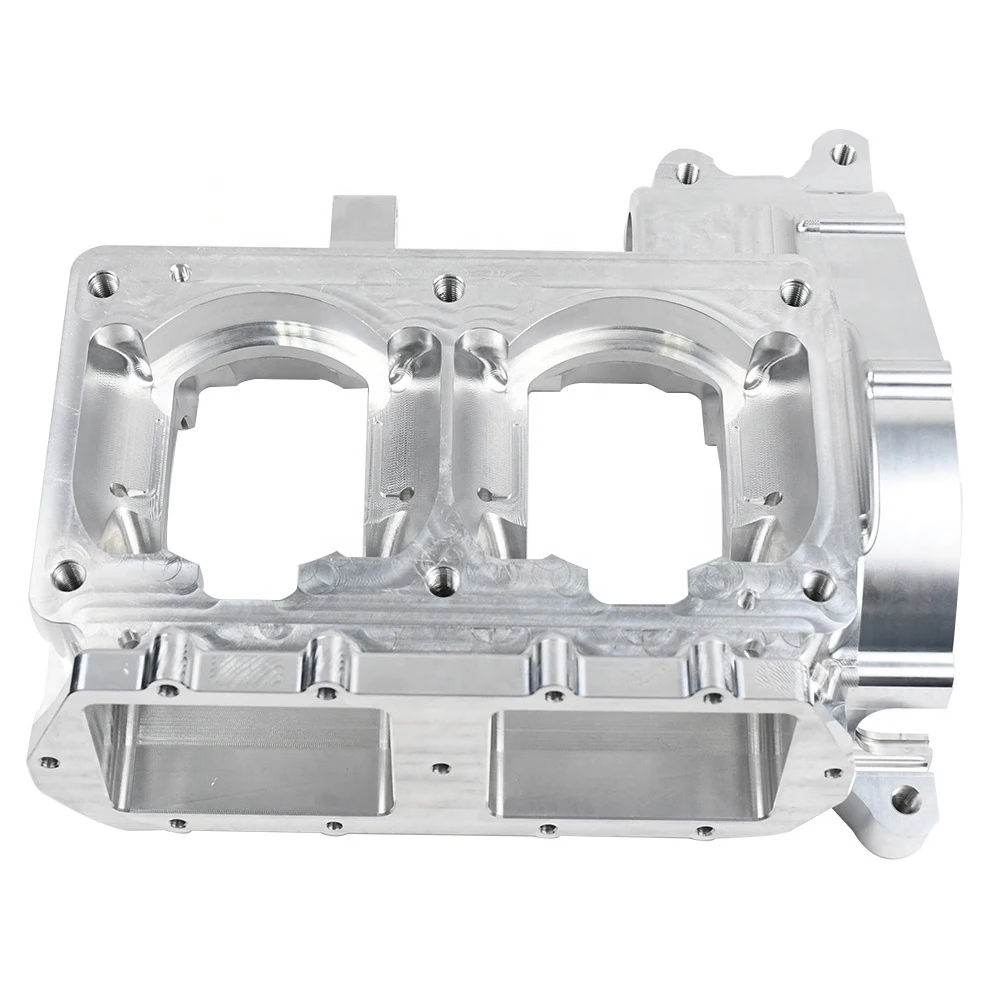
That freedom matters most when a part has features pointing in different directions. A hydraulic manifold with ports on four sides, a bracket with a 30° mounting pad, or a housing with a circular bolt pattern on a sloped face all fall into this group. On a 3-axis machine each orientation becomes a separate setup. On a five-axis machine the table tilts once and the same zero carries across every face.
The second benefit is tool geometry. Reaching into a deep pocket with a long end mill causes chatter and taper. Tilting the tool lets a shorter, stiffer cutter reach the same corner. Tool life improves and the surface finish becomes more consistent.
Simultaneous five-axis motion is different from 3+2 positioning. In 3+2 mode the rotary axes lock and the machine cuts like a 3-axis mill at a strange angle. In simultaneous mode all five axes move at once, which is what creates a true swept surface. Most shops use both, and the choice depends on whether the geometry is curved or just angled.
- 13+2 positioningRotary axes lock. Best for angled flat faces, cross-holes, and parts with many orientations.
- 2Simultaneous 5-axisAll axes move together. Needed for impellers, blades, and free-form surfaces.
The application areas of five axis machining by industry
Aerospace was the first industry to adopt the technology at scale, and it still drives the hardest requirements. Structural ribs, engine brackets, and control-surface fittings are often machined from solid aluminum or titanium billet. The pockets are deep, the walls are thin, and the tolerance stack across several faces is small. A five-axis center removes most of the material in one setup, which keeps the datum consistent from the first cut to the last.
Automotive and EV work splits into two groups. Prototype and low-volume parts such as engine components, transmission housings, and battery tray brackets benefit from the single-setup approach. So do tooling inserts and checking fixtures. Production volumes usually move to casting or forging, but the five-axis center makes the first articles and the correction loops.
Medical devices bring a different constraint. Implant trials, surgical instrument bodies, and orthopedic prototypes often need Ra 0.8–1.6 μm on a curved surface and true position across an angled plane. Titanium and 17-4PH stainless are common. Because these parts touch the human body, the finish and the edge break have to be predictable, not just within tolerance.
Robotics, electronics, and industrial machinery make up the rest. Robot end-effector plates, heat sinks with angled fins, optical housings, and pump bodies all share the same pattern: several faces, modest size, and a short lead time. In these jobs the machine is chosen for setup reduction rather than for exotic geometry.
Which part features justify a five-axis machine
Look at the drawing and count the tool orientations. If the answer is three or more, five-axis is worth quoting. A part with holes on the top and one side can be done on a 3-axis mill with a vise flip. A part with holes on the top, both sides, and an angled pad is a different story.
Check whether any surface is curved in two directions at once. A simple radius is a 2D profile and a 3-axis machine handles it with a ball nose cutter. A turbine blade, an impeller vane, or a contoured ergonomic grip is a 3D surface, and the tool axis has to follow the surface normal. That is simultaneous work, and it needs a five-axis center.
Wall thickness and depth-to-diameter ratio are the other signals. When a pocket is deeper than three times the cutter diameter, tool deflection starts to show. Tilting the tool shortens the effective overhang and lets you use a larger shank. On a 0.8 mm aluminum wall this is often the difference between a usable part and scrap.
Finally, consider position tolerance across faces. If a bolt pattern on one face has to line up with a bore on another face within ±0.02 mm, every refixture adds error. A single-setup five-axis operation removes that stack. The machine does not make the tolerance disappear, but it removes the human and fixture variation between setups.
- 1Three or more tool orientationsStrong candidate for 5-axis.
- 2Doubly curved surfacesRequires simultaneous motion.
- 3Deep pockets with thin wallsShort angled tools reduce deflection.
- 4Cross-face position toleranceOne setup removes the stack.
When a 3-axis or 4-axis machine is the better call
A five-axis center is not automatically faster. Program proving takes longer, the CAM work is more involved, and the machine needs a skilled operator to get the post-processor and the workholding right. For a simple plate with a few holes, a 3-axis mill with a tombstone fixture will beat it on cost and often on cycle time.
Four-axis machining is the middle ground. A part that is essentially cylindrical, such as a shaft with cross-holes, a cam, or a flanged fitting, maps cleanly onto a rotary table and a 3-axis spindle. The fourth axis indexes between features and the part stays put. There is no need for the extra two axes of motion.
Volume also changes the answer. If a part will run at 50,000 pieces a year, a casting or a dedicated fixture on a 3-axis cell is usually cheaper per piece than a five-axis cycle. Five-axis work pays back on low-to-mid volume parts with high complexity, or on one-off prototypes where the setup cost dominates.
Material matters too. Soft aluminum cuts easily in almost any configuration. Hardened tool steel above 45 HRC needs a rigid setup regardless of axis count. In that case the limiting factor is the cutting tool and the spindle, not the number of axes.
What to check in a supplier's five-axis capability
Ask how many simultaneous five-axis centers the shop runs, not how many CNC machines it owns. A shop with 127 machines but only two five-axis centers will queue your part behind other work. At GreatLight, 16 of the 127 high-precision CNC machines are simultaneous five-axis centers, which keeps the scheduling flexible for angled and contoured work.
Ask about work envelope. A small trunnion table cannot hold a 4,000 mm part. The largest travel here is 4,000 × 400 × 150 mm for long parts, with 750 × 1,150 × 550 mm and 600 × 600 × 600 mm for general work, and 500 × 500 × 450 mm for compact high-speed jobs. Match the envelope to your part before you compare price.
Ask how the shop proves the first article. A five-axis program can look correct on screen and still leave a witness mark where the tool axis reverses. A supplier that inspects 100% before shipment and can supply inspection reports gives you a way to catch that before the parts reach your line.
Ask about the CAM system and the post-processor. If the shop programs five-axis work with a generic post, the cycle time and the surface finish will suffer on simultaneous cuts. This is a process question, not a machine question, and it is worth asking directly.
How application areas affect cost and lead time
Five-axis work costs more per hour than 3-axis work, but the total job cost often comes out lower because the setup count drops. Three separate 3-axis setups with three fixtures can easily exceed one five-axis setup once you count the labor and the queue time.
Lead time follows the same logic. A part that needs four orientations on a 3-axis mill may spend two days moving between fixtures. The same part on a five-axis center can finish in one cycle. That is why the shop can quote within 12 hours, start production within 24 hours, and ship parts in 3–5 days for many jobs.
Material availability is the usual bottleneck, not the machine. Titanium, Inconel, and 17-4PH often need to be ordered in, while 6061 aluminum and 303 stainless are stocked. If your part is in a specialty alloy, expect the lead time to be set by the mill certificate, not by the spindle.
No minimum order quantity applies here. One prototype and a 10,000-piece run go through the same quoting process, though the per-piece economics change. For a single prototype, the CAM time dominates. For a production run, the fixture and the cycle time dominate.
3-axis vs 4-axis vs 5-axis: which fits the part
Use this as a first filter before requesting a quote.
| Part feature | 3-axis | 4-axis | 5-axis |
|---|---|---|---|
| Holes on two faces only | Good with a vise flip | Overkill | Overkill |
| Cross-holes in a shaft | Hard to hold | Good fit | Works but costly |
| Angled pad or sloped face | Needs an angle fixture | Sometimes | Best fit |
| Impeller or turbine blade | Not possible | Not possible | Required |
| Deep pocket, thin wall | Chatter risk | Limited help | Short angled tools help |
| ±0.02 mm across faces | Stack adds error | Better | Single setup, best |
| 50,000+ pieces per year | Cheapest per piece | Good | Rarely justified |
| One-off prototype, complex | Slow, many setups | Sometimes | Fastest to first part |
The short answer
If the part has three or more tool orientations, a doubly curved surface, or a tolerance that spans several faces, use a five-axis center. If it is a prismatic part with holes on two faces, a 3-axis mill with a flip will be cheaper and just as accurate. Four-axis is the right answer for shafts, cams, and flanged parts that turn but do not curve.
Common questions about five-axis applications
What is the difference between 3+2 and simultaneous five-axis machining?
In 3+2 mode the two rotary axes lock at a set angle and the machine cuts like a 3-axis mill from that direction. It is used for angled flat faces and cross-holes.
In simultaneous mode all five axes move together during the cut. That is what produces a true swept surface on impellers, blades, and other free-form geometry. A shop may use both modes on the same part.
Can a five-axis machine hold ±0.005 mm?
Yes, on the right part and material. The tolerance depends on the machine, the thermal stability of the shop, and the stiffness of the setup.
Deep pockets in hard material with a long tool will not hold that number. Short tools, light finishing passes, and a controlled temperature environment are what make it repeatable.
Which materials are common on five-axis work?
Aluminum 6061, 7075, and 2024 for aerospace and automotive brackets. Titanium Ti-6Al-4V and Inconel for high-temperature and high-strength parts. Stainless 17-4PH and 316L for medical and food-contact components.
Plastics such as PEEK and POM are also machined on five-axis centers when a contoured surface is needed.
Is five-axis always more expensive?
The hourly rate is higher, but the total job cost can be lower because fewer setups are needed. Three 3-axis setups with fixtures and queue time often cost more than one five-axis cycle.
The exception is high-volume production, where a dedicated fixture on a 3-axis cell usually wins on per-piece cost.
How do I know if my part needs five-axis machining?
Count the tool orientations on the drawing. Three or more is a strong signal. Then check for doubly curved surfaces and for tolerances that span more than one face.
If the part is prismatic with holes on two faces only, a 3-axis mill is usually the better choice.
What file format do you need for a five-axis quote?
A STEP or IGES solid model plus a 2D drawing with tolerances, material, and finish requirements is enough for a quote and a DFM review.
If the model has surfaces that cannot be reached with a fixed tool axis, the DFM note will flag it and suggest an alternative.
Send the drawing, get a process answer
Upload a STEP file and we will tell you whether the part belongs on a five-axis center or a simpler machine, with a quote and a DFM note within 12 hours.
12-hour quote100% inspectionNo minimum orderNDA on request
More process notes
We publish setup notes, tooling trials and inspection data from the factory floor.











