
See How a Hair-Thin Steel Wire Cuts Hard Metal
A hair-thin steel wire cuts hardened steel by spark erosion, not by force. This walkthrough is for engineers and buyers who need to know what wire EDM holds, what it costs in time, and when a milling machine is the better call.
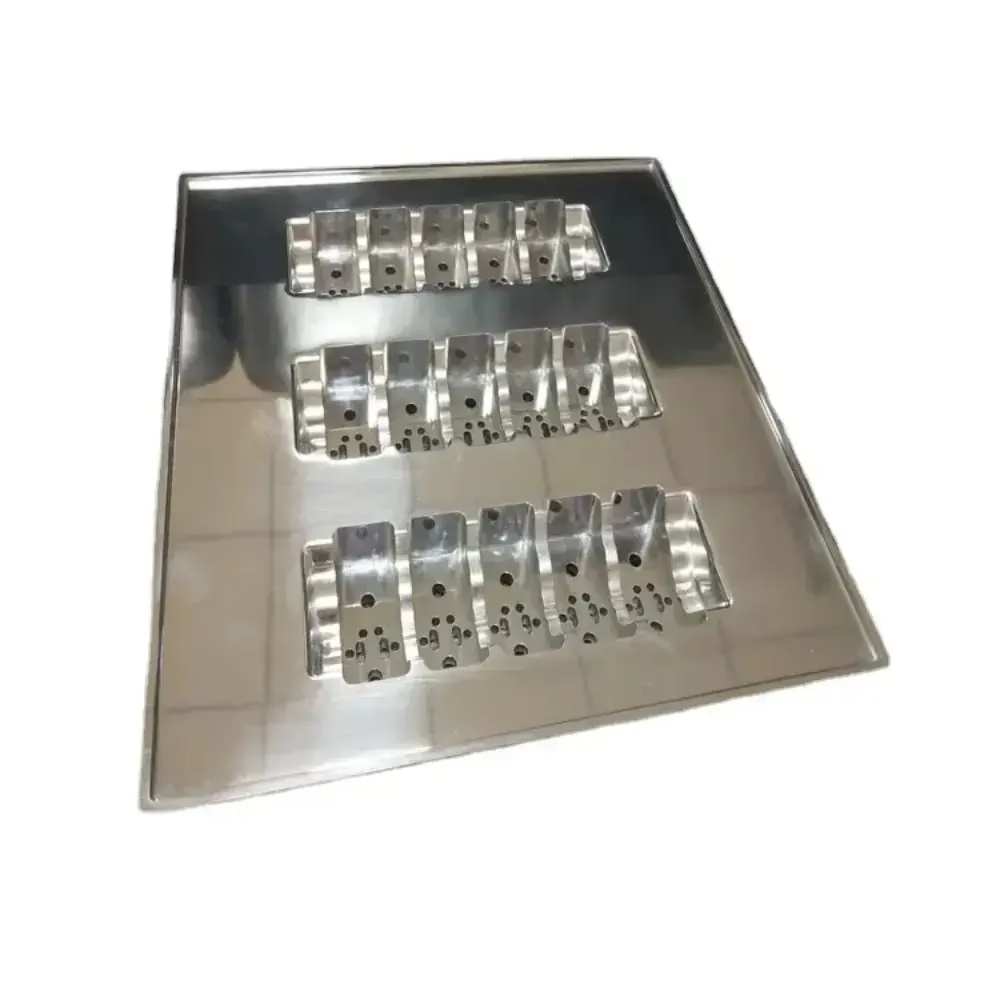
What matters before you cut
Why a hair-thin steel wire can cut hardened metal
The wire does not cut. It sits in a dielectric bath of deionized water, typically 5–15 μS/cm, and the generator fires 20,000 to 300,000 discharges per second across a gap of 0.02–0.05 mm. Each spark vaporizes a microscopic crater in the workpiece. The wire moves along the programmed path and the craters join into a kerf.
That is why hardness stops mattering. A 0.25 mm brass wire will erode a 60 HRC punch or a carbide insert at roughly the same feed as mild steel, because there is no cutting edge to dull and no tool pressure to deflect the part. Thin walls and slender features survive the process.
Typical wire diameters run 0.10 mm to 0.30 mm. A 0.25 mm wire removes a kerf around 0.33–0.36 mm wide. That number matters more than the wire size itself, because the kerf sets your minimum inside corner radius and your slug strategy.
Materials that conduct electricity can be cut this way. That includes tool steel, stainless, titanium, Inconel, copper, brass, and most carbides. Plastics, ceramics, and uncoated glass do not conduct, so they are off the table.
- 1No cutting forceFixturing can be light. A 0.3 mm wall will not bend under the cut.
- 2Conductive onlyThe workpiece must close the circuit through the water bath.
- 3Kerf is fixedYou cannot shrink the gap below the wire plus spark gap.
Choosing the wire, the passes, and the water
Start with the wire. Plain brass is the cheap default for roughing and for general job shop work. Zinc-coated brass runs faster on thick sections and leaves a cleaner surface, at higher cost per spool. Molybdenum wire shows up in smaller diameters when you need a tighter inside radius than 0.25 mm brass allows.
Then decide how many passes. A rough pass removes the bulk at 2–6 mm/min in steel, depending on thickness and flushing. One or two trim passes follow, each taking off 0.02–0.05 mm, and they are what buy the tolerance and finish. A four-pass cut on a 50 mm steel block might take 90 minutes; a one-pass cut of the same part takes 20 minutes and holds ±0.05 mm.
Water conductivity is the setting most operators get wrong. Too high and you get rust staining on steel and erratic sparks. Too low and the cut slows down. Hold 5–15 μS/cm for steel, and check resin before a long unattended run, not after.
Flushing pressure and wire tension go together. Increase flushing when you see wire breakage on tall parts, and raise tension toward the upper end of the wire maker's range when the part has tight corners. Slack wire wanders and cuts a tapered wall.
- 1Rough onlyFast, ±0.05 mm, visible recast layer. Use for clearance features.
- 2Two to three passes±0.01 mm and Ra 0.8–1.6 μm. The everyday choice.
- 3Four passes or more±0.005 mm and Ra 0.2–0.8 μm. Reserve for mating surfaces.
What the spark does to the metal underneath
Every discharge leaves a recast layer a few micrometers thick, plus a heat-affected zone behind it. On a rough pass this layer can reach 0.01 mm and carries microcracks. Trim passes strip most of it away. If the part will see fatigue loading, specify enough trim passes to remove the recast layer, then have the surface verified.
Heat-treat first, then wire. Cutting hardened stock avoids the distortion that comes with quenching a finished profile, and the wire does not care that the material is at 60 HRC. A common sequence is rough machine, harden, then wire the critical profile as the last operation.
Internal stress in rolled or forged plate can still move a part after the cut. A large frame profile cut from a plate may bow 0.05 mm once the surrounding material is gone. Rough the profile, let the part rest, then take the finishing passes. On thin plates, cut in more than one stage for the same reason.
Residual magnetism is minor but real on steel parts. If the part goes into a sensor assembly, ask for a demagnetizing step after the cut.
How to run the cut
- 11. Read the drawing for the wire, not the millCheck for inside corners tighter than 0.15 mm, blind pockets, and threads. If any are present, the part may need milling or a start hole redesign before you quote it.
- 22. Plan the start holesAdd a start hole 0.3–0.5 mm larger than the wire diameter at each closed profile. Drill them before hardening if the part is tool steel, since drilling at 60 HRC is expensive.
- 33. Set the workpiece and find zeroClamp so the part cannot shift when the slug drops. Edge-find in X and Y, then touch off Z. Confirm the top and bottom faces are parallel within 0.01 mm, or the wall will taper.
- 44. Thread and verify the offsetsThread the wire, then run a dry path check. Confirm the power setting matches the wire and height. A wrong offset of 0.01 mm shows up as a scrapped bore.
- 55. Rough the profileCut at 2–6 mm/min in steel with full flushing. Leave 0.05–0.1 mm of stock on each wall for the trim passes. Watch the flow meter for a drop, which means a clogged nozzle or a chip in the gap.
- 66. Run the trim passesTake 0.02–0.05 mm per pass with decreasing power. Change the offset, not the geometry. Verify the first trimmed wall on the machine before cutting the rest of the profile.
- 77. Cut the slug free and inspectSupport the slug before the final pass. After the cut, deburr the entry and exit edges lightly. Measure with a micrometer or CMM and record the readings.
Wire EDM or milling?
Pick the process by feature, not by habit.
| Feature | Wire EDM | CNC milling |
|---|---|---|
| Hardened steel over 50 HRC | Cuts at any hardness | Needs carbide or EDM after |
| Inside corner radius | Limited by kerf, about 0.15 mm min | Limited by cutter diameter |
| Blind pocket | Not possible without a start hole | Straightforward |
| Thin walls under 1 mm | No force, low risk of bending | Deflection can scrap the part |
| Surface finish as cut | Ra 0.8–1.6 μm typical | Ra 1.6–3.2 μm typical |
| Through-thickness taper | Controlled to a few μm with trim passes | Depends on tool runout |
| Soft aluminum, large pockets | Slow, costly per cm³ | Faster and cheaper |
| Setup cost for one part | Higher, needs threading and start holes | Lower with standard workholding |
When wire EDM is the right answer
Choose a hair-thin steel wire when the part is hard, thin-walled, or full of sharp internal corners. Choose milling when the part is soft, has blind pockets, or is mostly open pocketing.
Questions engineers ask
How thin can the wire be before the cut becomes impractical?
Production wires run down to 0.10 mm, and molybdenum can go smaller. Below 0.15 mm the wire breaks more often, flushing becomes difficult on tall parts, and the cut rate drops sharply.
Use small wire only when the geometry demands it, such as a 0.08 mm inside radius that nothing else can reach.
Does wire EDM leave a recast layer I need to worry about?
Yes, on the rough pass. It is typically 2–10 μm thick and may contain microcracks. Trim passes remove most of it.
For fatigue-critical or sealing surfaces, specify enough trim passes to clear the recast layer, and ask for a cross-section check on the first part.
Can I wire cut a part that was already heat treated?
Yes. That is one of the main reasons to choose the process. The wire does not care whether the steel is 30 HRC or 62 HRC.
The practical limit is the start holes. Drill or EDM them before hardening, or plan for a hole-popping operation afterward.
Why is my wall tapered when the drawing calls for straight?
Usually wire tension is too low, flushing is unbalanced between top and bottom nozzles, or the part is not sitting flat on the table.
Check the part's parallelism first, then raise tension and balance the flushing. A test cut on scrap stock confirms the fix before you run the real part.
Is wire EDM suitable for prototypes and one-offs?
It can be, when the part is hardened, thin-walled, or has corners a cutter cannot reach. The setup time is real, so a simple soft-metal part is usually faster on a mill.
For a one-off hardened punch or a small batch of hardened inserts, wire is often the only practical route.
What do you need from me to quote a wire EDM job?
Send a 3D model plus a 2D drawing with tolerances, material and hardness, and the finish callout. Note which features are critical.
If the part is already hardened, say so. That changes the start-hole plan and the quote.
Send us your hardened part
Upload a model and drawing; we return a quotation with DFM notes within 12 hours and can start production within 24 hours.
12-hour quote±0.005 mm100% inspection
More from the shop floor
We publish setup notes, tooling trials and inspection data from the factory floor.











