
What Makes a Professional Chinese 4 Axis CNC Machining Vendor
This page explains how the fourth axis actually works, where it pays off, and where it does not. It is written for engineers and sourcing staff who need to judge a chinese 4 axis cnc machining vendor on fixtures, rotary setup and inspection data rather than on a machine list.
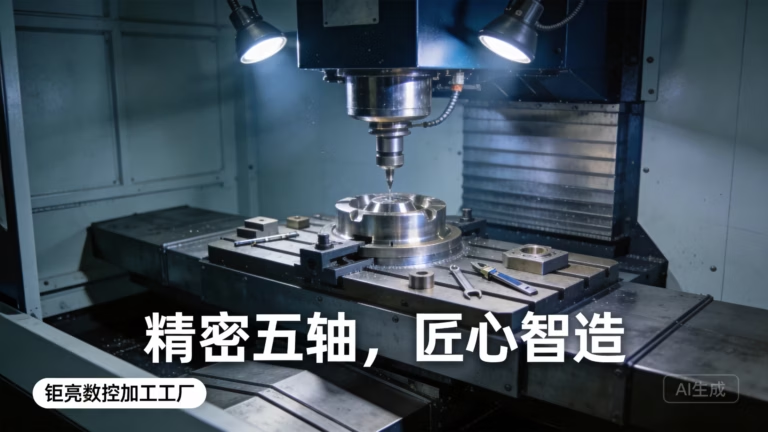
How the Fourth Axis Changes the Cut
A three-axis mill moves the tool in X, Y and Z. The part stays clamped to the table, so every face that is not facing up needs a second setup. A four-axis machine adds a rotary axis, usually A (about X) or B (about Y). The work rotates, the tool keeps its approach angles, and the machine reaches four sides of the part without anyone touching the clamps.
That single change removes a whole class of error. Every time a part is unclamped and re-clamped, the datum moves a little. On a bracket with four bolt-hole patterns, a 0.05 mm shift on the second setup shows up as a mismatch across the joint. On the rotary table the same part is cut in one continuous cycle, so the hole pattern stays concentric to the bore by virtue of the machine geometry, not by operator care.
Rotary motion is not free accuracy. The table has its own runout and backlash, and the chuck or fixture that holds the part adds more. A 4 axis CNC machining vendor that quotes ±0.005 mm on a turned feature should be able to show you the rotary table runout record and the warm-up routine used before the first cut.
The practical limit is the distance from the rotary centerline. A feature sitting 150 mm off center rotates through a 300 mm circle, and any angular error at the table is multiplied by that radius. Short parts near the center hold tight tolerances easily. Long parts out at the edge do not.
Which Parts Belong on a 4 Axis Machine
Four-axis work sits between simple and complex. If the part has features on two to four faces, a bore that must stay concentric with a cross hole, or a family of parts that only changes in length, the rotary table usually wins on both cost and repeatability.
Typical examples are automotive and EV housings, motor end bells, gearbox covers, medical instrument bodies, robot joint plates and hydraulic manifolds. Each one needs holes or slots on more than one side, and each one gains from cutting those faces in a single clamping.
Parts that stay flat and thin are a poor fit. A 2 mm aluminum panel with a few holes and a profile is faster on a three-axis machine with a vacuum table. Loading it onto a rotary fixture adds setup time and gives nothing back.
Very complex parts are also a poor fit. If the geometry needs the tool to reach five directions at once, or if undercuts must be cut without re-fixturing, a simultaneous 5-axis center is the honest answer. Pushing that geometry onto a four-axis machine means more fixtures, more setups and more chances to lose the datum.
Material matters too. Four-axis machines are generally stiffer than a comparably priced five-axis center, so stainless 316L, 17-4PH, titanium TC4 and tool steel cut well on them. The rotary table also lets the tool stay in the cut around a diameter, which spreads wear and improves surface finish on turned profiles.
Five Checks That Separate a Vendor From a Reseller
A vendor that owns machines talks about fixtures. A reseller talks about capacity. Ask what workholding the part will use, and listen for the answer. Soft jaws, a three-jaw chuck, a custom tombstone or an indexer with a tailstock are all real answers. Silence is not.
Second, ask for the first-article inspection plan before the quote is signed. On a four-axis part, that plan should name the rotary axis, the datum scheme, and how concentricity between a turned bore and a cross hole is measured. A CMM report with no datum callout is a number without meaning.
Third, check the process capability behind the tolerance. A shop that holds ±0.005 mm every day has data on it. GreatLight inspects 100% of parts before shipment, covering raw material check, in-process monitoring and final inspection, with reports available on request. Ask to see what that looks like on a part like yours.
Fourth, look at the engineering response. A useful DFM note tells you which corner radius will chatter at 6,000 rpm, or that a 0.8 mm wall will deflect when the rotary table indexes. A note that only restates the drawing is a form letter.
Fifth, test the paperwork side. Certifications should be current and specific: ISO 9001:2015, IATF 16949:2016, ISO 13485:2016 for medical work, ISO 27001:2022 for information security. If your drawings are sensitive, an NDA should be available on request, and uploads should be handled as confidential.
Tolerances, Finish and the Rotary Centerline
Tolerance on a four-axis part is not one number. It is a set of numbers that depend on where the feature sits. A bore cut on the rotary centerline is largely a function of spindle and tool runout. A hole pattern cut 150 mm off center also carries the table's angular error multiplied by that radius.
That is why a shop quoting ±0.005 mm should tell you which features the number applies to. On a well-set machine, ±0.005 mm is realistic for bores, slots and faces near the centerline. Move the feature to the rim and the practical window widens, even though the machine has not changed.
Surface finish follows the same logic. A turned profile on the rotary table finishes in the Ra 0.8–1.6 μm range with normal parameters. Push the feed down and use a wiper insert and you reach Ra 0.2–0.8 μm. Leave the standard parameters and you get Ra 1.6–3.2 μm. None of these are free, and the quote should reflect the one you asked for.
Rotary indexing also affects cycle time in a way buyers miss. Every index is a pause. A part with twelve index positions spends real seconds not cutting. For a one-off prototype that is irrelevant. For a 10,000-piece run it is the difference between one machine and two.
Materials shift the picture again. Aluminum 6061 and 6082 cut fast and hold finish easily. Stainless 316L and 17-4PH work-harden if the tool rubs during an index, so the program must keep the cutter engaged. Titanium TC4 and Inconel need lower surface speed and more coolant, which lengthens the cycle.
What to Send for an Accurate Quote
The quote is only as good as the input. Send a 3D model in STEP or Parasolid plus a 2D drawing with datums, tolerances and finish callouts. If the drawing is missing, expect the shop to assume general tolerances, and expect a revision later.
State the material grade, not just the family. Aluminum 6061-T6 and 7075 behave differently, and the difference shows up in the price. Stainless 303 machines freely, 316L does not. Copper C110 and beryllium copper sit at opposite ends of the machinability scale.
Say how many parts you need, and whether that number will grow. A four-axis vendor sets up a rotary fixture for the first part. If the volume is going to 10,000 pieces, that fixture should be built as a tombstone from the start. If it is a one-off prototype, soft jaws are enough.
Mention the finish and any secondary operation. Anodizing, electroless nickel, powder coating, bead blasting and laser marking all add steps, and laser marking has a minimum character height of 1.5 mm. Knowing this before quoting avoids a second round.
Finally, say what the part has to do. A housing that seals against a gasket and a bracket that holds a cable are not the same job, even if the drawing looks similar. That context is what lets an engineer flag a risk instead of just pricing the geometry.
Four-Axis, Three-Axis or Five-Axis: Which Fits the Part
Pick the machine class that matches the geometry, not the one with the longest spec sheet.
| Part feature | 3-axis | 4-axis | 5-axis |
|---|---|---|---|
| Features on one face only | Best fit | Overkill | Overkill |
| Holes on 2-4 sides | Extra setups needed | Best fit | Good, higher rate |
| Bore plus cross hole, concentric | Hard to hold | Best fit | Good fit |
| Undercuts, no re-fixturing | Not possible | Not possible | Best fit |
| Long shaft with milled flats | Needs support | Good with tailstock | Good fit |
| Thin flat panel | Best fit | Poor fit | Poor fit |
| Titanium or tool steel body | Limited rigidity | Good rigidity | Adequate rigidity |
When Four Axes Is the Right Call
Choose a four-axis machine when the part has features on two to four faces and a bore that must stay true to a cross feature; choose three-axis for flat single-face work, and five-axis when undercuts or five-direction access are unavoidable.
Questions Buyers Ask
Can a four-axis machine hold ±0.005 mm on every feature?
Near the rotary centerline, yes. Bores, slots and faces within roughly 100 mm of center are routinely held at ±0.005 mm on a maintained machine.
Features far from the centerline carry the table's angular error multiplied by the radius, so the practical window widens. Ask which features the tolerance applies to before you accept the number.
How do I know the shop owns the machines it quotes?
Ask for the workholding plan, the machine model and the rotary table size for your specific part. A shop with 12 four-axis mills and a Ø400 mm rotary table on the floor can answer in detail.
A reseller will answer with a general capacity statement and no fixture detail. That gap is the tell.
Does four-axis machining cost less than five-axis?
Usually yes, for parts that fit four-axis geometry. The machine rate is lower and the setup is simpler.
The saving disappears if the part really needs five-axis access. Forcing it onto a four-axis machine adds fixtures and setups, and those cost more than the rate difference.
What materials are a good fit for four-axis work?
Aluminum 6061, 6082 and 7075, stainless 303, 304 and 316L, steel 4140 and 4340, titanium TC4 and copper alloys all run well.
Very gummy plastics and thin-wall parts need extra support. Tell the shop the wall thickness when you request the quote.
How fast can parts ship after the drawing is approved?
Quotation and DFM analysis come back within 12 hours, and production can start within 24 hours of approval.
Standard parts ship in 3–5 days. Complex fixtures or secondary finishing add time, and the shop should tell you that up front rather than after the order.
Do I need an NDA before sending drawings?
Not always, but it is available on request, and uploads are handled as confidential.
For medical, aerospace or unreleased consumer products, sign the NDA first. It costs nothing and removes the question later.
Send the Drawing, Get a Fixture Plan Back
Share your 3D model and drawing and we will return a quotation, a DFM analysis and the workholding approach for your four-axis part within 12 hours.
12-hour quote and DFM100% inspection before shipmentNo minimum order quantity
More From the Shop Floor
We publish setup notes, tooling trials and inspection data from the factory floor.











