GreatLight CNC Machining Factory logo
CNC Machining
Rapid Prototyping
Materials
Industries
News
About GL

Get Instant Quote

Rapid Prototype Machining

Precision Prototype CNC Machining Services

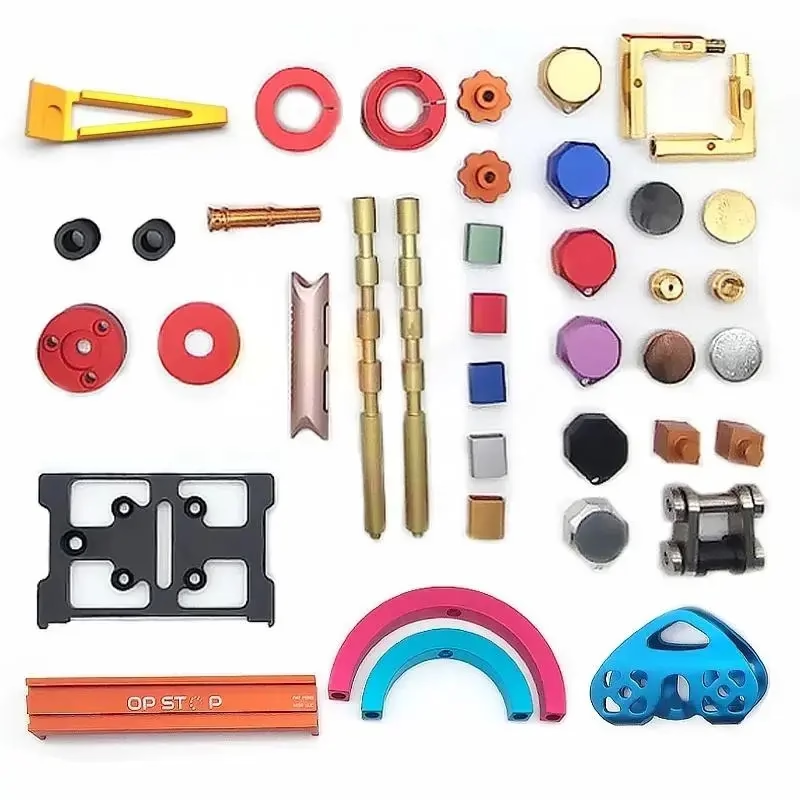
One-off parts and pilot runs cut on 127 CNC machines in Dongguan. Tight tolerances, real DFM feedback, and inspection reports you can hand to your own customer.

±0.005 mm toleranceNo minimum order quantityDFM analysis in 12 hoursISO 9001:2015ISO 13485:2016NDA on request
precision-custom-machining-solutions-from-prototype-to-production
±0.005 mmAchievable tolerance
16Simultaneous 5-axis centers
12 hQuote and DFM feedback
100%Inspection before shipment
Where prototypes go wrong

Four problems that stall a build

01

The quote takes longer than the part

You send a STEP file on Monday and hear nothing until Friday. The design review slips a week, and the tooling decision that depends on it slips with it. We return a quotation and a DFM analysis within 12 hours, so you can approve or change the geometry while the schedule still has room.

02

Tolerances that only exist on the drawing

The first article measures fine, then the second and third drift. Bores that should be round come out tapered, and hole positions walk. That usually means the setup was never stable, or the fixture was improvised. We hold ±0.005 mm on production runs by cutting on rigid 5-axis centers and checking in-process, not only at the end.

03

Finishing that costs you a second build

A prototype that fits but scratches white or shows tool marks will not survive a design review or a trade show. Sending it out for anodizing adds another week and another freight risk. We run anodizing, bead blasting, brushing, laser marking and plating in-house, so the part leaves one facility and arrives ready to show.

04

No data to defend the design

When the parts arrive with no dimensional report, you cannot tell whether a failed test came from the design or the machining. Material certificates and inspection reports are available on request, covering raw material check, in-process monitoring and final inspection.

How we build prototypes

From a STEP file to a part you can test

Machining decisions that keep a prototype close to the drawing, and to the production part that follows it.

Aerospace CNC Machining Prototype High Accuracy Custom
Capacity

Cut geometry that 3-axis setups cannot reach

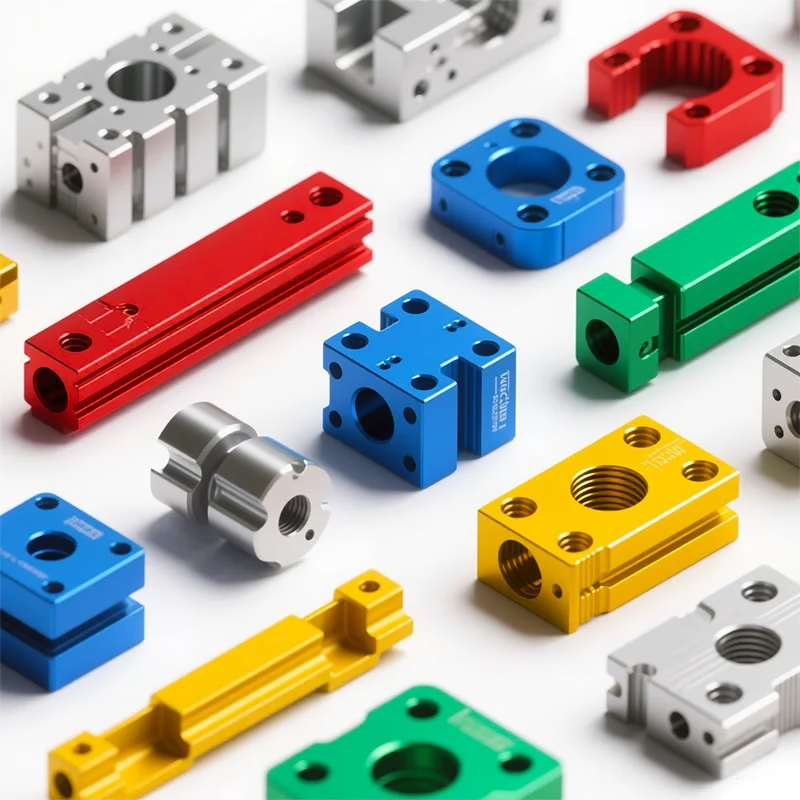
A prototype often has features on five faces: angled ports, undercuts, thin ribs, a boss that sits behind another wall. Each extra setup adds a datum shift and a chance for error. With 16 simultaneous 5-axis machining centers, we cut those features in one or two setups instead of five.

We also run 12 four-axis mills, 27 three-axis machines and 16 mill-turn centers. Maximum processing size is 4,000 mm, with travels of 4,000 × 400 × 150 mm and 750 × 1,150 × 550 mm on the larger platforms. Shafts, housings and long brackets all stay on one machine.

  • 1
    One setup, fewer datum shiftsAngled faces and side holes cut without re-fixturing.
  • 2
    Ø400 mm rotary tableRound parts and radial features indexed in-process.
  • 3
    From one part to 10,000+The same program scales when the design freezes.

Get Instant Quote

option-1-concise-seo-focused
Materials and finish

Pick the alloy your production part will use

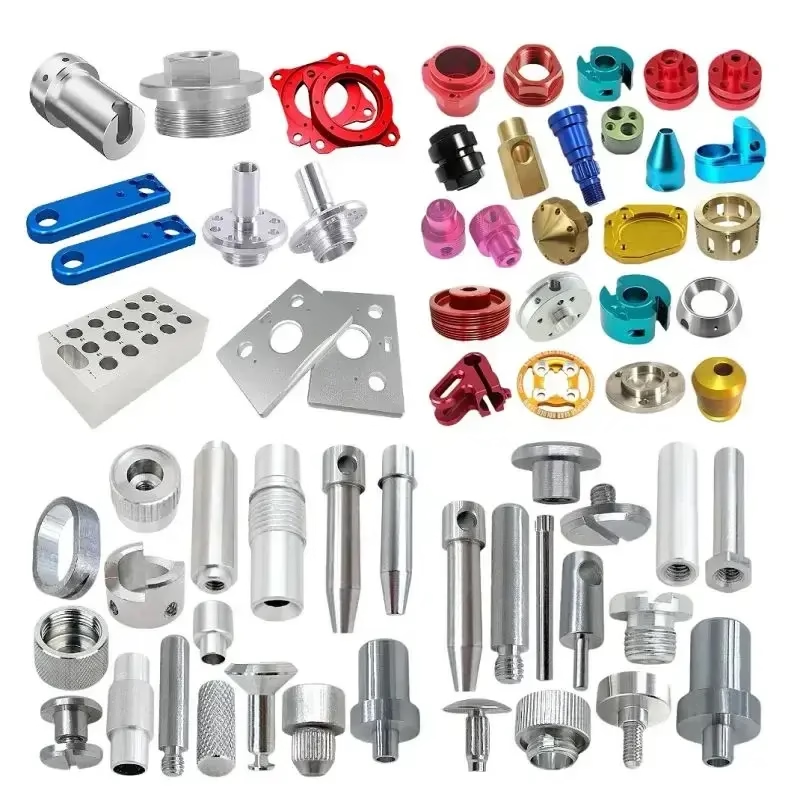
A prototype only tells the truth if it is made from the same material as the production part. We machine aluminium 6061, 6061-T6, 7075, 2024, 5052 and ADC12; stainless 303, 304, 316L, 17-4PH and 440C; steels including 4130, 4140 and 4340; copper and brass C110 and C36000; titanium TC4 (Ti-6Al-4V); and plastics from ABS and POM through PEEK and HDPE.

Surface finish is set to what the part has to do. Sealing faces and bearing bores go to Ra 0.2–0.8 μm. General machined surfaces sit at Ra 0.8–1.6 μm or Ra 1.6–3.2 μm as machined. Anodizing, plating, powder coating and laser marking run in the same facility, with a minimum character height of 1.5 mm for engraving.

  • 1
    Plastics and metals on the same orderPOM, PC, PMMA, PEEK and carbon fibre alongside alloys.
  • 2
    Finish kept consistentHardcoat, clear and colour anodizing in one plant.
  • 3
    Marking that stays legibleLaser engraving down to 1.5 mm character height.

Choosing a process

When machining is the right call for a prototype

Use this to decide before you commit a design to tooling.

SituationBetter fitWhy
Tight tolerance, functional testCNC machiningHolds ±0.005 mm and real material properties
Wall under 1.5 mm, complex inner channels3D printingMachining may deflect or need split parts
50 to 500 parts, one geometryCNC or vacuum castingMachining avoids tooling cost at low volume
Over 10,000 identical partsDie castingTooling cost pays back at higher volume
Large flat panels, simple bendsSheet metalFaster and cheaper than milling from solid
Transparent or optical partCNC on PMMA or PCPolished edges stay clear without layer lines
What we run

Services around a prototype build

01

5-Axis CNC Machining

Simultaneous 5-axis work for angled faces, deep pockets and contoured surfaces in one setup.

02

4-Axis and 3-Axis Machining

Prismatic parts, plates and brackets where indexed or three-axis work is enough.

03

CNC Milling and Turning

Mill-turn centers for shafts, fittings and parts that need turning and milling on one machine.

04

Rapid Prototyping

One-off parts and small batches, with DFM feedback before the first cut.

05

Sheet Metal and 3D Printing

Enclosures, brackets and printed parts for early form checks alongside machined prototypes.

06

Surface Finishing

Anodizing, plating, powder coating, bead blasting, polishing and laser marking in-house.

Scope and limits

What a prototype order includes

Numbers here are the ones we work to, not estimates.

ItemRangeNotes
Tolerance±0.005 mm (±0.0002 in)Held on production runs with in-process checks
Surface finishRa 0.2–3.2 μmFine, high and as-machined grades
Maximum part size4,000 mmTravels up to 4,000 × 400 × 150 mm
Order quantity1 part to 10,000+No minimum order quantity
Quote turnaround12 hoursQuotation plus free DFM analysis
Production start24 hoursAfter drawing and material are confirmed
Shipping3–5 daysParts ship once inspection passes
Why GreatLight

Fifteen years of prototype work

15Y

Machining since 2011

Three wholly-owned plants and 7,600 m² of manufacturing space in Dongguan, plus a factory in Singapore at No.3 Joo Koon Circle.

127

High-precision CNC machines

16 simultaneous 5-axis centers, 12 four-axis mills, 27 three-axis machines and 16 mill-turn centers under one roof.

±0.005

Millimetre control

Tolerance held to ±0.005 mm, with a qualification rate of 99.99% across shipped parts.

100%

Inspection before shipment

Raw material check, in-process monitoring and final inspection. Reports on request.

4

Certifications in place

ISO 9001:2015, IATF 16949:2016, ISO 13485:2016 and ISO 27001:2022.

<2%

Historical late-delivery rate

Measured across past orders, with shipping in 3–5 days on standard prototype work.

150Technicians
3Wholly-owned plants
7,600 m²Manufacturing space
12 hQuote and DFM feedback
Where prototypes are used

Industries and the parts they need

Aerospace CNC Machining Prototype Service Savannah

Aerospace brackets and housings

Material certificates and dimensional reports travel with the parts.

  • ±0.005 mm
  • 17-4PH
  • Inspection report
electronic-product-housing-prototype

Electronic enclosures

Thin walls, connector cutouts and anodized finish on one order.

  • Ra 0.8–1.6 μm
  • 6061-T6
  • Laser marking
cnc-machined-prototype-parts-for-product-demonstrations

Demonstration and review parts

Cosmetic surfaces finished so the part can go straight to a design review.

  • Bead blasting
  • Anodizing
  • 3–5 day ship
low volume manufacturing

Pilot runs before tooling

The same program scales from one part to a few hundred when the design freezes.

  • No MOQ
  • 10,000+ parts
  • Mill-turn
FAQs

Questions engineers ask before ordering

What file formats do you need for a quote?

STEP and IGES cover most work. For turned parts, a 2D PDF with dimensions helps us confirm what matters. Native SolidWorks, Fusion and Inventor files are fine too.

Send the assembly if fits and clearances matter. We check the mating part before cutting, not after.

Can you hold ±0.005 mm on a one-off part?

Yes, when the feature and material allow it. A 0.5 mm wall in PEEK behaves differently from a 20 mm steel bore, so we will tell you which dimensions are realistic on the first part.

We check in-process rather than only at the end. That way a drifting setup is caught while the part is still in the machine.

Do you have a minimum order quantity?

No. We machine single prototypes and run batches over 10,000 parts. The setup cost is the same whether you order one or twenty, so ordering spares with the first part is often cheaper than a second run later.

How fast can I get parts?

Quotation and DFM analysis come back within 12 hours. Production can start within 24 hours once the drawing and material are confirmed, and parts ship in 3–5 days.

If a feature needs a fixture or a special cutter, we tell you at quote stage so the date is real.

Can you match the material of my production part?

We stock or source aluminium 6061, 7075 and 2024, stainless 303, 304 and 17-4PH, steels 4130 and 4140, titanium TC4, brass C36000, and plastics including POM, PC, PEEK and HDPE.

If your specification names an alloy we do not list, tell us what property matters and we will suggest the closest equivalent.

How do you handle my design files?

Uploads are secure and confidential. We sign an NDA on request before files change hands, and we hold ISO 27001:2022 for information security.

Files are used for your order only. We do not reuse customer geometry in other projects.

What inspection data comes with the parts?

Every order gets a raw material check, in-process monitoring and final inspection before shipment. Dimensional reports and material certificates are available on request.

If your customer needs first article inspection to a specific format, say so at quote stage and we will work to that format.

When is CNC machining the wrong choice for a prototype?

Hollow parts with internal channels or lattice structures are usually better printed. Very thin walls in soft plastic can deflect under cutting force.

If you need hundreds of identical parts in a rubber-like material, vacuum casting or 3D printing may cost less than machining. We will say so rather than take the order.

Send a STEP file, get a quote and DFM notes

Upload your drawings and we will come back with pricing, lead time and the features we would change before cutting.

12-hour quote100% inspectionNo minimum order quantityNDA on request

Trusted by engineers and manufacturers worldwide

Tesla Ford Motor Company BYD Auto Denso Magna International Boeing Airbus Medtronic KUKA FANUC