
Bulk Metal Die Casting Service: One Stop or Split Vendors?
This guide is for engineers and sourcing teams comparing quotes for cast housings, brackets and covers in the 5,000 to 1,000,000 piece range. It sets out seven checks you can run before you release a purchase order, and the part features that tell you when a bulk metal die casting service is the wrong call.
In this article
- 1
- 2
- 3
- 4
- 5
- 6
- 7
- 8
Key takeaways
One stop bulk casting vs split vendors
Match your part and volume to the row that fits.
| Situation | One stop vendor | Split casting + machine shop |
|---|---|---|
| Annual volume 5,000–1,000,000 pcs | Die cost spreads; one PO covers all ops | Two POs, two lead times, two freight legs |
| Machined features at ±0.005 mm | Casting and CNC share one datum scheme | Datum handoff is a common error source |
| Cosmetic anodized or powder-coated faces | Finishing in house, no re-pack between ops | Castings ship out and back for coating |
| Porosity-critical pressure-tight parts | Vacuum-assist casting plus in-process checks | Casting vendor alone owns the porosity risk |
| Prototype or 200 pcs trial | No minimum order quantity applies | Tooling cost rarely justified at this volume |
| Heavy 4,000 mm class housings | Limited by machine travel, confirm first | Large-part machining may be easier to source |
The verdict
If two or more features must relate within ±0.005 mm, put casting, machining and finishing under one roof. If the part is cosmetic, low volume and loose-tolerance, split the work and buy each operation at its own price.
What a bulk metal die casting service actually runs
Die casting forces molten alloy into a hardened steel die at high pressure and speed. Aluminum, zinc and magnesium are the usual choices. The result is a near-net shape with thin walls and ribs that would cost far more to mill from solid stock. A casting on its own is rarely a finished part, though. Most housings need drilled holes, tapped threads, faced sealing surfaces and a coating before they bolt onto anything.
That gap between as-cast and ready-to-assemble is where a bulk metal die casting service differs from a casting house. The die maker, the casting cell and the CNC department work from the same 3D model. When the tool is cut, the datum scheme for first-op machining is already agreed, so the machinist clamps on a surface the toolmaker controlled. Split that across two suppliers and the second shop re-datums from whatever the first one shipped.
Volume is what makes the tooling math work. Below roughly 5,000 pieces a year, the die amortization usually pushes unit cost above sand casting or a machined billet, even with cheaper cycle times. From 5,000 to over 1,000,000 pieces annually, the picture flips and the die becomes the cheapest part of the program.
Bulk runs also change how you think about scrap. A die that survives hundreds of thousands of shots will wear, flash will grow, and cooling lines will slowly scale. A supplier running one die across a long production window needs a maintenance schedule tied to shot count, not to a calendar.
- 1Cold and hot chamber
- 2Draft and wall thickness
- 3Shot count planning
Machining, finishing and where tolerance really lives
A casting quote that ends at the die is not a usable quote. Ask what happens to the part after it drops out of the die. Deburring, shot blasting, drilling, tapping, facing and coating all add cost and lead time, and each one is a place where a split supply chain loses days.
Tolerance needs a clear split. As-cast features typically hold a looser band set by the die and the alloy. Machined features can hold ±0.005 mm (±0.0002 in) on critical fits, bores and sealing faces. Surface finish on those machined faces usually lands at Ra 0.8–1.6 μm for a general machined surface, and down to Ra 0.2–0.8 μm where a seal or bearing needs it. Write both tolerance sets into the drawing so nobody argues later.
Finishing options matter more than buyers expect. Anodizing in clear, color, hardcoat or conductive grades, electroless nickel, zinc, silver and gold plating, powder coating and black oxide all change the tolerance stack slightly. A coating applied after final machining can close a bore by several micrometers. If that bore is a bearing seat, plan the coating thickness into the drawing.
Laser marking is the last step and it needs real estate. Minimum character height is 1.5 mm, so a serial number on a small boss may not fit. Check the marking area before tooling, not after.
- 1Coating thickness
- 2Machined vs as-cast
- 3Marking area
Judging a supplier before you send the PO
The first thing to test is response quality. A supplier that returns a quote without asking about wall thickness, draft or the sealing face is quoting a price, not a process. A useful reply includes a DFM note that flags at least one feature you should change. That note is the cheapest engineering you will get on the project.
Second, ask for the inspection plan. 100% inspection before shipment sounds like a slogan until you see the actual report format. You want raw material check, in-process monitoring and a final dimensional report, with reports available on request. For automotive and medical work, the relevant certificates should be current: ISO 9001:2015, IATF 16949:2016, ISO 13485:2016, and ISO 27001:2022 if you are sharing controlled drawings.
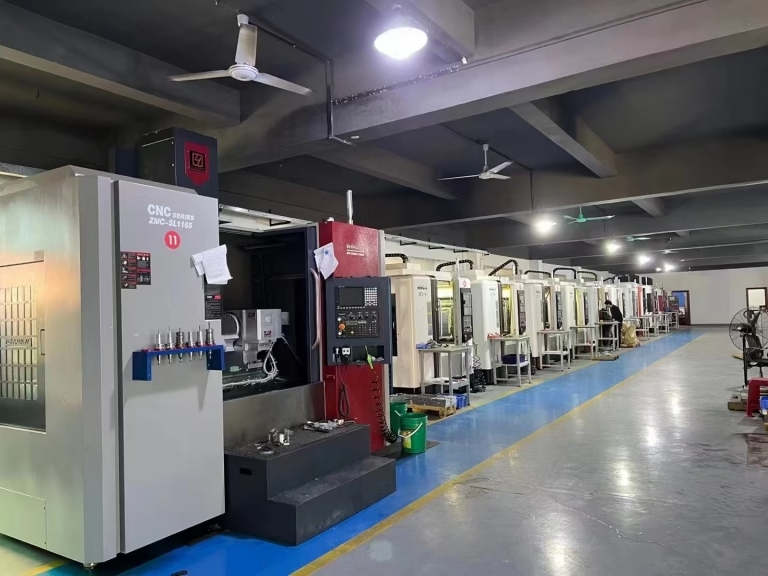
Third, look at machine capacity against your part. A die casting cell can produce a part the machine shop cannot finish. Check the largest machining envelope before you commit. GreatLight runs 127 high-precision CNC machines, including 16 simultaneous 5-axis centers, 12 four-axis mills, 27 three-axis machines and 16 mill-turn centers, with a maximum processing size of 4,000 mm.
Fourth, ask about order quantity flexibility. A supplier tied to a 10,000 piece minimum will not support a pilot build. No minimum order quantity, from one prototype to 10,000+ part runs, is what lets you validate the die before you commit to a year of production.
- 1DFM feedback
- 2Certificates
- 3Machine envelope
Lead time, confidentiality and the cost of switching
Lead time in die casting splits into tooling and production. Tooling is the long pole. Once the die is proven, casting and machining run on a much shorter clock. Ask for a quotation and free DFM analysis within 12 hours, and confirm how fast production can start after approval. For a supplier with a proven process, production can start within 24 hours of a released order, with parts shipping in 3–5 days on repeat runs.
Switching suppliers mid-program is expensive in a way that does not show up in the unit price. A new die, new datum scheme and new first-article approval can cost more than the savings. That is the strongest argument for picking the right partner before the tool is cut, and for treating the DFM stage as a real engineering review rather than a formality.
Confidentiality is a practical concern when you send full 3D models and assembly drawings. Uploads should be secure and confidential, and a non-disclosure agreement should be available on request without a long negotiation. If the supplier hesitates on an NDA, treat it as a signal about how they handle drawings.
Finally, ask who owns the die and what happens to it at the end of the program. Die ownership, storage and transfer terms belong in the contract, not in a verbal agreement.
- 1Tooling clock
- 2NDA on request
- 3Die ownership
When one stop is the wrong choice
A single vendor is not automatically better. If your part is a low-volume bracket with no critical fits, splitting casting and machining across two competitive shops will often be cheaper, because you are buying each operation at its own market rate. The integration premium only pays back when the operations interact.
It also stops paying when the features do not interact. A cosmetic cover with one tapped hole does not need the casting and the machining to share a datum. A housing with a sealing face, a bearing bore and a connector cutout does. Use that as the test: count the features that must relate to each other within ±0.005 mm. Two or more, and integration is worth paying for.
Part size is another boundary. Very large housings can exceed the machining envelope even when the casting machine can handle them. Confirm travel before you assume a one stop quote covers the finished part. GreatLight works to a 4,000 mm maximum processing size, with large travels of 4,000 × 400 × 150 mm and a Ø400 mm rotary table for parts that need multi-face work.
Alloy choice can also push you out of die casting. High-magnesium and some specialty alloys behave differently in a die, and small quantities of Inconel or titanium are better served by machining or vacuum casting. Magnesium AZ31B and AZ91D do run well in die casting when the wall sections suit the process.
- 1Count the related features
- 2Size check
- 3Alloy check
Seven checks before you release the PO
Run these in order. Each one can kill a quote before it costs you tooling money.
- 1Send the 3D model with tolerances markedMark machined faces, sealing surfaces and bearing bores separately from as-cast surfaces. A supplier who returns a quote without commenting on wall thickness or draft has not read the model.
- 2Request the DFM note in writingYou want a document listing at least one recommended change: draft angle, wall thickness, rib placement, gate location or a fillet that would trap porosity. Expect it within 12 hours from a responsive shop.
- 3Split the tolerance calloutsAsk for as-cast and machined bands in writing. Machined features can hold ±0.005 mm; as-cast features cannot. If a quote implies one number for the whole part, ask again.
- 4Confirm the machine envelopeGive the shop your largest overall dimension and ask for the travel it will run on. GreatLight works to 4,000 mm, with a Ø400 mm rotary table for multi-face parts.
- 5Ask for the inspection plan and report sampleRaw material check, in-process monitoring, final inspection, 100% before shipment. Ask to see a sample report format before you order.
- 6Check the volume and tooling termsConfirm the annual volume the die is sized for, the shot count it is rated to, who owns it and where it is stored. No minimum order quantity lets you run a pilot first.
- 7Agree the finishing and marking specName the finish, the coating thickness allowance and the marking area. Laser marking needs 1.5 mm minimum character height. Verify the marking fits before the tool is cut.
Questions buyers ask next
Does a bulk metal die casting service include CNC machining in the same quote?
It should, if the part needs machined features. Ask for the quote to list casting, machining, finishing and inspection as separate line items so you can see what you are paying for. A quote that stops at the die leaves you to source machining separately, which is exactly the split you were trying to avoid.
If the quote does include machining, ask which tolerance the machined features hold. Machined faces can reach ±0.005 mm; as-cast surfaces cannot.
What volume makes die casting cheaper than machining from billet?
It depends on geometry, but the crossover usually sits around a few thousand pieces per year. Below that, the die cost dominates and a machined billet or sand casting is often cheaper. Above roughly 5,000 pieces a year, die casting starts to win on unit cost.
Bulk runs from 5,000 to over 1,000,000 pieces annually are where the process is strongest, because the die amortizes across a long production window.
How tight can as-cast tolerances be compared with machined ones?
As-cast tolerances are set by the die, the alloy shrinkage and the thermal behavior of the shot. They are looser than machined tolerances and vary by feature. Machined features can hold ±0.005 mm, with surface finish down to Ra 0.2–0.8 μm where needed.
Keep critical fits on machined faces and leave the rest as-cast. Trying to hold tight tolerances across the whole casting raises scrap rates and unit cost.
Can I run a small pilot batch before committing to full production?
Yes, if the supplier has no minimum order quantity. A pilot run lets you validate the die, check the datum scheme and confirm the finish before you commit to a year of production.
Ask how the pilot cost is treated if you scale up. Some shops credit part of the tooling or pilot cost against the first production order. Get that in writing.
What certifications should a die casting supplier hold for automotive or medical work?
For automotive work, IATF 16949:2016 is the relevant quality system. For medical devices, ISO 13485:2016. A general quality baseline is ISO 9001:2015, and ISO 27001:2022 matters when you share controlled drawings and need information security.
Ask for current certificates, not a list of standards the shop intends to pursue.
How do I protect my drawings when sending them out for quote?
Send files through a secure upload channel and ask for a non-disclosure agreement on request. A supplier that handles aerospace, medical or automotive work will have an NDA process ready.
Keep the die ownership and drawing rights in the contract. If the program ends, you should know where the tooling is stored and how to get it back.
Send the model, get a DFM note back
Upload your 3D model and drawing. We reply with a quotation and a free DFM analysis within 12 hours, and we will tell you which features should change before the die is cut.
12-hour quoteDFM analysis included100% inspectionNo minimum order quantity
More from the shop floor
We publish setup notes, tooling trials and inspection data from the factory floor.











