
Master CNC Processing: Types, Advantages and Applications
This page explains what master CNC processing actually covers: the six machine configurations we run, the tolerances and finishes each one holds, and the part features that decide which type you should quote. It is written for design engineers and sourcing engineers who need to pick a process before they release a drawing.
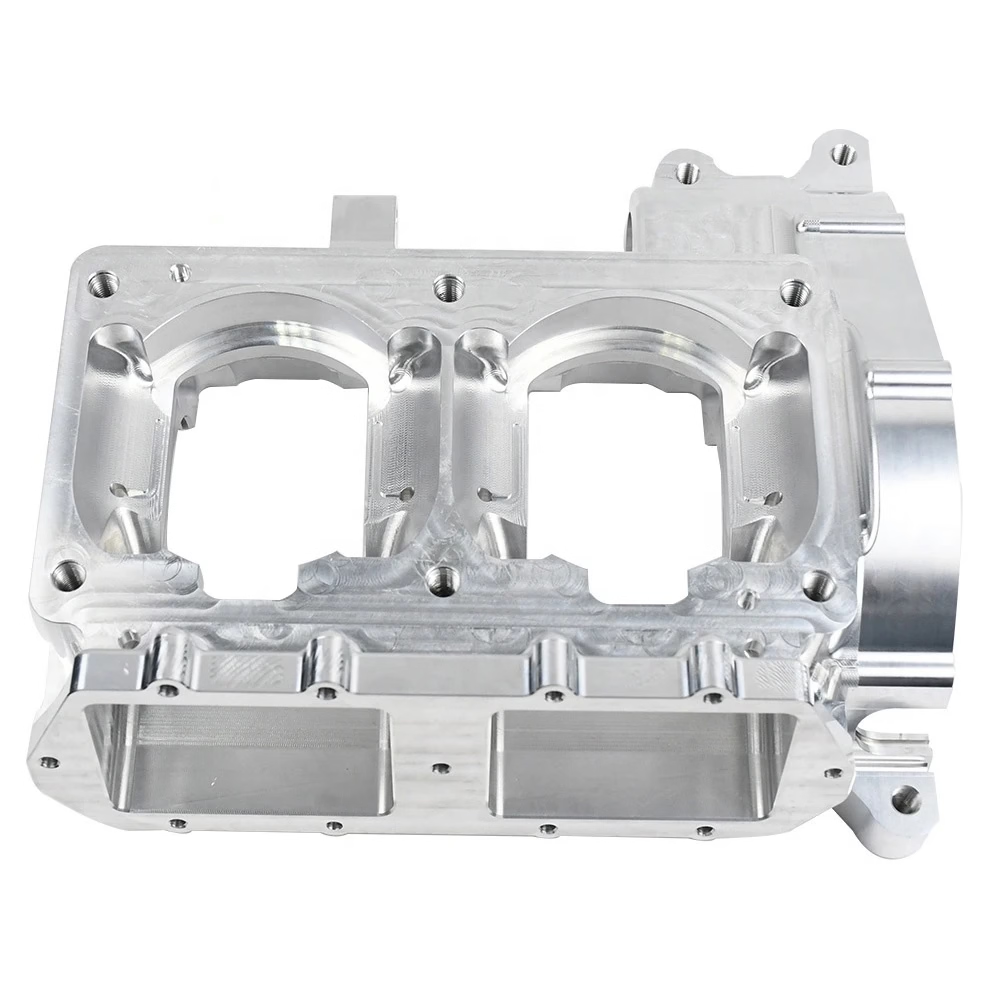
Key takeaways
The six types of master CNC processing we run
Machining centers are usually described by axis count, but the axis count only tells you how the tool approaches the part. What matters on a quote is which features can be cut without moving the workpiece. We run 27 three-axis machines, 12 four-axis mills, 16 simultaneous five-axis centers, 16 mill-turn centers and a set of large-travel mills, so the choice is about reach and setup count rather than availability.
2.5-axis work is the cheapest form. The tool cuts in X and Y at a fixed Z, then steps down. Pockets, slots, drilled hole patterns and flat faces all belong here. If your part is a plate with holes and a couple of counterbores, 2.5-axis is the right answer and paying for five-axis travel adds nothing.
Three-axis machining adds a controlled Z contour. It handles curved surfaces that stay visible from one direction: a contoured cover, a mold cavity half, a bracket with a swept rib. The limit is undercuts. Any feature that faces away from the spindle needs a second setup, and a second setup means a second datum.
Four-axis machining puts the part on a rotary table, usually Ø400 mm, and indexes it around one axis. This is the workhorse for parts with features on four sides: manifold blocks, hydraulic bodies, drive shafts with cross holes. Indexing is positional, so the rotary table locks before each cut. You get four-sided access without losing rigidity.
Five-axis machining moves the tool or the table through two extra rotary axes at the same time. Simultaneous motion lets a short, stiff tool reach deep pockets at a constant lead angle and machine compound angles in one pass. It is the correct choice for impellers, turbine blades, medical bone plates and any part where the drawing shows features on five or six faces.
Mill-turn combines turning and milling on one platform. A shaft with milled flats, cross holes and a threaded end finishes in a single cycle instead of two machine queues. That removes one re-chuck, and re-chucking is where concentricity errors come from. When a part is round with off-axis features, mill-turn usually wins on both accuracy and lead time.
Advantages that show up on the drawing
The advantage people quote first is repeatability. Once a program is proven, part 500 matches part 1 within the machine's positioning limits, provided the stock and the fixturing stay the same. For a production run of 10,000 pieces, that is what keeps assembly from needing selective fitting.
The second advantage is feature integration. One five-axis setup can produce a face, a bore, a thread and a chamfer that would otherwise need three operations and three fixtures. Fewer operations means fewer chances for a datum to drift, and it shortens the route through the shop.
The third is material range. Aluminium 6061 and 7075 cut fast and hold tight tolerances. Stainless 316L and 17-4PH work-harden, so the process window narrows and we slow the surface speed and keep the cutter engaged. Titanium TC4 and Inconel need low cutting speeds, rigid setups and generous coolant. The advantage is not that any material is easy; it is that the same geometry can be produced across all of them.
The fourth advantage is documentation. Every job gets a raw material check, in-process monitoring and a final inspection before shipment. Reports are available on request. For regulated work such as medical devices or automotive parts, that record is often worth more than a small price difference.
Applications and the fit criteria behind them
Aerospace parts are typically thin-walled and made from aluminium or titanium, with tolerances that leave little room for setup error. We machine them on five-axis centers so the wall stays supported and the tool stays short. Prototype housings and brackets often ship before a hard tool exists.
Automotive and EV work splits into two groups. Engine and drivetrain parts are round with off-axis features, which suits mill-turn. Battery trays, motor housings and brackets are larger and flatter, which suits three-axis and four-axis on the large-travel machines up to 4,000 mm.
Medical devices are usually small, stainless or titanium, and heavily documented. Bone plates, instrument handles and implant trials fit five-axis because their surfaces are compound and their edge radii are tight. ISO 13485:2016 is in place for this category.
Robotics and automation parts sit in the middle. End effectors, joint housings and gearbox plates mix turned and milled features, and quantities range from one prototype to a few thousand. Electronics and new energy work adds heat sinks, busbars and connector bodies, mostly aluminium and copper, where surface finish and flatness matter more than exotic geometry.
How to choose before you send the drawing
Start with the number of faces that carry tolerances. If all critical features are visible from one direction, three-axis is enough. If they sit on four sides, add a rotary table. If they sit on five or six faces, or the part has deep pockets with compound walls, go five-axis.
Then check the size against the machine envelope. Our large mills travel 4,000 × 400 × 150 mm. Medium machines travel 750 × 1,150 × 550 mm and 600 × 600 × 600 mm. Compact machines travel 500 × 500 × 450 mm and 500 × 310 × 200 mm. A part that barely fits leaves no room for the fixture, so plan for clearance.
Then decide the finish. As-machined surfaces run Ra 1.6–3.2 μm. A high-quality finish lands at Ra 0.8–1.6 μm, and fine finishing reaches Ra 0.2–0.8 μm on the faces that need it. Specify finish only where the function requires it; polishing a whole part to a sealing-surface spec costs more than it returns.
Finally, check the material against the tolerance. Tight tolerances in soft aluminium are easier than the same tolerances in 316L, because stainless moves as it cuts. If a feature is both tight and thin-walled, say so on the drawing so we can plan the operation sequence instead of discovering it at the machine.
Which machine type fits which part
Pick the row that matches your geometry, not the row that sounds most capable.
| Type | Best for | Typical tolerance | When it is overkill |
|---|---|---|---|
| 2.5-axis | Plates, holes, flat pockets | ±0.05 mm | Part has contoured surfaces |
| 3-axis | Contoured faces from one direction | ±0.01 mm | Features sit on four or more sides |
| 4-axis | Four-sided blocks, cross holes | ±0.01 mm | Compound angles and deep pockets |
| 5-axis simultaneous | Impellers, bone plates, 5-face parts | ±0.005 mm | Simple prismatic parts |
| Mill-turn | Shafts with milled flats and holes | ±0.005 mm | All-flat parts with no turning |
| Large-travel mill | Frames, trays up to 4,000 mm | ±0.01 mm | Small parts that fit a compact machine |
The decision in one line
If every tolerance face is reachable in one orientation, quote three-axis and keep the money for finishing. If the part needs four or more sides in one setup, or has compound surfaces and deep pockets, quote five-axis. Anything round with off-axis features should go to mill-turn.
Questions engineers ask before quoting
What is master CNC processing in practical terms?
Master CNC processing means having the full range of machine configurations under one roof and matching each part to the right one. It covers 2.5-axis, three-axis, four-axis, five-axis and mill-turn work, plus the finishing and inspection steps that follow.
The value is not a single machine. It is the ability to route a part to the process that reaches its features with the fewest setups.
How tight a tolerance can you hold?
We hold ±0.005 mm on critical features when the datum scheme is clean and the part stays in one fixture. That is roughly ±0.0002 in.
On thin walls, long bores or parts that need several refixtures, we will tell you which features can hold that and which cannot before we cut.
What surface finishes are available?
As-machined surfaces run Ra 1.6–3.2 μm. High-quality finishing reaches Ra 0.8–1.6 μm, and fine finishing goes to Ra 0.2–0.8 μm.
We also run anodizing, electroless nickel, zinc, silver and gold plating, powder coating, black oxide, bead blasting, tumbling, brushing and polishing.
Do you have a minimum order quantity?
No. We run from one prototype to 10,000+ part runs.
Quotation and a free DFM analysis come back within 12 hours, and production can start within 24 hours of approval.
Which materials do you machine most often?
Aluminium 6061-T6, 7075 and 6082; stainless 303, 304, 316L and 17-4PH; steel 1018, 1045, 4140 and 4340; copper C110 and brass C36000; titanium TC4 and Inconel; and plastics including POM, PEEK, PC and ABS.
Material choice changes the cutting parameters and the operation sequence, so tell us the alloy rather than just the family.
How is confidentiality handled?
Uploads are secure and confidential. An NDA is available on request before you send drawings.
ISO 27001:2022 is in place for information security, alongside ISO 9001:2015, IATF 16949:2016 and ISO 13485:2016.
Send the drawing, get a process recommendation
Upload your files and we will come back with a quotation, a DFM analysis and the machine type we recommend for each feature. No minimum order quantity, and 100% inspection before shipment.
12-hour quoteFree DFM analysisNo MOQ100% inspection
More from the shop floor
We publish setup notes, tooling trials and inspection data from the factory floor.











