
Advantages of CNC Processing Services
This page is for design and manufacturing engineers who need to decide whether a machined part beats a casting, a stamping, or a molding. We cover the real advantages of CNC processing services, where they come from on the machine, and the cases where they do not apply. Read it and you can judge whether your part suits a 3-axis, a 5-axis, or a mill-turn process.
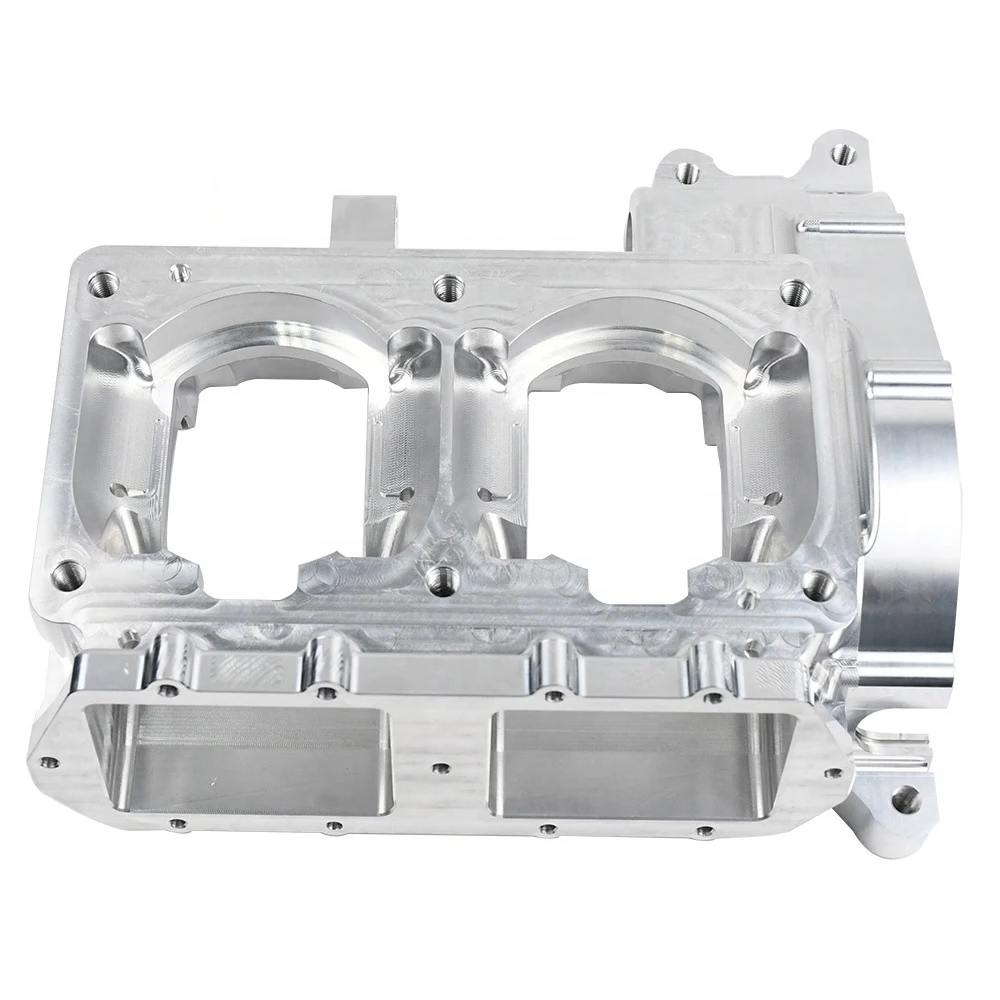
Where the accuracy advantage actually comes from
The accuracy advantage of CNC processing services is not magic. It comes from a rigid machine, a known tool path, and a control loop that corrects for load and temperature. On our 5-axis centers we hold ±0.005 mm on features that are cut in a single setup. That number is a floor for well-supported geometry, not a blanket promise for every part shape.
Single-setup machining is the key. Every time a part moves to a second machine, the stack-up of fixture error, re-datuming, and tool runout adds to the tolerance. A part with bores on four faces is far more accurate cut on a 5-axis center than on three separate 3-axis operations. This is one of the quiet advantages CNC processing services give you: fewer setups, fewer error sources.
Surface finish follows the same logic. With the right cutter and step-over, we reach Ra 0.8–1.6 μm as machined, and Ra 0.2–0.8 μm where a finish pass is planned in. A fine finish is a process choice, so tell us the requirement up front. Chasing Ra 0.4 μm on a deep pocket later usually means a new tool and a new setup.
- 1Deep pocketsUse a smaller tool and a longer reach; expect finish to drop unless a separate finishing pass is planned.
- 2Thin wallsBelow roughly 1 mm wall thickness, tool pressure bends the part and tolerance drifts. Support or redesign helps.
- 3Tight boresBores are the easiest feature to hold. Reaming after milling is cheap and reliable.
One process, many materials
A machined part can be cut from almost any metal or plastic that holds its shape. That range is a practical advantage of CNC processing services when a design is still moving: you can run aluminium 6061 for a fit check, then 7075 or 17-4PH for a load-bearing version, without a new tool. We machine aluminium, stainless 303/304/316/316L, 4140 and 4340 steel, titanium TC4 (Ti-6Al-4V), Inconel, brass C36000 and copper C110, plus POM, PEEK, PC, and carbon fibre.
Material choice changes the cut, not just the strength. Titanium and Inconel work-harden, so we slow the surface speed, keep the cutter engaged, and accept a longer cycle. POM and ABS cut fast but move with temperature, so we control coolant and let the part settle before a final measure. Knowing this lets you pick a material for function rather than for machinability alone.
The same flexibility applies to finishing. Anodizing, electroless nickel, black oxide, bead blasting, and laser marking are all available after machining. If a part needs a hard-wearing surface and a masked marking area, we plan the process order before the first cut, not after.
Which setup fits your part
Match the part geometry to the machine before you request a quote. This table is a starting point, not a rule.
| Part geometry | Recommended setup | Typical tolerance | Watch out for |
|---|---|---|---|
| Flat plate, holes on one face | 3-axis mill | ±0.005 mm | Thin plate can bow under clamping |
| Pockets on two or three faces | 4-axis mill | ±0.005 mm | Indexing error adds to the stack |
| Complex 3D contours, undercuts | 5-axis simultaneous | ±0.005 mm | Programming time is longer |
| Shaft with milled flats and threads | Mill-turn center | ±0.005 mm | One setup, so re-datuming is avoided |
| Large frame up to 4,000 mm | Large-travel 3-axis | ±0.005 mm | Check travel before designing |
| Rotary part with radial holes | 4-axis with Ø400 mm table | ±0.005 mm | Balance the fixture on the table |
Low volume without tooling cost
The biggest cost advantage of CNC processing services shows up at low and mid volume. There is no mold, no die, and no stamping tool to amortize. A run of one prototype and a run of 500 parts use the same machine and the same program. That matters when a design is not frozen, because a change is a new CAM file, not a new tool.
We run from one prototype to 10,000+ part runs with no minimum order quantity. For a pilot build, the first part proves the geometry and the fixture. From there, cycle time per part drops as the program is tuned and the setup repeats. If the volume grows past the point where a casting or a molding would be cheaper per part, we will say so.
Small batches also cut inventory risk. Instead of committing to a large first order, a team can take 50 parts, test them in the field, and order more against the same program. The tooling cost is already zero, so the second order is not a penalty.
Repeatability and inspection
A program runs the same path every time. The variation between part 1 and part 500 comes from tool wear, thermal drift, and fixture seating, not from operator judgment. We monitor those three and replace cutters on a count rather than on a hunch. This is why machined parts repeat well in a production line where a hand-finished part would not.
Inspection is built into the run, not bolted on at the end. We check raw material on arrival, monitor dimensions in process, and inspect 100% before shipment. Reports are available on request. Our historical qualification rate is 99.99%, which reflects the process control rather than any single inspection step.
For regulated programs, the quality system matters as much as the cut. We hold ISO 9001:2015, IATF 16949:2016, ISO 13485:2016, and ISO 27001:2022. The first three cover automotive, medical, and general quality. The last one covers how we handle your drawings and files.
When CNC machining is the wrong choice
Machining is a subtractive process, so the cost scales with the volume of material removed and the number of tools. A part that removes 80% of a billet as chips is expensive. If that part is needed in the tens of thousands, a die casting or an investment casting will beat it on unit price. We will tell you when a different process fits better.
Very thin, large, or flexible parts are also hard to machine. A 0.5 mm sheet panel will chatter and distort. A large frame with a 2 mm wall may need stress relief between roughing and finishing, which adds a day. None of this makes the part impossible; it makes it slower and more costly than the drawing suggests.
Hardened tool steel above roughly 60 HRC is another limit. It can be ground or EDM-cut, but a normal carbide end mill will not hold the tolerance for long. If your part is already heat treated, say so at the quote stage so we can plan the process route.
- 1High volumePast roughly 10,000 parts with simple geometry, casting or molding usually wins on unit cost.
- 2Deep cavitiesA cavity deeper than about 4× its width needs a long-reach cutter, which slows the cycle.
- 3Hardened materialAbove 60 HRC, plan for grinding or EDM instead of milling.
Questions engineers ask before quoting
What tolerance can you actually hold on a 5-axis part?
We hold ±0.005 mm on features cut in a single setup, with well-supported geometry and a rigid fixture. That is the working figure for the 16 simultaneous 5-axis centers we run.
If a feature is thin, deep, or far from the fixture, the achievable tolerance is looser. Send the drawing and we will flag the features that need a second look before quoting.
Do you charge for tooling on a prototype run?
No. There is no mold or die to make, so a one-off part carries no tooling charge. You pay for material, machine time, and finishing.
The same program is reused if the part goes into a larger run, so the second order does not repeat the setup cost.
How fast can I get a quote and a first part?
We return a quotation and a free DFM analysis within 12 hours. Production can start within 24 hours of approval, and parts ship in 3–5 days.
The DFM note points out features that will raise cost or risk, such as deep pockets, thin walls, or tolerances tighter than the geometry supports.
Which materials do you stock or source?
Aluminium 6061, 7075, 2024, 5052, 6082 and ADC12; stainless 303, 304, 316L, 17-4PH and 440C; steel 1018, 1045, 4130, 4140 and 4340; brass C36000 and copper C110; titanium TC4 and Inconel; and plastics including POM, PEEK, PC and ABS.
If your material is not on the list, ask. We source specialty grades on a per-project basis.
How do you protect our drawings and files?
Uploads are secure and confidential, and we hold ISO 27001:2022 for information security. An NDA is available on request before you send any file.
Inside the shop, files are released to the machine only for the operations needed, not shared across unrelated jobs.
Can you machine a part that also needs casting or sheet metal work?
Yes. We run machining, sheet metal fabrication, die casting, and vacuum casting, so a hybrid assembly can be quoted as one package.
That helps when, for example, a housing is cast and the mating face is then machined to ±0.005 mm.
Send a drawing and get a real answer
Upload your CAD file and we will return a quote with a free DFM analysis in 12 hours. If machining is not the right process for your volume or geometry, we will say so.
12-hour quoteFree DFM analysis100% inspectionNDA on request









