
Advantages and Applications of Aluminum Alloy CNC Processing
A practical walkthrough of why aluminum alloys machine so well, which grades suit which parts, and where the process stops making sense. Written for design engineers and sourcing engineers who need to pick an alloy and a tolerance before releasing a drawing.
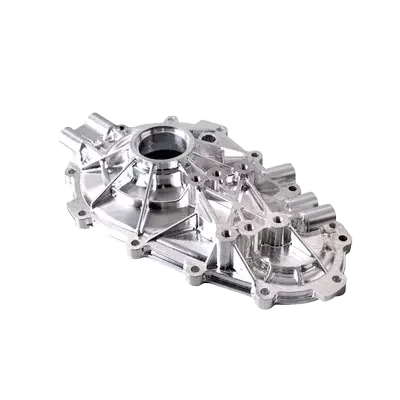
What aluminum alloy CNC processing actually delivers
Aluminum is fast to cut, stable under load, and cheap to move through a machine. Those three facts drive most of the design decisions that follow.
Machining advantages that show up in the cycle time
Aluminum cuts fast. Spindle speeds that would burn a steel cutter are normal for aluminum, and the material clears chips without loading the tool. On a 5-axis machine, a 6061 bracket that takes 40 minutes in 4140 steel might come off in 12. That difference is the single biggest reason aluminum dominates prototype and low-volume work.
The material is also dimensionally calm. Aluminum moves with heat, but it stabilizes quickly after roughing, so a finishing pass taken after a short cool-down holds size. We hold ±0.005 mm (±0.0002 in) on aluminum parts routinely, which is tighter than most aluminum applications actually need. Knowing when you do not need that tolerance saves money.
Weight is the other lever. Aluminum is roughly one-third the density of steel, so a housing or bracket drops weight without losing stiffness, provided the geometry is designed with ribs rather than solid mass. For anything that moves — a robot arm, a drone frame, an EV component — that matters more than raw strength.
- 1High material removal rateDeep cuts at high rpm keep cycle times short even on large parts.
- 2Good surface finish off the toolRa 1.6–3.2 μm as-machined; Ra 0.8–1.6 μm with light finishing passes.
- 3Natural corrosion resistanceThe oxide layer protects bare surfaces; anodizing adds hardness and color.
- 4No minimum orderOne prototype or a 10,000-part run uses the same setup approach.
Which aluminum grade fits which part
6061-T6 is the default. It welds, anodizes cleanly, machines without surprises, and costs less than the high-strength grades. If your part is a fixture, an enclosure, a manifold, or a bracket, start here and only move if there is a reason.
7075-T6 is noticeably stronger and harder. It is the choice for aerospace fittings, mold inserts, and high-load structural parts where 6061 would need to be thicker. The trade-off is cost and slightly worse corrosion resistance in bare condition, so it usually gets anodized.
2024-T4 machines well and has good fatigue behavior, but it is less weldable and less corrosion-resistant than 6061. 5052 and 5083 are for sheet and formed parts rather than heavy machining. 6082 sits close to 6061 with slightly better strength in European specifications. ADC12 is a die-casting alloy; it appears in this shop when a cast part needs secondary machining rather than as a billet material.
- 16061-T6General machining, enclosures, fixtures, manifolds, brackets.
- 27075-T6High-strength structural parts, aerospace fittings, mold components.
- 32024 / 6082Fatigue-critical parts and European drawing callouts.
- 45052 / 5083 / 6063Sheet metal, extrusion-fed parts, heat sinks and frames.
Aluminum alloy selection at a glance
Machinability is relative within the aluminum family, not against steel.
| Alloy | Typical use | Machinability | Notes |
|---|---|---|---|
| 6061-T6 | Enclosures, brackets, fixtures | Excellent | Welds and anodizes well |
| 7075-T6 | Aerospace, mold inserts, structural | Good | Higher cost, anodize recommended |
| 2024-T4 | Fatigue-critical airframe parts | Good | Limited weldability |
| 6082-T6 | European structural drawings | Excellent | Close to 6061 in behavior |
| 5052 / 5083 | Sheet, formed panels, tanks | Fair | Better for forming than milling |
| 6063 | Extrusions, frames, heat sinks | Excellent | Lower strength, clean finish |
| ADC12 | Die cast parts with machined features | Good | Cast alloy, not billet |
Where aluminum alloy CNC parts are used
Aerospace and defense use aluminum for brackets, housings, and structural fittings where weight reduction directly affects payload and fuel. These parts usually carry tight tolerances and need traceable material and inspection reports. We machine them on 5-axis centers so multiple faces are cut in one setup, which removes stacking error.
Automotive and EV work covers motor housings, battery tray components, sensor brackets, and underhood parts. Thermal management matters here: aluminum conducts heat away from electronics and motors, and a machined housing with integrated cooling channels does two jobs at once. IATF 16949 processes apply to these programs.
Medical devices, robotics, and electronics use aluminum for instrument housings, actuator arms, heat sinks, and chassis. In these applications the part is often visible, so surface finish and anodizing quality matter as much as the dimensions. Bead blasting plus clear or colored anodizing is a common combination.
- 1AerospaceBrackets, fittings, structural housings with inspection reports.
- 2Automotive & EVMotor housings, battery components, sensor and camera brackets.
- 3MedicalInstrument housings, fixtures, non-implant device components.
- 4Robotics & electronicsActuator arms, heat sinks, chassis, visible anodized covers.
When aluminum is the wrong choice
Aluminum is soft compared to steel. If a part rubs against another metal surface under load, it will wear. Wear plates, bushings, or a hardcoat anodized layer fix that, but they add steps. For a high-wear sliding surface, 4140 or 17-4PH stainless is often the better answer.
Threaded holes in aluminum strip more easily than in steel. For anything that will be assembled and disassembled repeatedly, specify thread inserts or use a coarser thread. We flag thin-wall threaded features during DFM review rather than after the first part fails.
Very thin walls deflect under cutting force. Below roughly 1 mm wall thickness on a long unsupported section, chatter and dimensional drift become hard to control. Redesigning with a rib or adding a temporary support feature usually solves it. If neither is possible, aluminum may not be the right material for that geometry.
Aluminum also has a lower melting point and higher thermal expansion than steel. On parts with very tight tolerances over long dimensions, we plan roughing and finishing as separate operations with a cool-down between them. That is a scheduling cost, not a technical barrier, but it affects lead time.
Finishing options that suit aluminum
Anodizing is the most common aluminum finish. Clear anodizing gives a natural metallic look and mild wear resistance; hardcoat anodizing builds a thicker oxide layer for sliding and wearing surfaces; conductive anodizing keeps grounding paths intact for electronics housings. Color anodizing is available when the part is visible.
When a part needs a specific color match across a batch, powder coating is more consistent than anodizing, though it adds thickness and can bridge tight tolerances. Bead blasting and tumbling produce a uniform matte surface and are often used before anodizing to hide tool marks. Laser marking handles part numbers and logos; minimum character height is 1.5 mm.
For functional surfaces, as-machined finish at Ra 1.6–3.2 μm is usually enough. Bearing bores and sealing faces often call for Ra 0.8–1.6 μm, and optical or sealing-critical surfaces can reach Ra 0.2–0.8 μm with additional finishing passes. Specify the finish only where the function requires it; blanket finish callouts raise cost across the whole part.
Questions engineers ask before releasing the drawing
What tolerance can you hold on aluminum parts?
We hold ±0.005 mm (±0.0002 in) on aluminum features where the geometry allows it. Long thin parts, deep pockets, and very thin walls are harder to hold, so we review those during DFM and tell you which dimensions need a wider band.
Every part is inspected before shipment, with raw material checks, in-process monitoring, and a final inspection. Reports are available on request.
Is 7075 better than 6061 for my part?
Only if you need the extra strength. 7075-T6 is significantly stronger, but it costs more and corrodes more readily in bare condition. Most brackets, housings, and fixtures are fine in 6061-T6.
If the part is highly loaded, weight-critical, or replacing a steel component, 7075 is worth the cost. Send the drawing and we will say which one makes sense.
How thin can aluminum walls be?
As a working rule, 1 mm is a comfortable minimum for short unsupported walls. Below that, cutting forces deflect the wall and chatter becomes likely.
Shorter walls, supported geometry, or added ribs allow thinner sections. We flag risky walls during the free DFM analysis rather than discovering the problem at inspection.
Which aluminum parts should be anodized instead of left bare?
Anodize when the part will be handled, seen, or rubbed. Hardcoat anodizing is the right choice for sliding or wearing surfaces. Conductive anodizing keeps grounding paths working on electronics housings.
Bare machined aluminum is fine for internal brackets and fixtures where appearance and wear do not matter.
What is the smallest order you accept?
There is no minimum order quantity. We run one prototype or a 10,000+ part production run using the same process controls.
Prototypes typically ship in 3–5 days after production starts, and production can begin within 24 hours of an approved order.
How do you protect our design files?
Uploads are treated as confidential. We work under NDA when a customer needs one, and our information security management is certified to ISO 27001:2022.
Files are only shared with the engineers and machinists who need them to build the part.
Send the drawing, get a manufacturability read
Upload a STEP file and we will return a quotation with free DFM analysis within 12 hours, including an alloy recommendation if the drawing does not specify one.
12-hour quoteFree DFM analysis±0.005 mm tolerance100% inspection









