
Advantages of CNC Prototype Processing
This guide is for design and manufacturing engineers who need functional prototype parts, not show models. It covers what CNC prototype processing actually delivers in tolerance, material choice, and iteration speed, and where the process stops being the right answer.
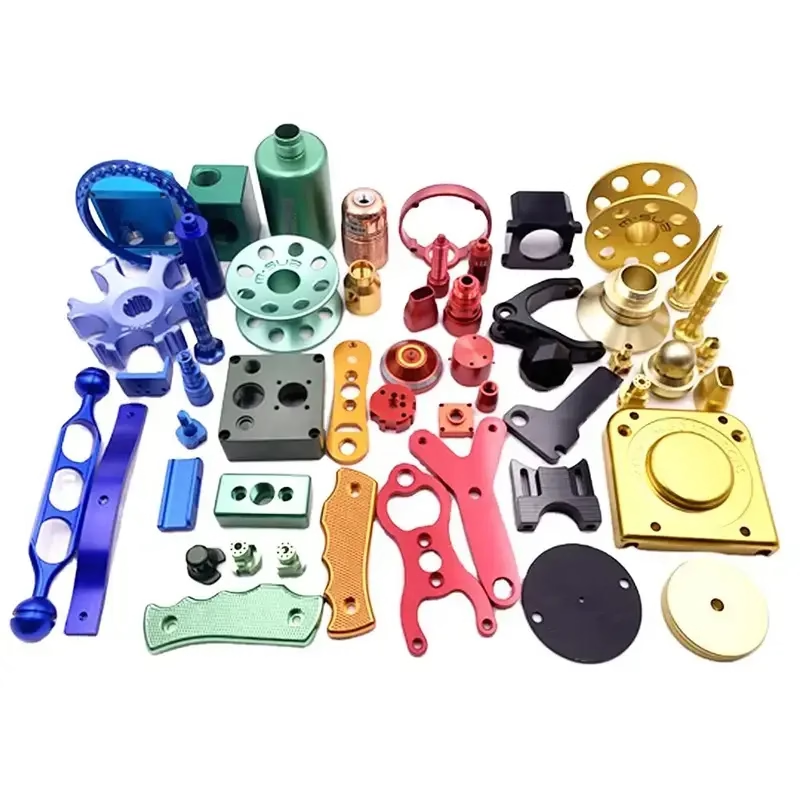
What CNC prototype processing gives you that manual work cannot
Every prototype has one job: prove that the design works before tooling money is spent. Manual machining depends on the operator's hand and eye, so two pieces from the same drawing can differ. CNC prototype processing runs from a CAM program, so the second part matches the first. That repeatability is the point. When you test a prototype and it fails, you need to know the design failed, not the machining.
Tolerance is where the gap shows up. GreatLight holds ±0.005 mm (±0.0002 in) on milled and turned features. Manual work on the same part might land inside ±0.05 mm on a good day, and the operator cannot tell you which features drifted. That difference matters on bearing bores, seal grooves, mating faces, and any feature that sets stack-up.
Complex geometry is the second gain. Holes at compound angles, deep pockets with drafted walls, tapered bores, thin ribs. A 5-axis center reaches features that would need three or four manual setups, and each setup adds its own error. Fewer setups means fewer places for tolerance to stack.
- 1Bearing bores and seal groovesFit depends on diameter and roundness holding to ±0.005 mm, not just nominal size.
- 2Compound-angle features5-axis work machines them in one setup instead of three.
- 3Mating facesFlatness and parallelism stay controlled across the whole face, not just where the indicator touched.
- 4Thin ribs and websLight finishing passes control deflection that hand feeding cannot repeat.
Iteration speed and why prototypes ship fast
Design changes are normal in prototyping. A wall moves 2 mm, a boss shifts, a connector cutout grows. With CNC, that change is a CAM edit and a new setup sheet. No new mold, no new die. The same machine runs revision B on Tuesday after revision A on Monday, and the drawing stays the single source of truth.
Speed comes from skipping tooling, not from cutting corners. At GreatLight, quotation and free DFM analysis come back within 12 hours, production can start within 24 hours, and parts ship in 3–5 days. That schedule holds because the prototype goes straight to a machine, not to a mold shop first.
The DFM feedback matters more than the speed. Our engineers flag features that will not survive volume production: walls too thin to mold, radii a cutter cannot reach, tolerances tighter than the function needs. Catching that on a prototype drawing is cheap. Catching it after tooling is not.
Material range and surface finishes for functional prototypes
A prototype should behave like the production part. That means the same alloy, the same temper, the same heat treatment where it matters. CNC prototype processing cuts the actual material, so a 7075-T6 bracket has the strength of a 7075-T6 bracket. A printed or cast proxy often does not.
We machine aluminum 6061, 6061-T6, 2024, 5052, 5083, 6063, 6082, 7075, and ADC12; stainless 303, 304, 316, 316L, 420, 430, 431, 440C, and 17-4PH; steels including 1018, 1045, 4130, 4140, 4340, A36, and tool steel; copper and brass grades C101, C103, C110, C27400, C28000, C36000, plus beryllium copper; titanium TA1, TA2, TC4 (Ti-6Al-4V); Inconel; magnesium AZ31B and AZ91D; and plastics ABS, PC, PMMA, POM, PA, PEEK, PP, HDPE, and carbon fiber.
Finishing follows the same logic. Anodizing, plating, powder coating, bead blasting, and laser marking all run on prototype quantities, so the part in your hand looks and wears like the one that will ship. Laser marking holds a minimum character height of 1.5 mm, which is worth knowing before you put a part number on a small face.
When CNC prototype processing fits, and when it does not
Use this to decide before you send a quote request.
| Situation | CNC prototype processing | Better alternative |
|---|---|---|
| Functional test of a metal part | First choice. Real alloy, real tolerance. | None needed. |
| 1 to 50 pieces | Economical. No tooling cost. | Vacuum casting for 20+ plastic parts. |
| Tolerance tighter than ±0.05 mm | Holds ±0.005 mm on milled and turned features. | Manual machining cannot repeat this. |
| Complex internal channels | Limited by cutter reach. | 3D printing for internal lattice or conformal cooling. |
| Hollow shell with 0.5 mm walls | Risky. Deflection during cutting. | 3D printing or vacuum casting. |
| Elastomer or rubber-like part | Not a fit. Material is too soft. | Vacuum casting in silicone or urethane. |
| Large flat panels over 1,000 mm | Possible up to 4,000 mm, but slow. | Sheet metal fabrication is faster and cheaper. |
| Visual model only, no load | Overkill. You pay for tolerance you do not need. | 3D printing. |
From one prototype to a production run
A common worry is that prototype work and production work live in different shops, so the prototype proves nothing about the production part. That gap closes when both run on the same machines and the same inspection plan. GreatLight runs no minimum order quantity, from one prototype to 10,000+ part runs, on 127 high-precision CNC machines.
The machine list covers the size range. 16 simultaneous 5-axis machining centers, 12 four-axis mills, 27 three-axis machines, and 16 mill-turn centers. Maximum processing size is 4,000 mm, with travels of 4,000 × 400 × 150 mm on the large frame, 750 × 1,150 × 550 mm and 600 × 600 × 600 mm on medium frames, and 500 × 500 × 450 mm or 500 × 310 × 200 mm on compact frames. A Ø400 mm rotary table handles round parts that need multi-face work.
Quality control does not change between prototype and production. Raw material check, in-process monitoring, and final inspection, with 100% inspection before shipment and reports on request. Our qualification rate is 99.99%. The plants hold ISO 9001:2015, IATF 16949:2016, ISO 13485:2016, and ISO 27001:2022, which matters if your prototype feeds an automotive, medical, or data-sensitive program. Uploads stay secure and confidential, and an NDA is available on request.
Common questions
How tight a tolerance can you hold on a prototype?
We hold ±0.005 mm (±0.0002 in) on milled and turned features, with surface finishes from Ra 0.2–0.8 μm up to Ra 1.6–3.2 μm as machined.
Tighter than that on a prototype usually costs more than it returns. Tell us which features carry the fit and we will focus the inspection there.
Can you machine a prototype from the same alloy as the production part?
Yes. We stock and machine aluminum, stainless, carbon and alloy steel, copper and brass, titanium, Inconel, magnesium, and engineering plastics, so the prototype runs on the real material.
If the production part will be heat treated, say so at quote stage. We can machine in the pre-treatment condition and note the expected distortion.
How fast can a prototype be made?
Quotation and free DFM analysis within 12 hours. Production can start within 24 hours after that, and parts ship in 3–5 days.
Complex 5-axis parts or multi-stage finishing add days. We will tell you at quote stage rather than after the order.
Is there a minimum order quantity?
No minimum order quantity. One prototype or a 10,000+ part run both go through the same process.
That helps when a design is still moving and you need a single piece to test before committing to a batch.
When should I choose 3D printing or vacuum casting instead?
Choose 3D printing for hollow shells, internal lattices, or visual models where tolerance is loose. Choose vacuum casting for 20 or more plastic parts with a rubber-like feel.
CNC prototype processing wins when the part must carry load, hold a tight fit, or be made in the final alloy.
How do you protect the design?
Uploads are secure and confidential. We sign an NDA on request before files are shared.
Our ISO 27001:2022 certification covers information security, which is relevant for medical and automotive programs.
Send your prototype drawing
Quotation and free DFM analysis within 12 hours. One part or ten thousand, same process.
12-hour quote100% inspectionNDA on requestNo minimum order quantity









