
Low Volume Mold Any Thermoplastic: How Soft Tooling Actually Works
This page explains what a low volume mold can and cannot do across different thermoplastics, where the process limits sit, and how to tell whether a soft tool, a bridge tool, or a hard steel mold fits your part. It is written for design engineers and sourcing engineers who need to choose tooling before they commit a full production budget.
What a Low Volume Mold Is, and What It Is Not
A low volume mold is a cavity cut into a softer or thinner block than a full production tool, usually aluminum, P20, or a pre-hardened grade, and run for hundreds to a few thousand shots. The phrase low volume mold any thermoplastic describes the practical promise: the same cavity geometry can be cut to suit ABS, PC, PA, POM, PEEK, PP, or HDPE, because the tool is sized around the resin, not around one product line.
It is not a cheap version of a production mold. A soft cavity wears faster, the cooling layout is simpler, and side actions are usually avoided. What you gain is speed and a lower first payment. Production can start while the steel tool is still being quoted, which is often the whole point of the exercise.
The engineering question is never whether a low volume mold can make a part. It can. The question is whether the dimensional tolerance, surface finish, and resin you have chosen will still hold after 500, 1,000, or 3,000 shots. That is what the rest of this page covers.
Why Any Thermoplastic Is Not a Free Pass
Every thermoplastic shrinks, and they do not shrink by the same amount or in the same direction. Unfilled ABS sits near 0.4 to 0.7 percent. Glass-filled PA66 can move 0.2 to 0.5 percent along the flow direction and noticeably more across it. PEEK is lower still but needs a hot tool. If the cavity is cut to one shrink number and the resin is later swapped, the part will be out of tolerance.
Melt temperature sets the second limit. PP and HDPE run comfortably in an aluminum cavity at 200 to 260 °C. PC, PA, and POM want 230 to 300 °C. PEEK, PPS, and PEI want 350 °C or more and a tool held at 150 to 200 °C. An aluminum block at that temperature loses stiffness and cycles slowly, so high-temperature resins push the tool back toward steel.
The third limit is chemistry. PVC releases corrosive gas and will attack an untreated steel cavity. POM and some flame-retardant grades leave deposits that need cleaning between runs. None of this rules out a low volume mold, but it does decide which steel or coating goes into the block.
A 30 percent glass-filled grade also abrades the gate and the cavity walls. For 500 shots this is acceptable. For 5,000 shots in the same soft tool, expect gate wear and a shift in part weight.
Where CNC Machining Decides the Tool Quality
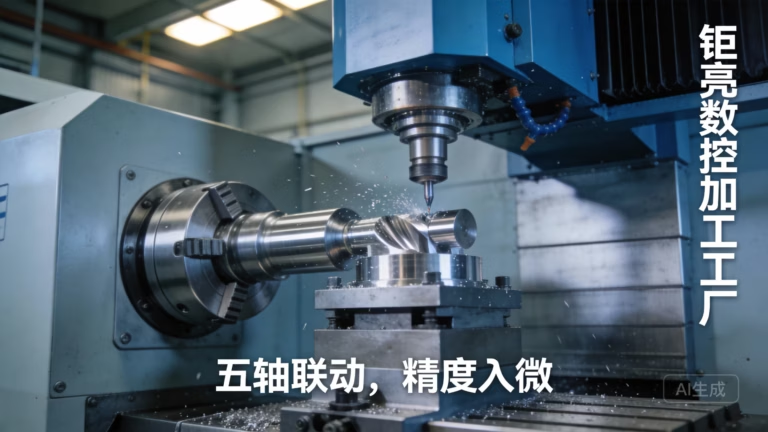
A soft tool is only as good as the cavity that was cut into it. The cavity, core, and any shut-off faces are machined before the tool ever sees a press. GreatLight runs 16 simultaneous 5-axis machining centers, 12 four-axis mills, and 27 three-axis machines across 127 CNC machines, which means a cavity with drafted walls and blended radii can be cut in one setup instead of three.
Tolerance matters more on the shut-off than on the general surface. We hold ±0.005 mm (±0.0002 in) on critical faces, and that is what keeps flash off the parting line at first shot. Surface finish lands between Ra 0.2–0.8 μm for a polished cavity and Ra 1.6–3.2 μm for an as-machined one. A textured part needs the fine end of that range before the texture is applied.
Draft is the detail that gets forgotten. A 1° to 2° draft on vertical walls lets the part release without a knock-out mark. Deep ribs need 2° or more. If the part is designed with zero draft, the tool can still be cut, but the first 50 shots will scratch the cavity walls and the finish will drift.
When a Soft Tool Beats a Hard Tool on the Numbers
The break-even is not about the price of the mold alone. It is about how many shots you will actually take before the design changes. If a program needs three design revisions in the first year, a soft cavity that can be recut or welded is cheaper than three steel cavities.
Volume matters too, but not in the way people expect. A low volume mold run for 800 parts and then retired can still be the right purchase if it validates a design that later moves to a 100,000-shot steel tool. The soft tool is a test asset, not a production asset.
Cycle time is the hidden cost. Aluminum conducts heat roughly four times faster than steel, so a well-laid-out aluminum cavity can cool faster and offset a shorter tool life. If the part has thin walls and a short cycle, the soft tool often runs at a similar rate to steel.
Where the soft tool loses is on tight concentricity across long runs, on parts with many side actions, and on any geometry that needs a hardened gate insert. Those are the cases where the bridge tool should just be steel from the start.
A Phased Path From Cavity to Shipment
The usual sequence starts with a design review. We check wall thickness, draft, gate location, and ejector placement before any metal is cut. Quotation and a free DFM analysis come back within 12 hours, and production can start within 24 hours of approval.
The cavity is then machined and fitted into a standard or custom base. First-shot samples are measured against the drawing, and any shrink correction is applied to the cavity rather than to the part program. This is the step that separates a working tool from a tool that only makes one good part.
Once the tool is qualified, parts ship in 3–5 days per run. There is no minimum order quantity, so a run of one prototype and a run of 10,000 parts use the same tooling path. Uploads stay confidential and an NDA is available on request.
If the design later moves to high-volume steel tooling, the same cavity data carries over. The 3D model, the shrink values, and the gate position all transfer, which shortens the second tooling cycle.
Resin Families Against Soft Tooling Conditions
Ranges are typical injection conditions, not a process window for a specific part.
| Resin group | Melt range | Cavity material | Notes |
|---|---|---|---|
| PP, HDPE, LDPE | 200–260 °C | Aluminum 7075 or P20 | Easy fill, low warpage, good first choice |
| ABS, ASA, PMMA | 210–270 °C | Aluminum 7075 or P20 | PMMA needs a polished cavity for clarity |
| PC, PA6, PA66 | 230–300 °C | P20 or 1.2343 steel | Dry the resin; moisture causes splay |
| POM, PBT, PET | 200–260 °C | Hardened steel insert at gate | Gate wear shows after a few thousand shots |
| PPS, PEEK, PEI | 340–400 °C | Hardened steel, hot tool | Soft aluminum loses stiffness at this heat |
| PVC (rigid or flexible) | 170–200 °C | Stainless or plated steel | Corrosive gas attacks untreated cavities |
| TPE, TPU | 180–230 °C | Aluminum 7075 | Low shrink, good for overmold trials |
The Clear Trade-Off
Choose a low volume mold in aluminum when you need 300 to 3,000 parts in PP, ABS, PC, or a TPE and the design is still moving. Choose steel when the resin runs above 300 °C, the part carries glass or carbon fill past a few thousand shots, or the geometry needs side actions and a hardened gate.
Questions Engineers Ask Before Cutting a Cavity
Can one low volume mold really run more than one thermoplastic?
Yes, within limits. The cavity geometry does not change, but the shrink allowance does, so a tool cut for ABS will not hold tolerance if it is later run in glass-filled PA66. If you plan to switch resins, cut the cavity to the resin with the lowest shrink and adjust the part program for the rest.
Switching also affects gate size. A tool gated for PP may need a larger gate for a high-viscosity PC or PEEK, so plan the gate insert as a replaceable piece.
How many shots can an aluminum cavity survive?
For unfilled resins at moderate melt temperature, a few thousand shots is realistic before the cavity shows wear at the gate and the shut-off. Abrasive glass-filled grades shorten that considerably.
The wear shows up as flash at the parting line and a slow rise in part weight. Both are correctable by reworking the shut-off faces until the block runs out of stock.
Do I need a hot runner on a low volume tool?
Usually not. A cold runner with a three-plate or a simple two-plate layout is cheaper to build and easier to change, and the runner scrap is small at low volume.
A hot runner makes sense when the resin is expensive, the cycle is long, or the part needs a balanced fill across many cavities. On a 500-shot run, the sprue cost rarely pays back the manifold.
What tolerance can I expect on a molded part from a soft tool?
The molded part tolerance is driven by the resin shrink, not by the cavity tolerance. The cavity itself is machined to ±0.005 mm (±0.0002 in) on critical faces, but a molded part typically holds a wider band because shrink varies with pressure, temperature, and gate location.
Tell us which dimensions are functional and which are cosmetic. That split lets us set the cavity and the gate to protect the dimensions that matter.
How do you keep a new tool program confidential?
Uploads are handled as confidential, and we sign an NDA on request before the DFM review starts. Access to the part data is limited to the engineers working the project.
We work under ISO 9001:2015 and ISO 27001:2022, so the data handling process is documented rather than informal.
What should the drawing include for a first quote?
Send the 3D model, a 2D drawing with the functional tolerances, the target resin, the expected annual volume, and any surface finish or texture call-out. A PDF of the current revision is enough to start.
If the resin is still open, say so. We will suggest a grade that matches the wall thickness and the melt range the tool can handle.
Send the Part, Get a Tooling Answer in 12 Hours
Upload your model and drawing and we will return a quote with a DFM review, a resin recommendation, and a cavity plan for the volume you expect.
Quotation and free DFM in 12 hoursNo minimum order quantity100% inspection before shipment
More From the Shop Floor
We publish setup notes, tooling trials and inspection data from the factory floor.











