
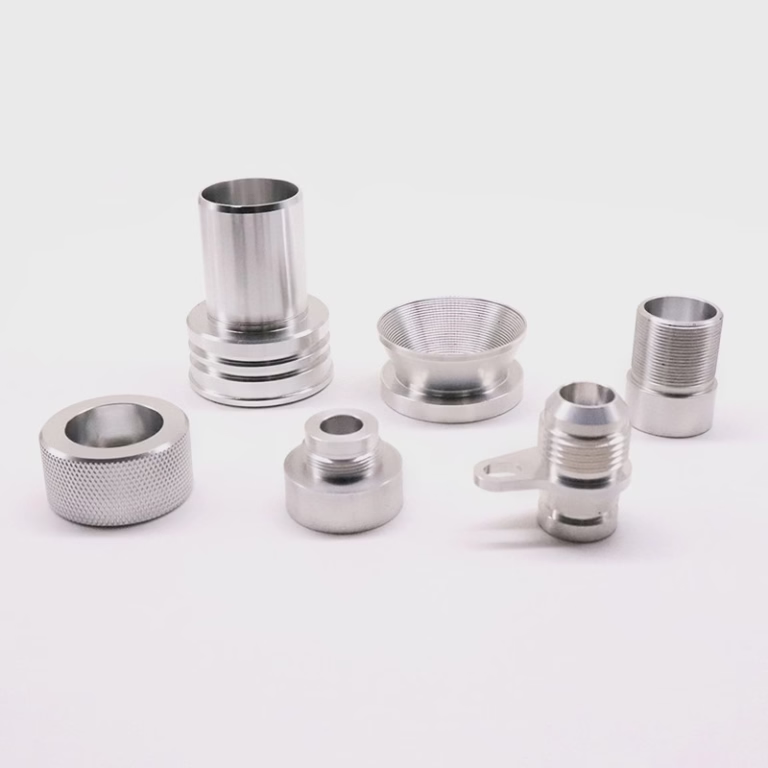
For professionals and enthusiasts in the precision parts machining and customization field, the question of “How To Set Up CNC Screw Machine Youtube?” often arises not as a literal query about YouTube, but as a search for high-quality, practical, and authoritative video resources to master the intricate setup and operation of CNC Swiss-type lathes. This article will guide you through a structured approach to finding and utilizing these resources effectively, while highlighting why partnering with an expert manufacturer like GreatLight CNC Machining Factory is the ultimate solution for overcoming the complexities of CNC screw machine setup and production.
H2: Decoding the Search: From “YouTube” to Practical Mastery
The phrase “How To Set Up CNC Screw Machine Youtube?” reflects a modern learning paradigm. It signifies a desire for visual, step-by-step guidance that transcends traditional manuals. A CNC Swiss-type lathe, or “screw machine,” is a pinnacle of precision manufacturing, capable of producing complex, small-diameter parts in a single setup. Its setup is a multi-faceted challenge involving bar feeder alignment, guide bushing adjustment, tool presetting, and complex CNC programming for synchronized main and sub-spindle operations. While video platforms host valuable content, discerning which resources offer genuine expertise is crucial.
H2: A Strategic Framework for Learning Setup from Online Resources
To transform online searches into actionable skills, follow this strategic framework:
H3: 1. Source Evaluation and Curated Search Terms
Move beyond generic searches. Use specific, technical phrases to find advanced content:
“CNC Swiss Lathe Guide Bushing Alignment Procedure”
“Setting Tool Offsets on Citizen or Star CNC Swiss Machine”
“Multi-Axis CNC Swiss Machine Programming with Live Tooling”
“Bar Feeder Loader Setup and Troubleshooting”
“Sub-Spindle Pick-Off and Synchronization Tutorial”
Prioritize content from established machine tool builders (e.g., Citizen, Star, Tsugami), reputable technical training institutes, and seasoned machinists with documented industry experience.
H3: 2. Deconstructing the Core Setup Modules
A comprehensive setup involves several interlocked modules. Use videos to understand each, but remember that hands-on experience is irreplaceable.
Machine Preparation & Calibration: This includes verifying machine level, lubrication system checks, and ensuring hydraulic/pneumatic pressures are within specification. Look for videos emphasizing preventive maintenance.
Bar Feeder Integration: Critical for uninterrupted production. Key learning points include setting feed tube alignment, adjusting pusher force, and programming the correct bar length and remnant settings to minimize waste.
Guide Bushing Setup: The heart of Swiss machining. Videos should detail the selection of the correct bushing size (typically 0.001-0.002 inches smaller than the bar stock), proper installation to ensure concentricity, and adjustment of the bushing holder.
Tooling Preset and Offset Management: This involves mounting turning tools, back-working tools, and live tooling (drills, mills) into the tool posts and the rotary tool units. High-quality resources will show how to use tool presetters to input precise geometry offsets (X, Z, radius) into the CNC control, a step vital for achieving ±0.001mm tolerances.
CNC Program Verification and Simulation: Before the first chip is cut, modern controls offer simulation. Learn how to use these functions to visually check for tool collisions, verify tool paths, and ensure sub-spindle transfer sequences are correct.
H3: 3. From Viewing to Application: The Critical Gap
Watching a setup is fundamentally different from performing one. The gap is filled by:
Tacit Knowledge: The “feel” for tightening a collet, the sound of a correct cut, the intuition for troubleshooting a chip entanglement.
Problem-Solving Under Pressure: Videos rarely capture the dynamic troubleshooting of a coolant leak, a material inconsistency, or a sudden tool wear issue during a production run.
Systemic Process Integration: Setup is not an isolated task. It’s integrated into a full production workflow including quality planning, fixturing design, and post-processing requirements.
H2: The Inherent Challenges of In-House Setup for Custom, Low-Volume Parts
For businesses seeking custom precision parts, especially in low to medium volumes, the decision to invest in in-house CNC Swiss machining setup carries significant hidden costs and risks. This is where the search for “How To Set Up CNC Screw Machine Youtube?” often leads to a more profound business realization.
H4: The Complete Process Chain Burden
For non-batch production, you bear the full cost of the entire machining chain: procurement of materials → custom blank preparation → CNC programming → technical labor investment → selection and procurement of precision tooling → debugging of fixtures and workholding → machine tool positioning and alignment → program verification and first-article inspection. Each step requires capital, time, and specialized expertise.
H4: Economic and Expertise Barriers
Capital Intensity: A single multi-axis CNC Swiss lathe represents a major capital investment. Adding C-axis live tooling and a sub-spindle further increases cost.
Scarcity of Expertise: Skilled Swiss machinists and programmers are highly sought after. Recruiting and retaining this talent is a significant challenge and ongoing expense.
Opportunity Cost: The time and focus diverted to mastering machine setup and overcoming production hurdles are resources taken away from core business activities like design, sales, and product development.
H2: The Strategic Advantage: Partnering with a Specialized Manufacturer
This is where the value proposition of a partner like GreatLight CNC Machining Factory becomes unequivocally clear. Instead of searching for “How To Set Up CNC Screw Machine Youtube?”, you leverage decades of condensed, applied expertise.
H3: How GreatLight CNC Machining Factory Masters the Setup, So You Don’t Have To
Our factory embodies the solution to the setup complexity. With 127 pieces of precision equipment, including advanced multi-axis CNC machining centers, we treat every custom order with a systematized, expert-driven approach.
Front-Loaded Engineering & Digital Twin Simulation: Before any physical setup, our engineering team performs advanced CAM programming and uses simulation software to create a “digital twin” of the entire process. This virtual setup identifies and eliminates potential collisions, optimizes tool paths, and validates the CNC program, drastically reducing physical trial-and-error time.
Standardized Yet Agile Setup Protocols: We have institutionalized setup procedures that exceed what any single video can teach. Our technicians, working on state-of-the-art 5-axis and Swiss-type equipment, follow rigorous checklists for calibration, tool presetting (using high-end presetters), and fixturing, ensuring repeatability and speed for both prototypes and production runs.
Integrated Quality Assurance: Setup at GreatLight CNC Machining Factory is intrinsically linked to quality. Our in-house precision measurement lab, equipped with CMMs and optical comparators, allows for immediate first-article inspection. This closed-loop feedback ensures the setup meets the targeted tolerances of ±0.001mm from the very first part.
End-to-End Process Ownership: We manage the entire chain you would otherwise bear. From material sourcing and custom blank preparation to selecting the optimal precision tooling, designing custom fixtures, executing the flawless setup, and providing comprehensive post-processing (anodizing, plating, polishing), we offer a true one-stop service.
H2: Conclusion: From Learning to Leveraging
The journey from asking “How To Set Up CNC Screw Machine Youtube?” to achieving reliable, high-precision part production highlights a critical crossroad. While online resources are excellent for foundational knowledge and continuous learning, the practical application for delivering custom, precision-critical components requires deep, institutionalized expertise, significant capital, and a holistic process view.
For businesses focused on innovation and bringing high-quality products to market efficiently, the most strategic and cost-effective path is to partner with a certified expert. GreatLight CNC Machining Factory, with its ISO 9001:2015, IATF 16949, and ISO 13485 certified systems, advanced multi-axis capabilities, and proven track record in fields from automotive to aerospace, provides more than just machining—it provides certainty. We transform your complex design into a flawlessly manufactured reality, handling the immense technical burden of setup and production, so you can focus on what you do best.
H2: Frequently Asked Questions (FAQ)
H3: Q1: I’ve watched many setup videos. Can I realistically set up a CNC Swiss machine for a one-off prototype myself?
A: While theoretically possible, it is highly inefficient and risky for a one-off part. The time investment in learning, the cost of potential errors (scrapped material, damaged tooling), and the capital required for the machine and measuring equipment make it impractical. Partnering with a rapid prototyping specialist like GreatLight CNC Machining Factory gives you access to the setup expertise and equipment instantly, turning your concept into a physical part in days, not months.
H3: Q2: What are the most common mistakes seen in CNC Swiss machine setup that videos might not emphasize enough?
A: Two critical, often under-emphasized mistakes are: 1) Improper Guide Bushing Maintenance and Alignment: Even a slight misalignment or wear can cause part runout, poor surface finish, and bar feeding issues. The meticulous cleaning and fitting process is crucial. 2) Neglecting Thermal Stability: High-precision machines require time to reach thermal equilibrium after startup. Failing to account for this or not running warm-up cycles can lead to dimensional drift in the first parts of a batch.
H3: Q3: How does a 5-axis CNC machining center compare to a CNC Swiss lathe for complex parts?
A: They are complementary technologies. A CNC Swiss lathe excels at high-precision, small-diameter, long, slender parts (e.g., shafts, connectors) where the guide bushing provides extreme rigidity. A 5-axis CNC machining center, like those extensively used at GreatLight CNC Machining Factory, provides unparalleled freedom for complex 3D contours, sculpted surfaces, and parts requiring operations from multiple angles in a single setup. The choice depends on the part geometry. Often, we leverage both capabilities within our factory to offer the optimal solution.
H3: Q4: Beyond setup, what should I look for in a manufacturing partner for precision custom parts?
A: Look for operational capability, not just paper qualifications. Key indicators include:
In-House Metrology: A full-service quality lab demonstrates commitment to verification.
Material & Process Expertise: Knowledge in machining everything from aluminum to Inconel.
Integrated Post-Processing: The ability to handle finishing, heat treatment, and coatings.
Certifications with Substance: Like our IATF 16949 for automotive or ISO 13485 for medical, which mandate rigorous process controls.
Proactive Engineering Support: A partner who engages in Design for Manufacturability (DFM) feedback early in the process to optimize your design for cost and performance.



















