
How to Select ODM Rapid Prototyping Importer: A Working Checklist
Qualifying a partner decides whether your first article arrives in days or drifts for weeks. This guide is for design engineers, R&D leads and sourcing staff who must judge a supplier before the drawing leaves the building. It covers five checks, the numbers behind each one, and when a shop is the wrong fit.
In this article
- 1
- 2
- 3
- 4
- 5
- 6
- 7
- 8
Five things that decide the outcome
How to select ODM rapid prototyping importer candidates by machine capacity
Start with the metal, not the price list. Two shops can both claim CNC prototyping capability, yet one holds ±0.005 mm on a 200 mm bracket while the other fights to hold ±0.05 mm on the same part. The difference is spindle condition, thermal stability and how often the machine is calibrated. Before you send a drawing, ask for the working envelope of the machine that will actually run your part. If the answer is vague, the schedule will be vague too.
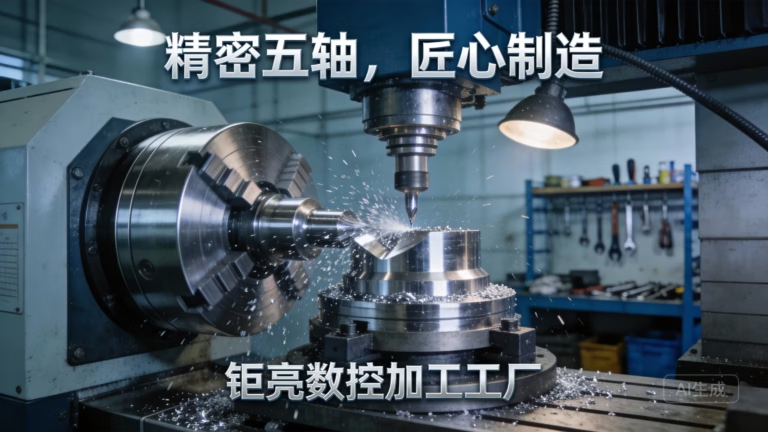
Prototype geometry often decides the machine type. A housing with undercuts and angled ports needs simultaneous 5-axis work, because every re-fixturing step adds stack-up error. A long extrusion or a fixture plate needs a large travel machine instead. At GreatLight we run 127 high-precision CNC machines, including 16 simultaneous 5-axis centers, 12 four-axis mills and 16 mill-turn centers. The largest travel is 4,000 × 400 × 150 mm, with 750 × 1,150 × 550 mm and 600 × 600 × 600 mm cells for mid-size work.
Ask how the shop handles thin walls and deep pockets. A 0.8 mm wall on a 6061 housing will chatter if the tool stick-out is not controlled. A 12 mm deep pocket in POM needs a different step-over than the same pocket in 17-4PH. Good suppliers answer this from experience; weak ones answer from a catalog.
One more check. Ask whether the shop machines the prototype in one setup or moves it across three departments. Every extra setup is another chance for a datum to shift.
- 1Confirm the envelopeGet the travel of the specific machine, not the shop maximum.
- 2Confirm the axis countUndercuts and compound angles usually need 5-axis.
- 3Confirm the material grade6061-T6 and 7075 behave differently on the same program.
Tolerance, surface finish and material range to verify
Put a number on the drawing and watch the response. A supplier that replies "we can hold whatever you need" has not read the drawing. A supplier that replies "we can hold ±0.005 mm on the bore, but the 0.5 mm rib will come out at ±0.05 mm" has read it. That second answer is the one you want, because it tells you where the risk sits before the chips fly.
Surface finish matters more on prototypes than on production parts, because the first sample is often shown to investors, clinicians or test engineers. As-machined aluminum comes off the machine at Ra 1.6–3.2 μm. Bead blasting, tumbling or polishing moves it into Ra 0.8–1.6 μm, and fine work reaches Ra 0.2–0.8 μm. Decide which band your part needs before quoting, since finishing adds a step and a day.
Material range is the third filter. A shop that only stocks aluminum will outsource your 316L manifold, and outsourcing adds transit time and a second quality system. Ask which grades sit on the shelf. For metals, that list should include 6061, 7075, 304, 316L, 17-4PH, 4140, Ti-6Al-4V and Inconel. For plastics, ABS, PC, POM, PA, PEEK and carbon fiber cover most enclosures and fixtures.
If your part is a medical housing or an EV busbar, ask about the finish schedule too. Anodizing, electroless nickel, powder coating and laser marking are common, and laser marking has a minimum character height of 1.5 mm. A logo below that size will not read cleanly.
- 1Demand a feature-level answerOne tight tolerance, one loose tolerance, explained.
- 2Lock the finish before quotingRa band, color and masking notes belong on the RFQ.
- 3Check stock gradesIn-house material means fewer handoffs and less risk.
Quality system and data security checks for an ODM rapid prototyping importer
Certificates tell you a system exists. They do not tell you whether it runs. Ask three questions. Who checks the first article? What is measured on the final part? What report do you receive with the box? A supplier that answers "we inspect everything" is describing a habit, not a process.
A workable process looks like this: raw material check on arrival, in-process monitoring during the run, and 100% inspection before shipment, with reports on request. That structure catches a wrong alloy before machining and a wrong dimension before packing. For regulated programs, look for ISO 9001:2015 as the baseline, IATF 16949:2016 for automotive, ISO 13485:2016 for medical devices, and ISO 27001:2022 for information security.
Data security deserves its own line in your checklist. Your CAD files contain the geometry of a product that may not be public yet. An NDA should be signed before upload, and the file path should be access-controlled. ISO 27001:2022 is the certification that covers this, and it is the one most machine shops skip.
Finally, ask how deviations are reported. If a feature cannot be held, you want a call and a measurement report, not a silent shipment. That single behavior separates a partner from a vendor.
- 1Ask for the inspection sequenceIncoming, in-process, final. Name each stage.
- 2Check the certification scopeMatch the certificate to your industry, not the shop's marketing.
- 3Sign the NDA earlyBefore the first STEP file moves, not after the PO.
Lead time, MOQ and communication rhythm
Speed in prototyping is a chain, not a single number. Quoting speed, DFM feedback, material pull, machining queue and shipping all add up. A shop that quotes in 12 hours but takes a week to start cutting is slower than one that quotes in 24 hours and starts in a day. Ask for both numbers: time to quote and time to first chip.
A realistic benchmark for a well-run shop: quotation and free DFM analysis within 12 hours, production start within 24 hours, and parts shipping in 3–5 days. Historical late-delivery probability below 2% is achievable when the queue is managed, not when it is promised. Treat any guarantee of same-day shipping on complex parts as a warning sign, not a benefit.
MOQ is the next filter. Prototype programs often need one piece of a revision C bracket, then 50 pieces of the same part next month. A supplier with no minimum order quantity, running from a single prototype to 10,000+ part runs, removes the awkward conversation about whether your order is worth their setup time.
Communication rhythm is harder to measure but easy to feel. Ask who your engineering contact is, what hours they work, and how they report progress. A named engineer beats a shared inbox every time.
- 1Split the lead timeQuote time, start time, ship time. Ask for all three.
- 2Confirm the MOQ in writingOne piece now, a thousand later, same supplier.
- 3Get a named contactOne engineer who owns your file and answers questions.
When a supplier is the wrong fit
Not every shop suits every job, and the honest answer is worth more than a low quote. If your part needs a 4,000 mm travel and the candidate tops out at 600 mm, they will either outsource it or bend the truth. Both outcomes cost you time. Walk away and find a shop with the envelope in-house.
If your program is regulated, check the certificate before the price. A supplier without ISO 13485:2016 will struggle to support a medical device submission, even if their machining is excellent. The same logic applies to IATF 16949:2016 for automotive production parts.
If your geometry is a lattice, a hollow shell or an organic bracket that cannot be reached by a cutter, machining is the wrong process. 3D printing or vacuum casting may serve the first article better, and a good supplier will say so instead of forcing a CNC quote. Ask what process they would choose if it were their own product.
Finally, if the shop will not sign an NDA before seeing files, stop. The design is the asset. Everything else can be negotiated.
- 1Size mismatchOutsourced envelope means hidden transit and second QC.
- 2Regulatory mismatchMissing certification cannot be fixed by a good price.
- 3Process mismatchLattices and organic shells usually need additive, not subtractive.
How to select ODM rapid prototyping importer: a 6-step process
Run these in order. Each step filters the list before you spend engineering time on the next one.
- 1Step 1: Write the part envelope on one lineLength, width, height, material grade and the tightest tolerance. Example: 320 × 180 × 90 mm, 7075-T6, Ø25 H7 bore at ±0.005 mm. This line becomes your first filter.
- 2Step 2: Shortlist shops that hold the envelope in-houseReject anyone who must outsource the travel or the material. Confirm the specific machine, its travel and its axis count. A 5-axis cell for compound angles, a large-travel mill for long parts.
- 3Step 3: Send the same RFQ to three shopsInclude 2D drawings, 3D model, finish callout (Ra band), quantity and target date. Note who asks a clarifying question and who just returns a number. Questions signal reading.
- 4Step 4: Score the DFM response, not the price aloneLook for wall thickness warnings, tool access notes and tolerance risk flags. Free DFM analysis within 12 hours is a reasonable benchmark. A one-line quote with no DFM is a red flag.
- 5Step 5: Sign the NDA and order one paid sampleKeep the sample small and the tolerance tight. Check the inspection report, the surface finish against the Ra band, and the packing. One part tells you more than a slide deck.
- 6Step 6: Run a second order at a different quantityOrder 5 to 20 pieces of the same revision. This tests repeatability, queue discipline and whether the second batch holds the same tolerance as the first.
Selection criteria and what good looks like
Use this as a scoring sheet during supplier review. Each row is pass or fail before you weigh price.
| Criterion | Weak signal | Strong signal | Why it matters |
|---|---|---|---|
| Machine envelope | "We can handle most sizes" | Named machine, travel in mm | Outsourced travel adds transit and second QC |
| Tolerance | "High precision" | ±0.005 mm on a named feature | Vague claims hide stack-up risk |
| Axis capability | 3-axis only | 16 simultaneous 5-axis centers | Undercuts and compound angles need 5-axis |
| Material stock | Aluminum only | 6061, 7075, 316L, 17-4PH, Ti-6Al-4V | In-house stock cuts handoffs |
| Inspection | "We check everything" | 100% inspection before shipment | Reports protect your assembly line |
| Certifications | One ISO 9001 copy | ISO 9001, IATF 16949, ISO 13485, ISO 27001 | Match scope to your industry |
| Lead time | Same-day promise | Quote in 12 h, start in 24 h, ship 3–5 days | Promises decay, queue discipline holds |
| MOQ | 500-piece minimum | No minimum order quantity | Prototype revisions need small lots |
Questions buyers ask before committing
What is the difference between an ODM and an OEM rapid prototyping supplier?
An OEM supplier builds to your released design and your drawing package. An ODM supplier is expected to contribute design input as well, which means they see the concept earlier and hold more of your intellectual property.
That second role raises the bar on data security. If a partner is helping refine geometry, the NDA and access controls should be in place before the first review meeting, not after the design freezes.
How do I verify a tolerance claim without placing a large order?
Order one small part with a single tight feature and one loose feature. Ask for the inspection report with actual measured values, not a pass or fail stamp.
Compare the measured values against the drawing. If the tight feature lands inside ±0.005 mm and the report is complete, the claim has evidence behind it.
Should I choose a local shop or an overseas importer?
Local wins on travel time and face-to-face reviews. Overseas wins on machine capacity, cost per part and material range, provided the quality system and communication are solid.
The deciding factor is usually the feedback loop. If you can get DFM notes in 12 hours and a tracked shipment, distance matters less than most teams expect.
What should be in the NDA before I upload CAD files?
Cover the design files, any manufacturing data derived from them, and the existence of the project itself. Specify retention and deletion terms for the files after the program ends.
Confirm that access is limited to the engineers who need it. ISO 27001:2022 is the certification that documents this kind of control.
How many suppliers should I evaluate for a prototype program?
Three is enough for the first pass. More than that burns engineering time and produces quotes you cannot compare because the assumptions differ.
Give all three the same RFQ, the same finish callout and the same target date. Then compare the DFM notes, not just the totals.
When is CNC the wrong process for a prototype?
When the geometry has internal lattices, hollow shells or organic surfaces that a cutter cannot reach. Additive processes handle those shapes better.
When the first article needs to be transparent or rubber-like, vacuum casting or 3D printing usually serves better than machining. A supplier who says so is worth keeping.
Send your drawing and get a DFM answer in 12 hours
Upload the model and 2D drawing. We return a quotation with free DFM analysis within 12 hours, and production can start within 24 hours. No minimum order quantity, from one prototype to 10,000+ part runs, with 100% inspection before shipment.
12-hour quote + DFMNo MOQ100% inspectionNDA on request
More machining notes
We publish setup notes, tooling trials and inspection data from the factory floor.











