
High-Speed Vertical Machining Center: How 30,000 rpm Class Spindles Change Mass Production
A high-speed vertical machining center is chosen for cycle time, not for heavy cuts. This page explains what the machine class can and cannot do, which features actually matter on a production floor, and how to tell whether your part belongs on one.
In this article
- 1
- 2
- 3
- 4
- 5
- 6
- 7
What Makes a High-Speed Vertical Machining Center Different
A high-speed vertical machining center is a vertical spindle machine built around small, fast moves instead of large, heavy ones. The spindle runs at 15,000 rpm or more, rapids reach 40–60 m/min, and acceleration is high enough that the machine spends most of its time cutting rather than waiting on axis motion. The structure is lighter, the travels are usually compact, and the control is tuned for short block processing.
The trade-off is obvious once you push it. A light structure and a small spindle bore cannot take the same depth of cut as a 50-taper box-way machine. What they can do is run a 6 mm end mill at 12,000 rpm and remove aluminum fast, or finish a small steel pocket with a fine stepover and keep the tool load steady.
On a production floor the decision is usually about part size, material, and volume. If the part fits a 600 × 400 mm table and the cycle is dominated by many short toolpaths, a high-speed vertical machining center wins. If it is a 300 kg casting with a 40 mm roughing cut, it does not.
Spindle speed alone is not the whole story. Thermal growth, tool change time, chip evacuation, and pallet exchange decide whether the spindle actually stays in cut. That is why two machines with the same rpm number can post very different cycle times.
Spindle Speed, Bearing Type, and Where the Heat Goes
Spindle speed comes from the bearing set. A high-speed vertical machining center typically uses angular contact ceramic bearings with oil-air lubrication, or an integral motor spindle. A 55 mm inner bore running 15,000 rpm is a common production configuration. It holds enough stiffness for a 12 mm carbide cutter in aluminum and stays within thermal limits over a long shift.
Heat is the enemy. At 15,000 rpm the spindle cartridge grows a few micrometers to tens of micrometers depending on the design, and that growth pushes the tool tip down in Z. Machines handle this two ways: a cooled spindle housing with a controlled temperature loop, or thermal compensation in the control that offsets Z based on spindle load and runtime. On a ±0.005 mm part, you need one of them.
Rigidity is not the same as mass. Roller guides on a short carriage keep the moving mass low, which raises acceleration. The guide rail sits close to the center of gravity of the moving parts, so the pitching moment during a rapid reversal is small. That is what lets the machine hold position after a 60 m/min move instead of settling for 200 ms.
Bearing preload and lubrication change over the spindle's life. Plan on spindle service intervals, and check runout at the tool taper when finish drifts. For most aluminum work at Ra 0.8–1.6 μm, a spindle in good condition plus a balanced holder is enough. For Ra 0.2–0.8 μm, the holder and the coolant delivery matter as much as the spindle.
- 115,000 rpm classCeramic hybrid bearings, oil-air lubrication, 55 mm bore.
- 2Cooled housingKeeps thermal drift predictable across a long run.
- 3Short carriageRoller guides near the center of gravity for fast settling.
- 4Balanced holdersHSK or shrink-fit above 10,000 rpm, always.
APC Pallet Swapping and Unattended Running for Mass Production
Mass production means the machine should cut while someone loads the next part. A two-pallet automatic pallet changer (APC) does exactly that. Cutting happens on pallet A; the operator unloads and reloads pallet B. Swap time is a few seconds, and the spindle stops only for the change, not for the operator.
The mechanism matters for uptime. A simple APC built on a large-diameter transverse roller bearing and a servomotor has few moving parts and a low failure rate. Elaborate linkage systems add maintenance. In production, a pallet changer that works every 90 seconds for three shifts beats a faster one that needs adjustment every week.
Workbench size sets the part envelope. A 600 × 300 mm pallet covers a lot of small parts: brackets, housings, connector bodies, sensor mounts, small gearbox covers. Fixturing on the pallet is what really decides throughput. A tombstone with four faces lets one pallet carry several part setups, so the APC swap amortizes across more cutting time.
Unattended or lightly attended running is the goal, and it changes how you program. Break the tool before it wears out, use a broken-tool detection routine, and keep an in-process probe for critical features. If the machine runs overnight, a single scrapped pallet costs more than the tool you saved by stretching its life.
Control, Programming, and Cycle-Time Data on the Shop Floor
Modern high-speed controls process blocks fast enough that the limiting factor is usually the CAM output, not the machine. On an intuitive operator interface with automatic programming support, a programmer can post a part, prove it on one pallet, then release it to the APC. USB or network transfer moves programs and offsets without walking a disk across the floor.
Look for look-ahead and smoothing parameters you can tune. A control that only offers one global accuracy setting will either leave cycle time on the table on roughing or leave witness marks on finishing. Separate tolerance levels for roughing, semi-finishing, and finishing let you trade time where it is safe.
Tool data is where production shops gain time. Preset tool lengths offline, store the offsets in the control, and verify with a tool setter. That removes the prove-out dial-in on the machine and shortens the setup between runs.
Keep the data honest. Log actual cycle time against the quoted cycle time for every run. When the gap widens, it is usually chip evacuation, tool wear, or a coolant nozzle that moved, not the control parameters.
Energy Use, Standby Behavior, and Maintenance Boundaries
High-speed machines are not automatically power-hungry. An efficient CNC system with LED lighting can cut energy consumption by roughly 30% against older designs. Servomotors and coolant pumps that idle down during standstill add to that. Over three shifts, standby behavior is a real cost line.
Maintenance follows the moving parts. Roller guides need lubrication on schedule, the APC needs its bearing and cam checked, and the spindle needs runout monitoring. A machine with fewer parts has fewer failure points, which is why compact, simple APC designs hold uptime well in high-volume work.
Know the boundary. A high-speed vertical machining center is not the right machine for deep bores, long reach, or heavy interrupted cuts in hard steel. It will do them slowly and wear out sooner. It is the right machine for small parts, tight position tolerances, high tool-change counts, and volume that justifies an APC.
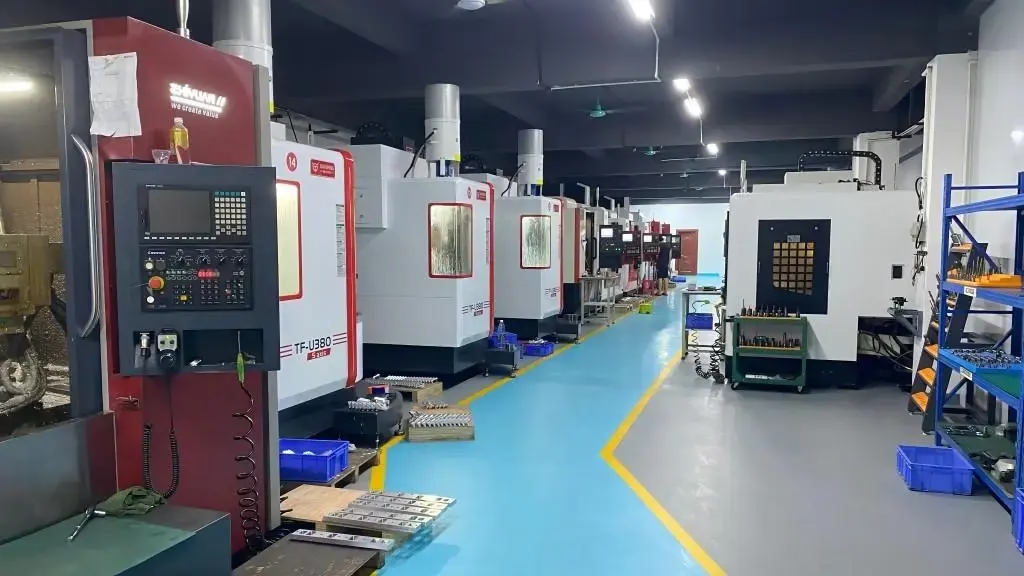
At GreatLight we run 127 high-precision CNC machines across three plants, including 16 simultaneous 5-axis machining centers and 27 three-axis machines. The mix matters: fast vertical work goes on the machines built for it, and heavy cutting goes where the rigidity is.
Which Parts Belong on This Machine Class
Small aluminum housings with many pockets and holes are the classic fit. The toolpaths are short, the tool changes are frequent, and the material cuts fast. A high-speed spindle turns that into a short cycle, and the APC keeps the spindle busy when the run is thousands of parts.
Thin-wall parts also benefit. Low radial engagement and high spindle speed reduce cutting force, so a 1.5 mm wall stays straight. On a heavy-cut machine the same wall deflects under a conventional roughing pass.
Parts that do not fit: large weldments, deep cavities with a length-to-diameter ratio above 5, and hardened tool steel above 45 HRC. Those need stiffness and torque, not rpm. Sending them to a high-speed machine usually shows up as chatter, tool breakage, or a finish that needs hand work.
Volume is the other filter. One prototype does not need an APC. A 10,000-part run does. GreatLight runs from a single prototype to 10,000+ part runs with no minimum order quantity, so the machine choice follows the part and the volume, not a fixed line.
High-Speed Vertical Machining Center vs Heavy-Cut Vertical Mill
Use this to pick the machine class before you quote the part.
| Criterion | High-speed VMC | Heavy-cut VMC |
|---|---|---|
| Spindle speed | 15,000 rpm and above | 6,000–10,000 rpm |
| Rapid feed | 40–60 m/min | 20–30 m/min |
| Best material | Aluminum, brass, plastics | Steel, cast iron, titanium |
| Part envelope | Small to medium, 600 × 400 mm class | Medium to large, up to 4,000 mm |
| Cut depth | Light, 0.3–3 mm radial | Heavy, 5–10 mm radial |
| Setup change | APC, seconds | Manual, minutes |
| Finish capability | Ra 0.2–0.8 μm on aluminum | Ra 0.8–1.6 μm typical |
| Tolerance | ±0.005 mm | ±0.005 mm to ±0.01 mm |
The Verdict
If your part is small, aluminum or brass, and runs in volume, a high-speed vertical machining center with an APC will beat a heavy-cut mill on cycle time. If the part is large, deep, or hard, choose rigidity over rpm and put it on a machine built for that cut.
Frequently Asked Questions
Do I need 15,000 rpm for aluminum?
Not always. With a 10 mm carbide cutter in 6061, 8,000–10,000 rpm already reaches the recommended surface speed. The higher spindle speed pays off when you use small cutters, 3–6 mm, where the same surface speed requires more rpm.
If your part has many small features, higher rpm shortens the cycle. If it is a few large pockets, a 10,000 rpm spindle with more torque may finish faster.
How does thermal growth affect tolerance?
The spindle cartridge grows as it warms, pushing the tool tip down in Z. On a ±0.005 mm part this shows up as a slow drift over the first hour of a run.
A cooled spindle housing or control-based thermal compensation removes most of it. Warm up the spindle before the first inspection cut and check the first-off part after 30 minutes of running.
Is an APC worth it for a 500-part order?
Usually yes if the cycle is under 5 minutes. The operator loads while the machine cuts, so the spindle stops only for the swap. On a 3-minute cycle, that can be most of a shift of recovered cutting time.
For a 30-minute cycle with a single setup, the gain is small. Spend the effort on fixturing instead.
What tolerance can GreatLight hold on these machines?
±0.005 mm (±0.0002 in) for critical features, with 100% inspection before shipment. Finishes run from Ra 0.2–0.8 μm on fine work to Ra 1.6–3.2 μm as-machined.
Raw material check, in-process monitoring, and final inspection are standard. Inspection reports are available on request.
Which materials cut well on a high-speed VMC?
Aluminum grades 6061, 7075, 2024, and ADC12; brass C36000 and C27400; plastics such as POM, PEEK, and ABS. Magnesium AZ31B and AZ91D also machine well at high speed with proper chip handling.
Stainless 303 and 17-4PH can be finished on these machines with light passes. Heavy roughing in 316L or Inconel belongs on a more rigid machine.
Do you sign an NDA for production parts?
Yes. Uploads are secure and confidential, and an NDA is available on request before you send drawings. Quotation and free DFM analysis come back within 12 hours, and production can start within 24 hours of approval.
Send the Drawing, Get a Cycle-Time Answer
Tell us the material, the tolerance, and the annual volume. We will match the part to the right machine class and quote it within 12 hours.
12-hour quoteNo minimum order quantity100% inspection
More Machining Notes
We publish setup notes, tooling trials and inspection data from the factory floor.











