
Fast 3 Axis CNC Machining: How to Pick a 24/7 Supplier That Holds the Schedule
This guide is for engineers and buyers sourcing fast 3 axis cnc machining on a 24/7 schedule for prototypes, bridge parts and small production runs. It covers the checks that separate a shop that genuinely runs around the clock from one that only advertises it: quoting speed, tolerance control, material stock, finishing, and what a usable quote should contain.
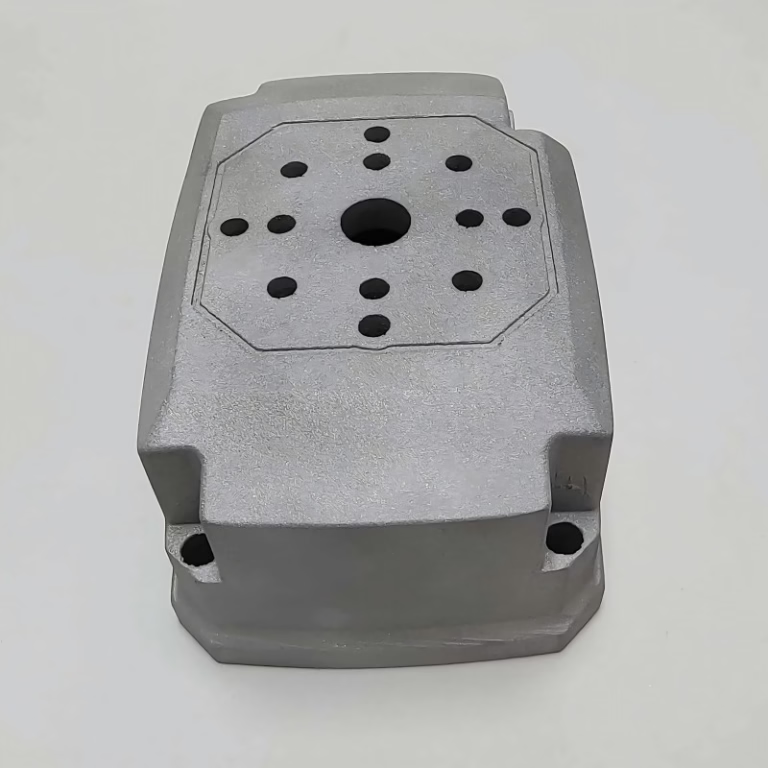
In this article
- 1
- 2
- 3
- 4
- 5
- 6
- 7
Key takeaways
What to check before you send the RFQ
Match the part to the process before you compare prices.
| Check | Good sign | Warning sign |
|---|---|---|
| Quote turnaround | Free DFM feedback within 12 hours | Three days to answer a 2D PDF |
| Stated tolerance | ±0.005 mm with datum callouts | "Standard tolerance" with no number |
| Material stock | 6061, 304, 7075, POM on the shelf | Every grade ordered per job |
| MOQ | No minimum, 1 to 10,000+ parts | 500-piece minimum on a prototype |
| Certifications | ISO 9001, IATF 16949, ISO 13485 | "We follow ISO standards" |
| Finishing | Anodizing and plating in parallel | Parts wait a week after machining |
| Inspection | 100% before shipment, reports on request | Sample check only, no report |
The verdict
Pick the supplier whose quote states tolerance, setup count and finishing schedule in writing. Fast 3 axis cnc machining is easy to promise and hard to hold, and the paperwork is where you find out which one you bought.
Where fast 3 axis cnc machining fits and where it does not
Fast 3 axis cnc machining cuts along X, Y and Z with the workpiece held in one orientation, or flipped once onto a second face. That single setup constraint is the whole story. If your part has pockets, slots, holes, profiles and a flat back, 3-axis work is usually the quickest and cheapest route to metal in your hand.
The limit is reach. Undercuts, holes that cross at compound angles, and features on five faces all need the part repositioned, which adds setups and fixturing time. A shop that tells you this up front is more useful than one that quietly quotes it as 3-axis work and then misses the date.
For a 24/7 schedule, the practical split is simple. Keep the first article on 3 axes if you can, get the geometry validated, then move to 4- or 5-axis only where the design demands it. Mixing the two in one order is normal and does not slow the simple parts down.
- 1Good fitPlates, housings, brackets, manifolds with features on one or two faces
- 2Good fitPrototypes and bridge parts needed in days, not weeks
- 3Poor fitImpeller blades, complex undercuts, compound-angle ports
- 4Poor fitParts needing five-face access in a single setup
Tolerance and finish: what a 24/7 shop can actually hold
A 3-axis machine can hold ±0.005 mm on a well-fixtured part, and ±0.0002 in in imperial terms. That number depends on the setup as much as the machine. Thin walls, long tool overhangs and unsupported sections will move no matter how good the spindle is.
Surface finish follows the same logic. As-machined aluminum sits around Ra 1.6–3.2 μm. A finishing pass with a smaller stepover gets you to Ra 0.8–1.6 μm, and a fine finishing strategy reaches Ra 0.2–0.8 μm on faces the tool can reach cleanly. Deep pockets and sharp internal corners will not hit the fine end.
When you write the RFQ, give one tolerance block per feature group rather than a single global callout. Datums matter too. If the drawing has no datum scheme, the inspector has to guess which face is the reference, and two good shops can produce two different measurements.
- 1State the datumOne primary datum face, then secondary and tertiary in order
- 2Separate critical featuresCall out the three or four dimensions that carry function
- 3Name the finishRa value per face, not "smooth" or "fine"
How to read a quote from a 24/7 machine shop
A quote you can act on has five parts: material grade and stock form, machining time, setup count, finishing operations, and inspection. If any of those is missing, the price is not comparable to the next one you receive.
Watch the material line. A shop that quotes 6061-T6 but stocks only 6061 will either delay the job or substitute without telling you. The same applies to 304 versus 316L, and to 7075 where the temper changes machinability.
Lead time should be broken out, not summarized. A 3–5 day shipping window only holds if the finishing step runs in parallel with machining rather than after it. Ask directly how anodizing is scheduled, because that is where most fast jobs lose their speed.
Volume pricing is worth requesting at the same time as the prototype quote. If a shop can move from one part to a 10,000+ part run without re-quoting the process, you avoid a second qualification cycle later.
Confidentiality, certification and the paperwork trail
Fast work often means early-stage designs, and early-stage designs are the ones you least want circulating. Confirm in writing that uploads are handled confidentially and that an NDA is available before you send STEP files.
Certifications are not decoration. ISO 9001:2015 covers the general quality system. IATF 16949:2016 matters if the part ends up in a vehicle program. ISO 13485:2016 applies to medical devices, and ISO 27001:2022 covers information security, which is the one that matters when your files are the asset.
Ask what the inspection record looks like. Raw material check, in-process monitoring and final inspection before shipment are the baseline. Reports on request are useful for your own incoming inspection, especially on a first article.
One more thing to settle early: who owns the fixture. On repeat orders, a shop that keeps and reuses your fixture will quote faster and hold tolerance better than one that rebuilds it every time.
Step by step: running a fast 3-axis job without losing the date
Each step names the parameter range and the mistake that costs you a day.
- 1Send a complete data packSTEP or IGES plus a 2D PDF with datums, tolerance block and finish callouts. Missing datums are the most common cause of a slow first quote.
- 2Ask for DFM feedback with the priceA useful shop returns manufacturability notes within 12 hours: wall thickness, tool reach, corner radii. Fix these before cutting, not after.
- 3Lock the material grade and temperName the alloy and condition, e.g. 6061-T6 or 316L. Substitutions change both the finish and the dimensional behavior after machining.
- 4Agree the setup countOne setup for single-face work, two for a front-and-back part. Each extra setup adds fixturing time and typically 0.01–0.02 mm of positional variation.
- 5Schedule finishing in parallelAnodizing, plating or powder coating should be booked when machining starts, not when it ends. Serial scheduling is where 24/7 promises break.
- 6Confirm the inspection scopeFirst article with a dimensional report, then 100% inspection before shipment. Ask for the report format you need for incoming inspection.
- 7Book the production slot earlyProduction can start within 24 hours of approval. Send the PO before the prototype is signed off if the volume run is already funded.
Questions buyers ask before the first order
What makes a shop genuinely 24/7 rather than just advertising it?
Three things show up in practice: machines running unattended or across shifts, material stock on the shelf instead of ordered per job, and finishing operations scheduled in parallel with machining.
Ask what happens when a job finishes at 2 a.m. If the answer involves a person driving in to unload it, the schedule is fragile.
Can fast 3 axis cnc machining hit ±0.005 mm on a first article?
Yes, on a rigid setup with a supported part and a stated datum scheme. The tolerance belongs to the process, not the machine alone.
Thin walls, deep pockets and long tool overhangs will push you past that. If your part has any of those, expect ±0.01 mm or plan a finishing operation.
Do I need 4- or 5-axis machining instead?
Only if the geometry needs it. Parts with features on three or more faces, compound-angle holes or undercuts cannot be done in a single 3-axis setup without custom fixturing.
For everything else, 3-axis work is faster to set up and easier to inspect. Keeping the simple parts on 3 axes keeps the whole order moving.
What order quantity makes sense for a fast-turn job?
There is no minimum order quantity, so a single prototype and a 10,000+ part run are both viable. The economics change, not the process.
If the design is still moving, order one or two parts first, then release the volume run once the geometry is frozen.
How should confidentiality be handled?
Uploads are handled as secure and confidential, and an NDA is available on request. Ask for it before the first file transfer, not after.
For regulated industries, ISO 27001:2022 covers the information security side, which is separate from the manufacturing quality certificates.
What finishing options can run alongside 3-axis machining?
Anodizing in clear, color, hardcoat and conductive types; electroless nickel, zinc, silver and gold plating; powder coating and black oxide; bead blasting, tumbling, brushing and polishing; laser marking with a minimum character height of 1.5 mm.
Specify the finish per face. Masking decisions affect both appearance and dimensional stack-up on tight-tolerance features.
Send the drawing, get a real answer
Upload your files and get a quotation with free DFM analysis within 12 hours, plus material and finishing notes you can act on.
12-hour quote100% inspectionNo minimum orderNDA on request
Follow GreatLight
We publish setup notes, tooling trials and inspection data from the factory floor.











