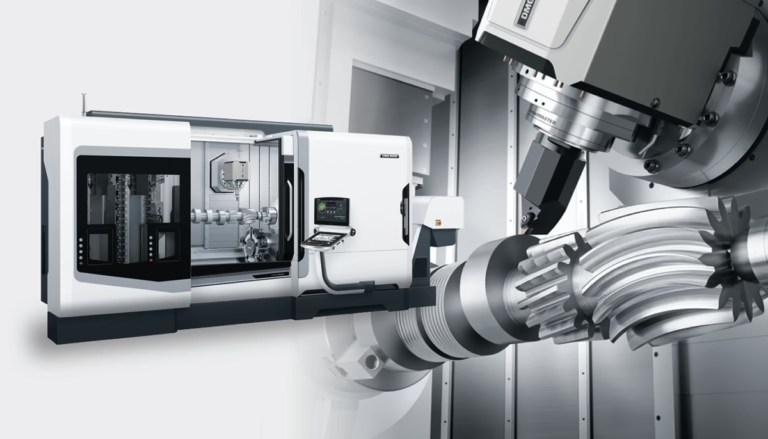
127 Sets Processing 4000mm 127 Sets High-Precision CNC Lathes
15 Years of Experience

Design Driven Bulk CNC Machining Services ODM

As the manufacturing landscape continues its shift toward hyper-specialization and shorter time-to-market cycles, the concept of Design Driven Bulk CNC Machining Services ODM has moved from a niche outsourcing option to a strategic imperative. Instead of simply handing off blueprints for production, companies now seek manufacturing partners who can interpret design intent, optimize for manufacturability […]

As the manufacturing landscape continues its shift toward hyper-specialization and shorter time-to-market cycles, the concept of Design Driven Bulk CNC Machining Services ODM has moved from a niche outsourcing option to a strategic imperative. Instead of simply handing off blueprints for production, companies now seek manufacturing partners who can interpret design intent, optimize for manufacturability under strict regulatory frameworks, and deliver consistent quality across tens of thousands of parts. This blend of engineering insight and scalable production is what truly defines a modern ODM (Original Design Manufacturer) relationship in precision CNC machining.

Decoding Design Driven Bulk CNC Machining Services ODM

At its core, Design Driven Bulk CNC Machining Services ODM is about merging upstream design collaboration with high-volume, high-precision manufacturing. It goes far beyond the traditional “you-design-we-machine” model. In this paradigm, the service provider assumes shared responsibility for the finished part’s functionality, cost-effectiveness, and compliance with relevant industry standards – often engaging with clients during the prototyping phase to refine geometries, select materials, and plan for efficient bulk runs. This article unpacks the regulatory, technical, and partnership dimensions of such a service, drawing on real-world practices from the precision engineering sector.

The ODM Model in Precision Machining: A Paradigm Shift

Conventional contract manufacturing often treats design as a static input. The client submits a 2D drawing or 3D CAD file, and the supplier’s job is to replicate it within stated tolerances – end of story. A design-driven ODM, conversely, acts as an extension of the client’s engineering team. It brings to the table a deep understanding of how design choices cascade into manufacturing complexity, tooling costs, surface finish options, and, critically, regulatory conformity.

In bulk scenarios (think 5,000 to 500,000 annual units), even microscopic inefficiencies in a part’s geometry can lead to massive cost overruns, elevated rejection rates, or latent safety risks. An ODM partner examines the design through multiple lenses simultaneously:

Manufacturability: Can the feature be machined reliably in a 5-axis setup without excessive tool changes or special fixtures?
Regulatory compliance: Does the material specification, traceability, and post-processing meet the QMS requirements of ISO 13485 for medical devices or IATF 16949 for automotive components?
Cost optimization: Could a slight modification to a fillet radius or a change in thread type halve the cycle time while preserving function?

Thus, “design driven” doesn’t mean the ODM replaces the customer’s designers; it means the manufacturing intelligence is infused into the design loop early enough to avoid downstream disaster.

Regulatory Frameworks Shaping Bulk ODM Manufacturing

One of the most overlooked but decisive aspects of bulk CNC machining ODM is the regulatory environment in which the final product will operate. In aerospace, medical technology, automotive, and even premium consumer electronics, machining processes are no longer just judged by dimensional accuracy – they are audited for process control, material pedigree, data security, and traceability. Understanding these frameworks is essential for any engineer or procurement professional evaluating an ODM partner.

ISO 9001: The Baseline of Quality Management

ISO 9001:2015 is the universal language of quality. Any credible precision machining factory will hold this certification, as it confirms that the organization follows a process-based approach to consistently deliver products that meet customer and statutory requirements. At a minimum, this means documented work instructions, calibrated inspection equipment, continuous improvement loops, and robust non-conformance handling.

However, when we speak of design-driven ODM for regulated industries, ISO 9001 is only a starting point. A factory that stops there may be perfectly adequate for commodity parts, but it won’t satisfy the more stringent demands of a medical device manufacturer or an automotive Tier‑1 supplier.

图片

ISO 13485: The Medical Device Blueprint

For bulk CNC machining of medical components – surgical instruments, orthopedic implants, diagnostic device housings – ISO 13485 is non-negotiable. This standard layers additional requirements on top of ISO 9001: risk management throughout the product realization cycle, validation of processes for sterile or clean-room production, and stringent traceability from raw material to finished good. In an ODM context, the service provider must demonstrate that its design-for-manufacturability reviews incorporate these extra controls. For example, a seemingly simple design change from a polished to a passivated surface finish on a surgical tool might trigger a complete re-validation of the cleaning and packaging protocols. A design-driven partner anticipates this before it becomes a regulatory finding.

IATF 16949: Automotive Rigor

IATF 16949 is often described as one of the toughest quality management certifications in manufacturing. It’s built upon ISO 9001 but injects automotive-specific requirements: error-proofing, statistical process control (SPC), production part approval process (PPAP), and zero-defect mindset. For bulk CNC machining, IATF 16949 means that every aspect of the ODM’s operation – from tool life monitoring to line-side gaging – is geared towards preventing defects in high-volume runs. A design-driven ODM with IATF 16949 will scrutinize a part print for potential failure modes (think stress concentrations, chip trap areas, or difficult-to-inspect dimensions) long before the first chip is cut.

ISO 27001 and Data Security for IP-Sensitive Designs

In a design-driven relationship, the ODM often receives native CAD data, material specifications, and sometimes proprietary assembly information. This makes data security paramount. ISO 27001 certification assures that the manufacturing partner has robust information security management systems in place. For companies developing next-generation medical devices or confidential automotive hardware, this certification is as critical as any machining certificate.

The Cumulative Trust of Certifications

A facility that holds multiple accreditations – say, ISO 9001, ISO 13485, IATF 16949, and ISO 27001 – signals a culture where quality and compliance are embedded, not bolted on. This is precisely the environment where design‑driven bulk ODM flourishes, because the partner already operates with the discipline required for high-stakes volumes.

Key Certifications and Their Impact on Bulk Machining Quality

To make this tangible, let’s map typical certifications to how they directly influence the ODM engineering process and final part quality.

CertificationCore FocusRelevance to Design-Driven Bulk ODM
ISO 9001:2015Overall quality managementFoundation for repeatable processes; ensures CNC programs, inspection plans, and handling procedures are documented and auditable.
ISO 13485Medical devices (special emphasis on risk management & traceability)Drives material lot control, validation of cleaning/passivation, and biocompatibility documentation; design review must account for sterilization & packaging.
IATF 16949Automotive production (defect prevention, PPAP)Requires process capability studies (Cpk), full PPAP submissions, and error‑proof tooling; design adjustments may be needed to achieve capable Cpk values in bulk.
ISO 27001Information security managementProtects sensitive CAD files, ensures access control; vital when the ODM holds the client’s proprietary design.
ISO 13485 + IATF (combined)Cross‑industry high reliabilityIndicates ability to serve multiple regulated verticals with a single quality framework, minimizing compliance risk for the customer.

A factory equipped with precision 5‑axis CNC machining centers, Swiss‑ type lathes, and wire EDM can handle complex geometries, but without the corresponding management systems, the risk of a silent drift in a critical dimension over a 20,000‑piece lot remains high. That’s why the combination of hardware capability with deep certification knowledge is the hallmark of a true design‑driven ODM.

For projects requiring the utmost in geometric complexity, a partner offering precision 5-axis CNC machining services{target=”_blank”} with full PPAP documentation and automated in‑ process measurement can compress development timelines while locking in part conformity.

Design Considerations for Regulatory Compliance in Bulk

When a client enters an ODM relationship, the collaborative design review often uncovers opportunities to “design out” compliance risks. Some of the most common points examined include:

Material selection and certification
In medical or aerospace applications, the material must come with mill test reports and, depending on the part, be validated for biocompatibility or fire‑resistance. The ODM’s engineering team advises on material alternatives that are readily available in certified forms and can still meet strength, corrosion, and weight requirements.

Geometric Dimensioning and Tolerancing (GD&T)
Over‑tolerancing is a frequent pain point. A design with unnecessary tight tolerances on non‑functional surfaces drives up cost and requires more frequent measurement, which can itself introduce inspector variability. An experienced ODM suggests selective loosening of non‑critical tolerances while reinforcing critical‑to‑function dimensions with Cpk‑capable process controls.

Traceability features
For bulk parts that must be traceable to the heat lot, the ODM may recommend incorporating laser‑marking pockets or specifying unique identifiers directly into the CNC program. This is especially relevant under ISO 13485 and IATF 16949, where full genealogy tracking is expected.

Surface finish and post‑processing
Anodizing, passivation, powder coating, or electroplating introduce their own regulatory layers (e.g., RoHS, REACH). The design‑driven ODM reviews the entire finishing chain to ensure no non‑compliant substances are introduced and that finish thickness tolerances don’t compromise press‑fit or assembly relations.

Assembly and testing friendliness
In many ODM engagements, the machined component is part of a larger subsystem. Small design tweaks — a slight counterbore, a relief groove, a built‑in alignment feature — can dramatically simplify downstream assembly and in‑line testing, reducing overall cost of quality.

GreatLight’s Approach to Design‑Driven ODM

At GreatLight CNC Machining (Great Light Metal Tech Co., LTD.), we’ve built our ODM capability around the principle that production excellence begins at the design phase — and that regulatory readiness is never an afterthought. Founded in 2011 in Chang’an Town, Dongguan — China’s epicenter of precision manufacturing — our 7,600 m² facility houses over 127 units of advanced equipment, including large‑format 5‑axis, 4‑axis, and 3‑axis machining centers, mill‑turn stations, wire EDM, and an in‑house metrology lab equipped with CMMs and laser scanners. This technology cluster allows us to process components up to 4,000 mm while holding tolerances as tight as ±0.001 mm when the design demands it.

But what truly separates a design‑driven ODM from a job shop is the engineering culture that surrounds the machinery. Our engineering team routinely conducts manufacturability reviews using Moldflow, stress simulation, and toolpath optimization software before a single piece of metal is cut. When a client brings us a complex aluminum housing for a humanoid robot joint, we don’t merely quote; we propose modifications that reduce the number of setups from six to three, suggest alternate thread forms that eliminate secondary tapping, and verify that the resulting surface finishes will pass IP67 leak tests – all while ensuring the part remains inside the client’s functional envelope.

Our certification portfolio directly supports this approach:

ISO 9001:2015 forms the backbone of our documented processes.
ISO 13485 demonstrates our competence in medical device manufacturing — we can manage the validation, traceability, and clean‑ready finishing steps required for surgical tools and diagnostic components.
IATF 16949 aligns us with the automotive industry’s zero‑defect goal; we deliver full PPAP documentation, maintain process capability indices, and implement mistake‑proofing poka‑yoke fixtures.
ISO 27001 safeguards the sensitive CAD data and technical specifications that form the core of an ODM relationship, giving clients confidence that their intellectual property is secure.

Moreover, our integrated one‑stop service model — from CNC machining and die casting to sheet metal fabrication, 3D printing (SLM/SLA/SLS), and full‑spectrum surface finishing — means that design decisions made early in the CNC phase can be seamlessly carried through to all subsequent processes. This prevents the all‑too‑common scenario where a beautifully machined part fails because the anodizing thickness wasn’t accounted for in the machined dimensions.

We have also observed that clients coming from a pure prototyping background often underestimate the impact of scaling. A design that machines perfectly in a one‑off 5‑axis run may exhibit unacceptable tool chatter or thermal distortion when produced at 1,000 pieces per day. Our engineers proactively dial in feed rates, tool paths, and clamping strategies that are suited for sustained bulk production, not just a single bench‑top demonstration. This ability to bridge prototype and scaled manufacturing is the essence of ODM.

Comparing ODM Capabilities Across the Industry

For engineers evaluating ODM partners, it’s useful to understand how different providers position themselves. While many advertise “precision” and “fast turnaround,” the depth of regulatory qualification, material range, and true design‑engineering support varies significantly. Below is a high‑level comparison of select established players, focusing on facets relevant to design‑driven bulk machining.

CompanyDesign CollaborationRelevant CertificationsTypical Sweet Spot
GreatLight Metal (GreatLight CNC Machining)Deep DFx support, in‑house tooling design, FAI/PPAP documentationISO 9001, ISO 13485, IATF 16949, ISO 27001Medium‑ to high‑volume precision parts for medical, automotive, robotics; integrated finishing and assembly
ProtocaseDesign feedback focused on sheet metal enclosuresISO 9001:2015Custom electronics enclosures, quick‑turn prototypes, short runs
XometryAutomated DFM feedback via instant quoting platformISO 9001, AS9100 (via partner network)Distributed manufacturing marketplace; broad material and process selection
RapidDirectOnline manufacturing platform with engineering reviewISO 9001:2015Prototypes and low‑volume production, with integrated CNC, injection molding, and sheet metal
FictivDesign‑for‑manufacturability algorithms plus engineering supportISO 9001, ISO 13485 (via partner network)Prototyping and on‑demand production with a digital supply chain
Owens IndustriesSpecialized in ultra‑precision 5‑axis machining for demanding industriesISO 9001, AS9100, ITAR registeredAerospace, defense, medical; single‑source complex parts

While the list highlights that many players offer competent machining, a clear differentiator for complex bulk ODM is the simultaneous possession of IATF 16949 and ISO 13485 under one roof. This signals that the provider understands both the automotive sector’s statistical rigor and the medical industry’s risk‑management framework – knowledge that directly feeds back into the design review cycle. Additionally, an in‑house, owned factory (as opposed to a broker model) offers tighter control over process changes and faster reaction when design iterations are needed.

Tackling the Top Pain Points in ODM Sourcing

In over a decade of collaborating with hardware innovators, we’ve catalogued the pain points that repeatedly erode project timelines and budgets:

Precision black hole: A supplier quotes ±0.005 mm but delivers parts that drift after a few hundred cycles due to thermal expansion or worn tooling. A design‑driven ODM addresses this proactively by analyzing thermal compensation strategies and selecting tooling geometries that maintain edge life.
Certification theatre: Some suppliers claim a certification but only apply it to a limited production line or a parent company, not the actual shop floor producing your parts. A trustworthy ODM is transparent about the scope of its certifications and welcomes on‑site audits.
Design‑to‑manufacturing gap: The “it works in CAD” syndrome leads to impossible undercuts, impractical wall thicknesses, or un‑anodizable thread pockets. Early DFM engagement with the ODM closes this gap.
Post‑processing disconnect: A beautifully machined part is ruined by an outsourced anodizer who doesn’t know the masking requirements. An ODM with in‑house surface finishing removes this communication breakdown.

Design Driven Bulk CNC Machining Services ODM exists precisely to eliminate these friction points by ensuring that every step, from initial 3D model to final shipment, operates under a single quality management system and a unified engineering oversight.

The Road Ahead: Regulation, Innovation, and Intelligent Manufacturing

Looking forward, regulations will only become more stringent. The medical device industry is moving toward more comprehensive unique device identification (UDI) requirements; the automotive sector is pushing functional safety under ISO 26262, influencing how mechanical components are designed and verified; and data privacy laws like GDPR place additional demands on manufacturing data handling. ODM partners who have already internalized multiple ISO standards are best positioned to adapt.

Simultaneously, intelligent manufacturing — automated in‑line optical inspection, machine learning for tool wear prediction, and digital twin simulation — is becoming a practical tool, not just a buzzword. At GreatLight, we are actively integrating these technologies to shorten the feedback loop between a design decision and its manufacturing outcome. For instance, when we simulate a 5‑axis toolpath in a digital twin environment, we can immediately assess cycle time, collision risks, and even surface roughness, allowing us to fine‑tune the CNC program and, if necessary, propose a design tweak before any metal is cut. This closed‑loop model is the ultimate expression of design‑driven ODM: data‑informed, certifiably compliant, and relentlessly optimized.

Conclusion

In a world where product lifecycles shrink and regulatory scrutiny intensifies, Design Driven Bulk CNC Machining Services ODM is not merely an option — it is becoming the expected level of partnership for hardware teams that value speed to market without sacrificing quality or compliance. It demands a manufacturing partner that possesses advanced multi‑axis machining assets, an in‑house team of process engineers, and — crucially — a suite of internationally recognized certifications that prove their quality system works under the most demanding conditions.

Selecting such a partner requires looking beyond glossy brochures and investigating the real‑world capability behind the claims. A facility like GreatLight CNC Machining demonstrates that when technical skill, design‑oriented engineering, and ISO/IATF maturity coalesce, the result is a reliable pipeline for transforming ambitious designs into flawless, production‑ready precision parts — batch after batch, year after year.

For companies about to embark on a critical hardware project, forging an early relationship with a fully certified, design‑driven ODM can be the single most effective insurance against the hidden costs of re‑work, recalls, and postponed launches. Explore the difference that true design‑driven manufacturing can make, and connect with GreatLight CNC Machining{target=”_blank”} to discover how its integrated capabilities can accelerate your next project from concept to scalable reality.

图片

CNC Experts

Picture of JinShui Chen

JinShui Chen

Rapid Prototyping & Rapid Manufacturing Expert

Specialize in CNC machining, 3D printing, urethane casting, rapid tooling, injection molding, metal casting, sheet metal and extrusion

CNC Recent Posts

CNC News

Welcome to GreatLight Metal,Maximum Processing Size 4,000 mm

Precision Machining CNC Quote Online

Loading file

Upload Click here to upload or drag and drop your model to the canvas.

The model is too large and has been resized to fit in the printer's build tray. [Hide]

The model is too large to fit in the printer's build tray. [Hide]

The model is too large, a fitting printer is selected. [Hide]

The model is too small and has been upscaled. [Hide]

Warning: The selected printer can not print in full color [Hide]

Warning: obj models with multiple meshes are not yet supported [Hide]

Warning: Unsupported DXF entity  [Hide]

Warning: could not arrange models [Hide]

[Hide]


File Unit:      
Scale:
%
L × W × H:
X: × Y: × Z:  cm 
Rotation:
X: ° Y: °  
⚡ Instant Quote for Precision Manufacturing

Submit your design files (STEP/IGES/DWG) and receive a competitive quote within 1 hour, backed by ISO 9001-certified quality assurance.

📋 How It Works

  1. Upload & SpecifyShare your 3D model and select materials (Aluminum/Stainless Steel/Titanium/PEEK), tolerances (±0.002mm), and surface treatments.

  2. AI-Powered AnalysisOur system calculates optimal machining strategy and cost based on 10+ years of automotive/aerospace data.

  3. Review & ConfirmGet a detailed breakdown including:
    - Volume pricing tiers (1-10,000+ units)
    - Lead time (3-7 days standard)
    - DFM feedback for cost optimization

Unit Price: 

Loading price
5 Axis CNC Machining Equipment
4 Axis CNC Machining Equipment
3 Axis CNC Machining Equipment
CNC Milling & Turning Equipment
Prototype and Short-Run Injection Moldings Exact plastic material as final design
Volume Metal Die Casting Services - Precision Cast Parts
Bridge the Gap From Prototype to Production – Global delivery in 10 days or less
Custom high-precision sheet metal prototypes and parts, as fast as 5 days.
Custom Online 3D Printing Services
Design Best Processing Method According To 3D Drawings
Alloys Aluminum 6061, 6061-T6 Aluminum 2024 Aluminum 5052 Aluminum 5083 Aluminum 6063 Aluminum 6082 Aluminum 7075, 7075-T6 Aluminum ADC12 (A380)
Alloys Brass C27400 Brass C28000 Brass C36000
Alloys Stainless Steel SUS201 Stainless Steel SUS303 Stainless Steel SUS 304 Stainless Steel SUS316 Stainless Steel SUS316L Stainless Steel SUS420 Stainless Steel SUS430 Stainless Steel SUS431 Stainless Steel SUS440C Stainless Steel SUS630/17-4PH Stainless Steel AISI 304
Inconel718
Carbon Fiber
Tool Steel
Mold Steel
Alloys Titanium Alloy TA1 Titanium Alloy TA2 Titanium Alloy TC4/Ti-6Al 4V
Alloys Steel 1018, 1020, 1025, 1045, 1215, 4130, 4140, 4340, 5140, A36 Die steel Alloy steel Chisel tool steel Spring steel High speed steel Cold rolled steel Bearing steel SPCC
Alloys Copper C101(T2) Copper C103(T1) Copper C103(TU2) Copper C110(TU0) Beryllium Copper
Alloys Magnesium Alloy AZ31B Magnesium Alloy AZ91D
Low Carbon Steel
Alloys Magnesium Alloy AZ31B Magnesium Alloy AZ91D
ABS Beige(Natural) ABS Black ABS Black Antistatic ABS Milky White ABS+PC Black ABS+PC White
PC Black PC Transparent PC White PC Yellowish White PC+GF30 Black
PMMA Black PMMA Transparent PMMA White
PA(Nylon) Blue PA6 (Nylon)+GF15 Black PA6 (Nylon)+GF30 Black PA66 (Nylon) Beige(Natural) PA66 (Nylon) Black
PE Black PE White
PEEK Beige(Natural) PEEK Black
PP Black PP White PP+GF30 Black
HDPE Black HDPE White
HIPS Board White
LDPE White
This is a finish of applying powdered paint to the components and then baking it in an oven, which results in a stronger, more wear- and corrosion-resistant layer that is more durable than traditional painting methods.
No coating required, product’s natural color!
This is a finish of applying powdered paint to the components and then baking it in an oven, which results in a stronger, more wear- and corrosion-resistant layer that is more durable than traditional painting methods.
This finishing option with the shortest turnaround time. Parts have visible tool marks and potentially sharp edges and burrs, which can be removed upon request.
Sand blasting uses pressurized sand or other media to clean and texture the surface, creating a uniform, matte finish.
Polishing is the process of creating a smooth and shiny surface by rubbing it or by applying a chemical treatmen
A brushed finish creates a unidirectional satin texture, reducing the visibility of marks and scratches on the surface.
Anodizing increases corrosion resistance and wear properties, while allowing for color dyeing, ideal for aluminum parts.
Black oxide is a conversion coating that is used on steels to improve corrosion resistance and minimize light reflection.
Electroplating bonds a thin metal layer onto parts, improving wear resistance, corrosion resistance, and surface conductivity.
This is a finish of applying powdered paint to the components and then baking it in an oven, which results in a stronger, more wear- and corrosion-resistant layer that is more durable than traditional painting methods.
Please provide additional text description for other surface treatment requirements!
Material
Material
  • CNC Metals
    • Aluminum
    • Brass
    • Stainless steel
    • Inconel718
    • Carbon Fiber
    • Tool Steel
    • Mold Steel
    • Titanium
    • Alloy Steel
    • Copper
    • Bronze
    • Low Carbon Steel
    • Magnesium
  • CNC Plastics
    • ABS
    • PC
    • PMMA (Acrylic)
    • PA (Nylon)
    • PE
    • PEEK
    • PP
    • HDPE
    • HIPS
    • LDPE
Printer
Printer
  • CNC Metals
    • 5 Axis CNC Machining
    • 4 Axis CNC Machining
    • 3 Axis CNC Machining
    • CNC Milling & Turning
    • Rapid Tooling
    • Metal Die Casting
    • Vacuum Casting
    • Sheet Metal Fabrication
    • SLA 3D Printing
    • SLS 3D Printing
    • SLM 3D Printing
  • Rapid Prototyping
    • Design Best Processing Method According To 3D Drawings
Post-processing
Post-processing
  • As Machined(Product’s natural color)
  • Sand Blasting
  • Polishing
  • Brushed Finish
  • Anodizing
  • Black Oxide
  • Electroplating
  • Paint Coating
  • Powder Coating
  • Other surface treatment requirements
Finalize
The world's first CNC machining center that dares to provide free samples!

Free for first product valued at less than $200. (Background check required)

precision machining cnc quote online

15 Years CNC Machining Services

When you’re ready to start your next project, simply upload your 3D CAD design files, and our engineers will get back to you with a quote as soon as possible.
Scroll to Top

ISO 9001 Certificate

ISO 9001 is defined as the internationally recognized standard for Quality Management Systems (QMS). It is by far the most mature quality framework in the world. More than 1 million certificates were issued to organizations in 178 countries. ISO 9001 sets standards not only for the quality management system, but also for the overall management system. It helps organizations achieve success by improving customer satisfaction, employee motivation, and continuous improvement. * The ISO certificate is issued in the name of FS.com LIMITED and applied to all the products sold on FS website.

greatlight metal iso 9001 certification successfully renewed
GB T 19001-2016 IS09001-2015
✅ iso 9001:2015
greatlight metal iso 9001 certification successfully renewed zh

IATF 16949 certificate

IATF 16949 is an internationally recognized Quality Management System (QMS) standard specifically for the automotive industry and engine hardware parts production quality management system certification. It is based on ISO 9001 and adds specific requirements related to the production and service of automotive and engine hardware parts. Its goal is to improve quality, streamline processes, and reduce variation and waste in the automotive and engine hardware parts supply chain.

automotive industry quality management system certification 01
Certification of Production Quality Management System for Engine Hardware Parts Engine Hardware Associated Parts
automotive industry quality management system certification 00
发动机五金零配件的生产质量管理体系认证

ISO 27001 certificate

ISO/IEC 27001 is an international standard for managing and processing information security. This standard is jointly developed by the International Organization for Standardization (ISO) and the International Electrotechnical Commission (IEC). It sets out requirements for establishing, implementing, maintaining, and continually improving an information security management system (ISMS). Ensuring the confidentiality, integrity, and availability of organizational information assets, obtaining an ISO 27001 certificate means that the enterprise has passed the audit conducted by a certification body, proving that its information security management system has met the requirements of the international standard.

greatlight metal technology co., ltd has obtained multiple certifications (1)
greatlight metal technology co., ltd has obtained multiple certifications (2)

ISO 13485 certificate

ISO 13485 is an internationally recognized standard for Quality Management Systems (QMS) specifically tailored for the medical device industry. It outlines the requirements for organizations involved in the design, development, production, installation, and servicing of medical devices, ensuring they consistently meet regulatory requirements and customer needs. Essentially, it's a framework for medical device companies to build and maintain robust QMS processes, ultimately enhancing patient safety and device quality.

greatlight metal technology co., ltd has obtained multiple certifications (3)
greatlight metal technology co., ltd has obtained multiple certifications (4)

Get The Best Price

Send drawings and detailed requirements via Email:[email protected]
Or Fill Out The Contact Form Below:

All uploads are secure and confidential.